














 ASTER-0.26%
Market Analysis
ASTER-0.26%
Market Analysis
BlackRock Places $5Bn SpaceX IPO Order: What You Need to Know
BlackRock's $5B SpaceX IPO Order: What It Means for Retail


Editorial disclosureRead more
All reviews, research, news and assessments of any kind on The Tokenist are compiled using a strict editorial review process by our editorial team. Neither our writers nor our editors receive direct compensation of any kind to publish information on tokenist.com. Our company, Tokenist Media LLC, is community supported and may receive a small commission when you purchase products or services through links on our website. Click here for a full list of our partners and an in-depth explanation on how we get paid.
In SpaceX IPO news, BlackRock placed an order for at least $5Bn of SpaceX shares ahead of the company’s Nasdaq debut Friday, according to reporting by the Wall Street Journal, as total investor demand across the $75Bn offering reached approximately $250Bn, nearly 4x the available supply.
SpaceX priced 555,555,555 shares at $135 each on Thursday, locking in a valuation of approximately $1.77 trillion and claiming the title of the largest public offering in history.
To contextualize that single order: BlackRock’s $5Bn bid is nearly equivalent to the entire $5.55Bn raised by chip maker Cerebras Systems, which held the record for the largest U.S. IPO of 2026 before SpaceX eclipsed it.
The asset manager, which oversees roughly $536Bn in actively managed funds, was joined by sovereign wealth funds and a single family office investor whose order alone exceeded $1Bn.
BlackRock Involvement, Record Scale, Record Demand: The $250Bn Order Book That Dwarfs Every Prior IPO Benchmark
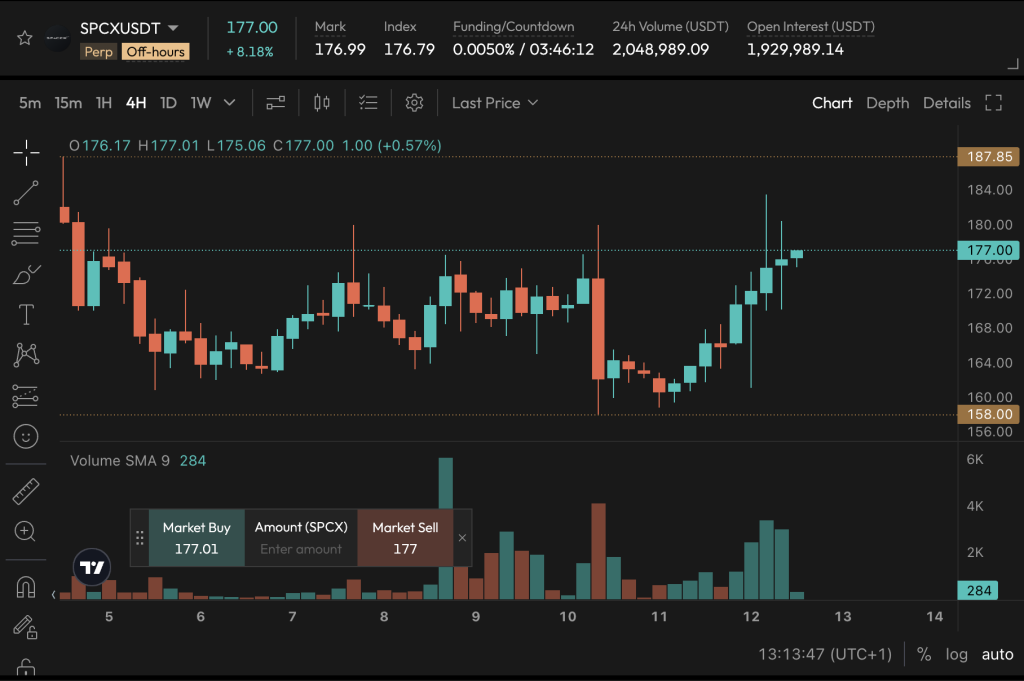
SpaceX’s confidential IPO filing earlier this year aimed for a valuation of $1.75 trillion, with the final share price confirming that target.
The order book closed with demand totaling about $250Bn, indicating investors requested more than three times the available shares before final allocations.
Individual investors alone submitted more than $70Bn, surpassing Saudi Aramco’s $29Bn debut in 2019, previously the largest IPO.
Goldman Sachs and Morgan Stanley are leading the underwriting syndicate, along with Bank of America and JPMorgan, with fees around 1.0%–1.25%, significantly lower than the typical 3%–7%.
This reflects SpaceX’s strong negotiating position. The dual role of Goldman Sachs as a lead underwriter raises potential conflicts of interest regarding any positive analyst commentary from the firms involved.
EXPLORE: Goldman Sachs Projects SpaceX AI Revenue Will Hit $322Bn by 2030
How IPO Allocation Works at This Scale: The Mechanics Behind a 4x Oversubscribed Book
In a standard IPO book-build, investors submit orders knowing they will receive only a fraction of the shares in oversubscribed deals.
Allocations are determined by underwriting banks based on order size, investor type, history, and issuer directives, with retail investors typically getting around 10%.
In contrast, SpaceX, under Elon Musk, aims for a retail allocation of about 30%, around $22.5Bn of the $75Bn offering, through firms like Charles Schwab and Fidelity.
This is 2–3 times higher than the Wall Street norm, signaling Musk’s intent to make the Starlink and SpaceX IPO accessible to smaller investors.
Additionally, underwriters hold a greenshoe option covering about 83.3 million shares, which could generate an additional $11.2Bn if exercised, potentially raising total capital to the mid-$80Bn range.
This option helps stabilize post-listing trading by allowing banks to cover short positions if the stock dips below the $135 IPO price in the first 30 days.
Retail Investors Face Low Fill Rates Despite the Largest Individual Allocation in U.S. IPO History
CNBC reported on June 11 that SpaceX reduced its retail tranche from ~30% to the low 20s due to surging institutional demand, driven in part by BlackRock’s $5Bn order.
Retail investors are competing for about $15–17Bn in shares, with $70–100Bn in orders, resulting in low fill rates. In a 15x oversubscription scenario, a $10,000 order results in about $667 of stock, translating to a 6.7% fill rate.
Broker minimums vary, with Fidelity lowering its to $2,000, while others like Robinhood have no stated floor. Retail investors may face a tough choice about whether to buy in the secondary market at nearly double Morningstar’s $63 fair value estimate.
The allocation cut is not unusual, but it highlights the gap between expectations and outcomes. SPCX will begin trading on Friday, and initial pricing will influence decisions for those with partial allocations.
EXPLORE: SpaceX IPO: China Lockout, Binance Futures, and Retail Access Alternatives
Disclaimer: The author does not hold or have a position in any securities discussed in the article. All stock prices were quoted at the time of writing.

Tim Baker
Tim Baker is a Senior Market Analyst at Tokenist with over a decade of experience educating readers about traditional finance, crypto and DeFi. A former equity researcher turned on-chain analyst, Tim specializes in regulatory framework shifts and institutional DeFi adoption. His work focuses on distilling complex liquidity cycles and the macro environment into actionable intelligence for the modern DIY investor.


