














Editorial disclosureRead more
All reviews, research, news and assessments of any kind on The Tokenist are compiled using a strict editorial review process by our editorial team. Neither our writers nor our editors receive direct compensation of any kind to publish information on tokenist.com. Our company, Tokenist Media LLC, is community supported and may receive a small commission when you purchase products or services through links on our website. Click here for a full list of our partners and an in-depth explanation on how we get paid.
 By Tim Fries
 Reviewed by Shane Neagle
Warren Buffet was famously quoted for saying, “I always knew I was going to be rich. I don’t think I ever doubted it for a minute.” This kind of confidence is necessary if you plan to trade the foreign exchange (forex) markets.
In forex, most traders focus on EUR/USD pairs. While Warren Buffett only gets involved in currency markets occasionally, he provides some insights via this interview on forex trading. In addition, it’s also about understanding clusters of good luck and bad luck.
But before you dive head-first into the wild world of fx trading, it’s important to ask yourself a few questions:
Do you want to bet on Euro and USD?
Do you want to look into other currencies?
The forex market offers a lot of benefits to traders who want a very liquid market. You can trade 24 hours a day from Monday to Friday. Are you ready and able to be switched on at all hours of the day?
In order to trade forex, you need an account with a brokerage that offers forex trading access. The best brokers for forex offer more benefits and trading tools specifically tailored to understand volatile currencies.
The best forex brokers have a customizable dashboard that lets you track each and every currency that matters to you. We’ve tested the top 46 forex broker platforms in the US and around the world, and put together this short list of our most-recommended brokers.
Based on low costs, trading tools, currency evaluation, and real-time data, we chose the following as the best forex trading platforms.
Top Forex Brokers and Trading Platforms
 Here’s our top pick of the best brokers and trading platforms based on fees, usability, tools, and market access:
 Here’s our top pick of the best brokers and trading platforms based on fees, usability, tools, and market access:
- eToro
- Best for Copy Trading
- Bitpanda
- Best for Simple Multi-Asset Investing
- Pepperstone
- Best for Tight Spreads
- Plus500
- Best Overall
- PrimeXBT
- Best Multi-Asset CFD Platform
- Binance
- Best for Crypto Market Depth
- Bybit
- Best for Active Crypto Traders
- BingX
- Best Social Trading Platform
- FP Markets
- Best for MetaTrader Users
The Best Forex Brokers and Trading Platforms – Our Reviews
Since the global foreign exchange market is the largest and most actively traded financial market in the world, there are several ways to compare each brokerage or trading platform.
One platform may be the best option for beginners, while another may suit advanced traders who need tighter spreads, more order types, or access to MetaTrader. The most important factors include fees, spreads, commissions, trading tools, platform software, charting, customer support, education, regulation, and reliability.
Some of the platforms below are traditional forex and CFD brokers, while others are crypto-first trading platforms that offer broader market access, copy trading, derivatives, or multi-asset tools. Availability varies by jurisdiction, so traders should always check whether a platform is available in their country before opening an account.
1. eToro: Best for Copy Trading

Whether you’re a complete beginner or an experienced trader, eToro has a simple platform and a social-trading model that makes it stand out from most traditional forex brokers.
eToro is best known for CopyTrader, which allows users to copy the trades of other registered users. Instead of building every strategy from scratch, users can review trader profiles, performance history, risk scores, and portfolio allocations before deciding whether to copy them.
Pros
- Excellent copy trading features
- User-friendly platform and mobile app
- Useful for beginners who want a simpler trading experience
- Offers access to several major asset classes depending on region
Cons
- Spreads may not be the lowest for high-volume forex traders
- Research tools are not as deep as some specialist brokers
- Product availability varies by country
eToro was founded in 2007 and has since become one of the most recognizable retail trading platforms in the world. Its main appeal is not that it gives advanced traders the deepest possible toolset, but that it makes trading easier to understand for users who want a cleaner interface.
The web platform and mobile app are both simple to navigate. Traders can follow markets, open positions, track watchlists, and use charting tools without feeling buried inside a professional terminal. This makes eToro especially appealing to newer users who want exposure to forex, stocks, ETFs, commodities, cryptoassets, and CFDs where available.
CopyTrader remains eToro’s standout feature. Users can review traders based on past performance, preferred markets, risk level, number of copiers, and other profile data. Once a trader is copied, the user’s account mirrors that trader’s activity proportionally.
That said, copy trading should not be mistaken for guaranteed performance. A trader who performed well in the past can still lose money in future market conditions. eToro is best approached as a platform with strong usability and social features, not as a shortcut around risk management.
The platform also offers a demo account, which allows prospective users to practice before committing real funds. This is particularly useful for traders who want to understand how copy trading works before risking their own capital.
eToro is not necessarily the cheapest option for advanced forex traders who mainly care about raw spreads. However, for users who value ease of use, social features, and a strong mobile experience, it remains one of the most approachable platforms in the market.
Risk Warning: Your capital is at risk. CFDs are complex instruments and come with a high risk of losing money rapidly due to leverage. Copy Trading does not amount to investment advice. Product availability and protections vary by jurisdiction.
2. Bitpanda: Best for Simple Multi-Asset Investing
Bitpanda is not a traditional forex broker in the same sense as Pepperstone or FP Markets. Instead, it is a European multi-asset platform that focuses on simple access to cryptoassets, stocks, ETFs, commodities, and selected leveraged products.
That makes Bitpanda a better fit for users who want a broad investing platform rather than a specialist forex terminal. Its main strength is accessibility. The platform is clean, beginner-friendly, and designed for users who want to manage several asset classes from one account.
Pros
- Simple and beginner-friendly platform
- Broad selection of cryptoassets and other investment products
- Strong fit for users who want a multi-asset account
- Useful recurring investment and portfolio tools
Cons
- Advanced charting and active-trader tools are limited compared with MetaTrader brokers
- Product availability varies by country
Bitpanda was founded in Austria and has become one of Europe’s better-known retail investment platforms. It is particularly popular with users who want a straightforward way to buy, sell, and manage digital assets alongside other investment products.
Where Bitpanda differs from traditional forex brokers is in its product focus. Rather than building its identity around MetaTrader, raw spreads, and professional execution tools, Bitpanda emphasizes simplicity, account usability, and multi-asset access.
The platform’s main advantage is that it lowers the barrier to entry. Users do not need to understand advanced terminal layouts to get started. The interface is clean, the order process is straightforward, and the mobile experience is designed for users who want quick portfolio access.
Bitpanda also offers leveraged products in some markets, but this is not the same as using a full-service forex broker with deep FX liquidity and professional-grade execution. Traders who want advanced forex charting, Expert Advisors, or raw spread pricing will likely be better served by a dedicated forex broker.
For investors who want a simpler platform to access several asset classes, Bitpanda is a strong choice. For pure forex trading, it is better viewed as a multi-asset alternative rather than a direct replacement for a broker such as Pepperstone or FP Markets.
Risk Warning: Investing and trading involve risk. Cryptoassets and leveraged products are volatile and may not be suitable for all users. Product availability varies by jurisdiction.
3. Pepperstone: Best for Tight Spreads
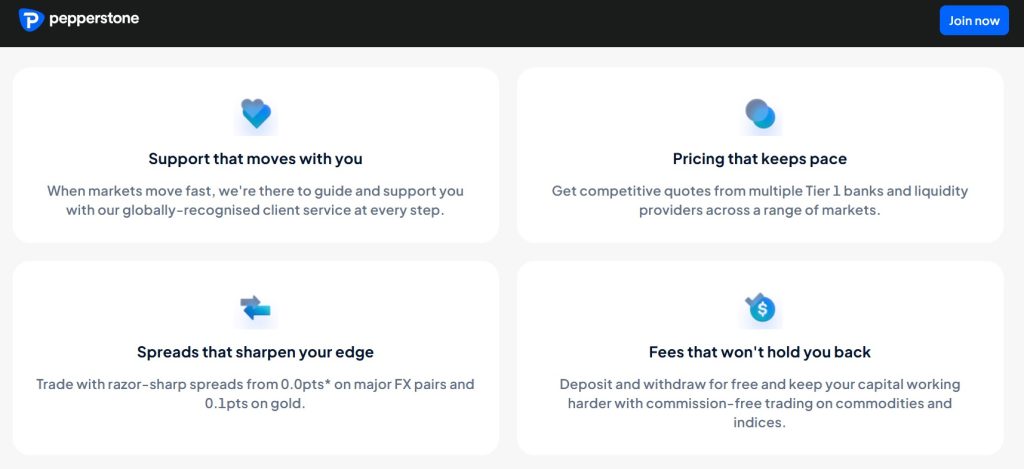
Pepperstone’s customizable platform selection and low-cost account structure make it an appealing choice for beginners and experienced forex traders alike.
The broker is particularly strong for users who want tight spreads, fast execution, and access to familiar trading platforms such as MetaTrader 4, MetaTrader 5, cTrader, and TradingView.
Pros
- Tight spreads and competitive pricing
- Supports MT4, MT5, cTrader, TradingView, and Pepperstone’s own platform
- Strong fit for forex and CFD traders
- Copy trading features available
- Well-regarded customer support and education
Cons
- Not available in every jurisdiction
- Some advanced tools may feel complex for beginners
- CFDs carry a high level of risk
Pepperstone was founded in Melbourne, Australia, in 2010 and has grown into one of the best-known forex and CFD brokers in the market. The company built its reputation around competitive pricing, fast execution, and support for several popular trading platforms.
The biggest attraction is choice. Traders can use MetaTrader 4, MetaTrader 5, cTrader, TradingView, or Pepperstone’s own platform. This flexibility makes Pepperstone useful for several different types of traders, from discretionary chart readers to users who want algorithmic or automated strategies.
Pepperstone offers two main account types: Standard and Razor. The Standard account is generally easier for beginners because trading costs are built into the spread. Razor accounts are more appealing to active traders because they offer raw spreads with a separate commission.
The broker also supports social and copy trading tools, which gives users more flexibility if they do not want to build every strategy manually. These features do not remove trading risk, but they can make Pepperstone more versatile than a bare-bones forex platform.
Education is another useful part of the Pepperstone experience. The broker provides platform tutorials, webinars, market analysis, and guides for both newer and advanced traders.
Overall, Pepperstone is strongest for users who want a serious forex and CFD broker without being forced into one trading platform. The combination of tight spreads, multiple platforms, and a strong reputation makes it one of the most balanced options on this list.
Risk warning: CFDs are complex instruments and come with a high risk of losing money rapidly due to leverage. You should consider whether you understand how CFDs work and whether you can afford to take the high risk of losing your money.
4. Plus500: Best Overall

Plus500 is recognized as a major global trading platform, offering a broad range of instruments, competitive pricing, and a user-friendly experience. The platform is particularly well suited to traders who want access to markets without a steep learning curve.
Established in 2008 and listed on the London Stock Exchange, Plus500 has grown into one of the more recognizable names in online trading. Its biggest strength is simplicity. The platform is easy to understand, even for users who are still learning how forex and CFD trading works.
Pros
- Intuitive and user-friendly platform
- Broad range of tradable instruments depending on jurisdiction
- Regulated in several major markets
- Useful risk management tools
Cons
- Lacks some advanced third-party platform integrations
- Not ideal for traders who want MetaTrader
- Product access varies by region
Plus500 places a strong focus on user experience. The platform is clean, direct, and built around a simple trading workflow. Traders can search markets, review charts, set order parameters, and monitor open positions without needing to download complicated third-party software.
The platform offers a web trading interface and mobile apps. Depending on the user’s country, available markets may include forex, commodities, shares, indices, ETFs, options, and futures-related products.
Plus500 also provides several risk management tools, including close-at-profit, close-at-loss, and stop-related order types. These features are useful because leveraged trading can move quickly, particularly when markets are volatile.
The platform is less attractive for traders who want to use MetaTrader, Expert Advisors, or highly customized technical indicators. Plus500 is better understood as a streamlined proprietary platform rather than a professional trading terminal.
For beginners and intermediate traders, that simplicity is part of the appeal. Plus500 gives users an easier route into trading without requiring them to build a complex desktop setup.
Overall, Plus500 offers a strong balance of brand recognition, ease of use, market access, and risk management tools. Traders who value a simple platform over advanced customization may find it one of the most practical options available.
Risk warning: Trading leveraged products involves risk and may not be suitable for all investors. You should consider whether you understand how these products work and whether you can afford to take the high risk of losing your money.
5. PrimeXBT: Best Multi-Asset CFD Platform
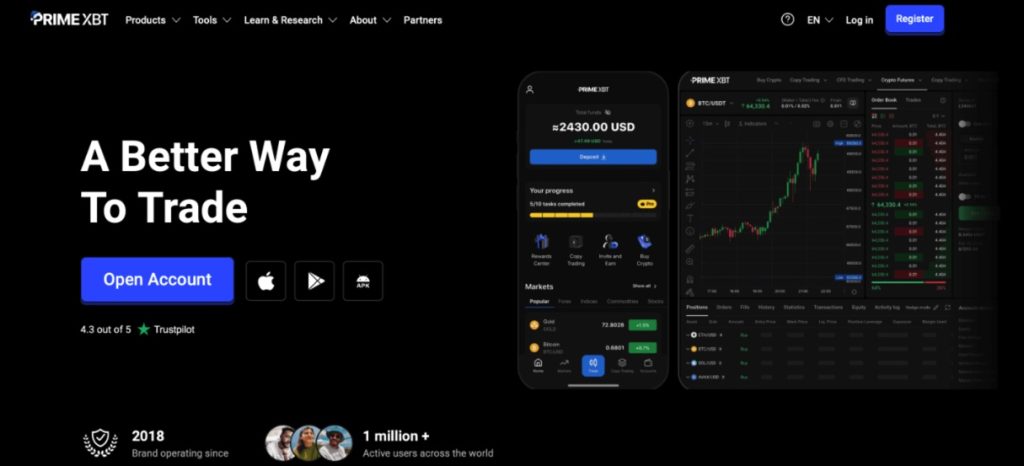
PrimeXBT is a multi-asset trading platform that combines access to crypto, forex, commodities, indices, shares, and CFDs from a single account. It is best suited to traders who want broad market exposure without moving between separate platforms.
Unlike some traditional forex brokers, PrimeXBT has a strong crypto-native identity. It appeals to users who want to trade digital assets alongside more traditional markets such as forex pairs, stock indices, and commodities.
Pros
- Access to forex, crypto, commodities, indices, shares, and CFDs
- Strong fit for traders who want one multi-market account
- Practice account available
- Crypto-focused trading ecosystem
Cons
- May not suit users who only want a regulated traditional forex broker
- High-risk products are available
- Availability varies by country
PrimeXBT is built for traders who want flexibility. The platform supports a wide range of markets, including major and minor forex pairs, crypto futures, commodities, stock indices, shares, and cryptocurrencies.
This makes PrimeXBT different from brokers that focus mainly on forex. Instead of asking users to choose between a crypto exchange and a CFD broker, PrimeXBT attempts to bring both worlds into one interface.
The platform’s forex offering includes access to major, minor, and exotic currency pairs. Traders can also use CFDs to speculate on other markets without owning the underlying asset. This structure can be convenient, but it also increases risk when leverage is involved.
PrimeXBT also provides a practice account, which is useful for users who want to test the platform before trading real funds. This is particularly important for traders who are new to CFDs or who are moving from spot crypto trading into leveraged markets.
The platform is strongest for users who actively trade across multiple markets. Traders who only want a classic forex broker with MetaTrader, local regulatory coverage, and narrow FX-only functionality may prefer a more traditional option.
Overall, PrimeXBT is a strong fit for traders who want broad market access, a crypto-friendly account structure, and the ability to move between forex, commodities, indices, and digital assets without changing platforms.
Risk warning: Trading CFDs, forex, crypto futures, and leveraged products involves significant risk. Losses can occur quickly, and these products may not be suitable for all traders.
6. Binance: Best for Crypto Market Depth
Binance is not a traditional forex broker. It is one of the world’s largest crypto exchanges and is best suited to users who want deep crypto liquidity, low trading fees, and a broad range of digital-asset products.
For forex-focused traders, Binance is more relevant as a crypto trading venue than as a classic FX broker. Its strength is market depth, product breadth, and access to spot and derivative crypto markets where available.
Pros
- Deep liquidity across major crypto markets
- Large number of supported cryptoassets
- Low trading fees compared with many platforms
- Advanced tools for active crypto traders
Cons
- Not a specialist forex broker
- Regulatory access varies significantly by country
- Derivatives are restricted in several major markets
Binance is included here because many modern traders move between forex, crypto, stablecoins, and digital-asset derivatives. While Binance does not replace a dedicated forex broker, it remains one of the most important platforms for crypto market access.
The exchange offers spot crypto trading, advanced order types, charting tools, earning products, and derivatives in jurisdictions where those products are available. This makes it a powerful platform for users who already understand crypto market structure.
Binance’s main advantage is liquidity. For heavily traded crypto pairs, the platform often provides tight markets and fast execution. This matters for active traders who need reliable fills and deep order books.
However, Binance is also more complex than a simple broker. Newer traders may find the number of products overwhelming, especially if they move beyond basic spot trading into margin or derivatives.
Regulation is another important consideration. Binance products and services vary widely by region. Some users may have access to the full global platform, while others may be limited to a local version or restricted from certain products entirely.
Overall, Binance is best suited to traders who want crypto depth rather than a classic forex trading experience. It should be considered a crypto-first platform with advanced tools, not a direct substitute for a regulated forex broker.
Risk warning: Cryptoassets are volatile and high risk. Derivatives and leveraged products may not be available in all jurisdictions and can lead to rapid losses.
7. Bybit: Best for Active Crypto Traders
Bybit is a crypto trading platform built for active users who want access to spot markets, derivatives, copy trading, and advanced trading tools. Like Binance, it is not a traditional forex broker, but it plays an important role for traders who operate across crypto and leveraged markets.
Bybit is particularly known for its derivatives interface and copy trading features. It is most suitable for experienced users who understand volatility, liquidation risk, and the mechanics of crypto futures.
Pros
- Strong platform for active crypto traders
- Copy trading tools available
- Good mobile and web trading experience
- Useful for traders who want spot and derivatives access in one place
Cons
- Not a dedicated forex broker
- Derivatives are high risk and restricted in some regions
- Can be too advanced for complete beginners
Bybit has built its reputation around speed, active trading tools, and a crypto-first product lineup. The platform offers spot trading and derivatives in eligible regions, alongside tools such as copy trading and trading bots.
Copy trading is one of Bybit’s more accessible features. Users can follow selected traders and automatically copy their trades based on allocation settings. This can be useful for beginners, but it still carries risk. A copied trader can lose money just as quickly as any other trader.
Bybit’s interface is generally strong for active users. The platform gives traders access to detailed charts, order books, position management tools, and mobile features that suit fast-moving crypto markets.
The main drawback is that Bybit is not designed primarily for forex. Users looking for regulated forex trading, direct MetaTrader access, and traditional FX account types will likely prefer Pepperstone or FP Markets.
Bybit is also subject to regional restrictions. Some products, especially derivatives, are unavailable in certain jurisdictions. Traders should verify local access before opening an account.
Overall, Bybit is a strong choice for active crypto traders who want more than basic spot trading. It is less suitable for users who only want a straightforward forex broker.
Risk warning: Digital asset trading and derivatives trading involve significant risk. Copy trading does not guarantee profits, and past performance is not a reliable indicator of future results.
8. BingX: Best Social Trading Platform
BingX is a crypto exchange and social trading platform that combines spot trading, futures, copy trading, and access to selected traditional-market products in some regions.
The platform is best suited to users who want a trading experience built around social features. Like Binance and Bybit, it is not a traditional forex broker, but it can appeal to traders who want crypto markets, copy trading, and broader trading tools in one place.
Pros
- Strong focus on copy and social trading
- Supports spot and futures crypto trading
- Broad cryptoasset selection
- Useful for users who want trader discovery features
Cons
- Not a specialist forex broker
- Copy trading can create a false sense of security
- Product availability depends on jurisdiction
BingX has grown around the idea of social trading. The platform gives users tools to follow, compare, and copy other traders. This makes it more approachable than some advanced exchanges, particularly for users who want guidance from visible trader profiles.
The exchange supports crypto spot trading and futures trading, with additional products depending on the user’s location. It also emphasizes copy trading as a core part of the platform rather than a small add-on feature.
For newer traders, this can be useful. Seeing how other traders operate may help users understand position sizing, timing, and market selection. However, copying another trader is not the same as having a risk-free strategy.
BingX is strongest for users who want crypto trading with social features. It is weaker for traders who want a traditional forex broker, deep regulatory coverage in major FX markets, or direct MetaTrader support.
The platform also carries the same general risks as other crypto exchanges. Digital assets can move sharply, futures can magnify losses, and trader performance rankings can change quickly.
Overall, BingX is best viewed as a social crypto trading platform with broader market ambitions. It can be useful for users who value copy trading, but it should not be mistaken for a low-risk route into trading.
Risk warning: Trading digital assets, futures, and copied strategies involves high risk. Past performance of a trader is not a reliable indicator of future results.
9. FP Markets: Best for MetaTrader Users
FP Markets is a global forex and CFD broker founded in Australia in 2005. It is best suited to traders who want competitive pricing, broad market access, and familiar platforms such as MetaTrader 4 and MetaTrader 5.
The broker offers access to thousands of instruments across several asset classes, making it a strong option for traders who want more than just major forex pairs.
Pros
- Strong support for MetaTrader users
- Competitive spreads on raw accounts
- Large range of tradable instruments
- Multi-regulated broker
- Good fit for active forex and CFD traders
Cons
- May feel less beginner-focused than simpler platforms
- Advanced platform choice can be confusing at first
- Product availability varies by region
FP Markets has been operating since 2005 and has built a reputation around forex, CFDs, competitive pricing, and platform choice. It is particularly relevant for traders who already know MetaTrader or want to use automated tools and custom indicators.
The broker offers MetaTrader 4, MetaTrader 5, and other platforms, depending on the jurisdiction. This makes FP Markets more flexible than brokers that only offer a proprietary trading platform.
FP Markets is also known for raw account pricing, where traders can access tighter spreads with a separate commission. This can be attractive to active traders who care about all-in trading costs.
The broker’s product range is broad. Depending on the entity and region, users may be able to trade forex, indices, commodities, shares, metals, and other CFDs. This gives active traders several markets to work with from one account.
The main drawback is that FP Markets may not feel as simple as eToro, Bitpanda, or Plus500. Its platform selection is powerful, but beginners may need time to understand the difference between account types, trading platforms, spreads, and commissions.
Overall, FP Markets is one of the stronger choices for traders who want a traditional forex and CFD broker with strong MetaTrader support, competitive pricing, and a wide range of markets.
Risk warning: Forex and CFDs are leveraged products and can result in losses that occur quickly. You should only trade if you understand the risks involved.
What to Look for in a Forex Broker 🔍
If you want to trade forex, you should first consider how much you plan to trade in terms of money and volume. The best forex brokers offer bigger discounts to active traders—especially those who participate in forex day trading—but you may also have to maintain a minimum balance.
Most of these conditions are clearly set when you sign up for an account, but other brokerages get tricky with their commission rates and fees.
Here is a look at what we use to decide if a forex brokerage is worth it or not.
Is a Forex Broker Trustworthy? 🧐
If you conduct a search for forex, you may see a lot of sponsored ads at the top for odd brokerages that don’t make it onto our top forex broker list. This is because they are probably scams and don’t have any tier level jurisdictions. It’s important that a forex trading platform be compliant and regulated so that you know it’s trustworthy.
Most forex brokers are publicly traded and have jurisdiction in the US, UK, Canada, Singapore, and Australia. These are the most reliable jurisdictions due to the regulation they enforce, to protect investors. In the United Kingdom, for example, forex trading is regulated by the Financial Conduct Authority.
In addition to governing bodies, there are also organizations. In the US, one of which is the National Futures Association (NFA), which is a registered futures association designated by the CFTC.
In the UK, there was the Financial Services Authority (FSA). The FSA regulated financial entities in the UK from 2001 – 2013. The UK restructured its financial regulation after the 2008 financial crisis, and the FSA morphed into the Financial Conduct Authority (FCA).
Due to the high risk involved in forex trading, you should keep an eye for any brokerage that looks too good to be true and isn’t based in one of these five countries.
Company Policies 📝
The best brokers post their account security measures, initial deposit requirements, account levels, and regulations on their websites, but you also want to verify the broker’s regulatory licenses. Also, what does it do to safeguard your money from scam artist forex traders?
Lastly but most importantly, where is the company located? If it’s not located within the United States, U.K., Australia, Canada, Cyprus (CySec), or Singapore, you run the risk of getting scammed like those who worked with these Chinese forex brokers.
How Many Assets Can You Trade 🤔
The best forex brokers should be open to all currency pairs and allow you to trade in cryptocurrency as well, but that might not be important to you if you are strictly a EUR/USD trader.
Some brokers also include forex in addition to stocks, ETFs, options, mutual funds, commodities, and securities. You should always check the list of assets and currency pairs before signing up.
💡 Keep in mind: Search for brokers that allow you trade all currency pairs. Some even allow you to trade cryptocurrencies.
FX Broker Platform Technology and Trading Tools 🧰
Forex trading involves complex instruments. With better charts, analysis tools, automated traded, and backtesting, you can become a better trader. However, it’s also about the interface and whether you can access these tools across all trading platforms including your phone.
Many of the best forex brokers today have a mobile app, but does it let you do everything that you can on a desktop or browser-based platform? In addition, how secure is the trading platform? Some forex trading platforms use a VPN to protect your privacy at all costs.
To the surprise of many, there are actually a number of great apps you can leverage to trade Forex. Thanks to the benefits of modern-day technology, trading Forex can be done through a smartphone. The best forex trading apps offer much of the same technology seen in the brokers listed above.
Forex Spreads and Trading Costs 💵
You typically won’t pay any commissions for most brokers at the moment, particularly in the US. However, forex trading is based on the all-in cost to the final completed order, or the open to close spread.
Each trade consists of these spread costs, plus any round-turn commissions that are also charged. It’s the same for CFDs as well in terms of bidding and asking spreads plus a commission for each trade.
Reliable Trade Execution 👌
Active FX traders know that your data and orders must be timed pretty accurately. The execution method matters a lot to those who trade on the forex because poorly executed traders always result in a loss.
Free trade protection tools can guarantee stop-loss orders at most modern FX brokers, but that’s not enough. A broker should have multiple order types that allow you to automatize your trades completely—that way, there is no need to sit in front of a screen all day if you plan ahead.
❗ Pro tip: Most popular brokers have fast execution but it is impossible to day trade effectively without using stop-loss orders and other order types.
Customer Support ☎️
When something goes wrong with a trade or if the app is bugging out, you want to be able to contact someone right away. While 24/7 customer service every day of the week is almost unheard of, there are some brokerages that have this chat service.
Phone support is the best way to get help when you have a complicated problem, but not all brokerages offer this support. Most of all, the response time is the most important. You want to know that you can get assistance, and if you choose a global exchange in another time zone, you may be out of luck if something goes wrong.
Expanding Your Education 🏫
Most brokerages supply some knowledge base materials, but there are others that go beyond this to provide a ton of research tools and educational courses. What’s more, almost every forex broker offers a demo account—this allows you to trade in the markets using fake, virtual money so that you can practice without risk.
Another forex trading platform that didn’t make our list—but not by much—is Pepperstone. As a leading forex platform in Australia, Pepperstone offers incredible educational resources, such as articles, videos, webinars, and market simulators—it also has a very intuitive platform with a demo account feature.

You can also get step-by-step guides for forex trading. When searching for an FX broker with education, all you need to do is check out their support pages and look at customer satisfaction ratings.
You might be surprised at how many external factors impact the forex market—GDP, for example, has a major influence. Many factors, which change daily, impact the value of the US Dollar, as well as other currencies. Learning all of this starts with the educational offerings of the forex broker you choose.
Maybe you’re not sure what a market maker is, or you’re curious about a retail investor account. How exactly does trading forex differ from trading stocks through a traditional stock exchange? If you’re new to the forex world, you need a forex broker that offers the resources to get you ready to start trading.
Beginners vs. Advanced Traders 🕴️
Some platforms have easy setup features, hover tips, educational courses, and testing tools to make it easier for beginners to get started with forex. Then, there are platforms with customizable automated strategies that require extensive knowledge of scripting languages.
Before you jump into a platform because it is praised by forex traders, you should look at reviews and see if it’s easy to get into. You don’t want to lose money because you signed up for an active trading platform that relies on hotkey algorithmic bidding if you don’t know what that means.
Trading Forex with an ECN ✔️
Some forex brokers use Electronic Communications Networks (ECNs) to provide their clients with greater access to the forex market. An ECN combines different prices from a number of market participants.
Here’s the advantage: because of this, they’re usually able to provide clients with better bid/ask spreads than what is typically available.
Should You Try Forex Trading? 🤷
When it comes to personal financial services, there are some benefits to trading on the forex market versus the stock market. For one, it’s the largest financial market. You can trade 24 hours a day, Monday through Friday.
If you want to be a very active trader and study currency pairs, you can jump right into it without much capital. Most brokerages require little to no account minimum, and it’s low cost to trade on forex in comparison to options and stocks.
While there is some risk, it’s largely mitigated by choosing a trustworthy broker and testing out strategies before you invest actual money. Some strategies involve high risk, but offer high reward as well. The forex market is quite large with 183 currency pairs in some cases.
With large volumes trading, it’s highly liquid as well. You know that someone will trade with you, and you can even automate your trades based on certain buy and sell conditions to make it more profitable.
Forex isn’t really owned by anyone. There never will be a single company controlling the market. This levels the playing field for everyone. There are no middlemen since it’s also decentralized. When you trade, you trade directly with another trader on the forex. The retail broker simply acts as a facilitator.
However, you do have to learn about spreads, transaction costs, and currency pairs. You also have to follow trends for emerging cryptocurrencies and accept that there is a high amount of risk when you invest largely in certain currencies that don’t follow the pattern you thought they would.
Most forex brokers have a small cryptocurrency offering for established digital currencies, but there are others that open it up to a variety of crypto. It’s up to you to do the research on which one will earn you a profit.
💲 Worried you will lose money in forex? A good way to stay safe while trading is using the popular forex trading strategies that leave little room for human error.
Wrapping Up: Which is the Best Forex Trader?
The best forex broker or trading platform depends on your trading style. eToro stands out for copy trading and ease of use, while Bitpanda is better suited to users who want a simple multi-asset investing platform. Pepperstone and FP Markets are stronger choices for active forex and CFD traders who want tighter pricing and advanced platforms.
Plus500 offers a clean proprietary platform with broad market access, while PrimeXBT is useful for traders who want forex, crypto, commodities, indices, and CFDs in one place. Binance, Bybit, and BingX are better understood as crypto-first platforms rather than traditional forex brokers, but they remain relevant for traders who operate across digital assets and high-volatility markets.
Before opening an account, check whether the broker is available in your country, what products you can legally access, and whether the platform matches your experience level. The right choice is not always the platform with the most markets. It is the one that gives you the tools you need without pushing you into products you do not understand.

Best Forex Brokers by Jurisdiction
Here are the top forex brokers in the world’s leading jurisdictions:

Tim Fries
Tim Fries is the cofounder of The Tokenist. He has a B. Sc. in Mechanical Engineering from the University of Michigan, and an MBA from the University of Chicago Booth School of Business. Tim served as a Senior Associate on the investment team at RW Baird's US Private Equity division, and is also the co-founder of Protective Technologies Capital, an investment firm specializing in sensing, protection and control solutions.