













 BTC+4.67%
Market Analysis
BTC+4.67%
Market Analysis
BlackRock Sets 1–2% Bitcoin Risk Budget for Advisor Portfolios
BlackRock Investment Institute's formal 1–2% Bitcoin allocation guidance gives advisors a risk-budgeting framework comparable to a single Magnificent Seven holding.


Editorial disclosureRead more
All reviews, research, news and assessments of any kind on The Tokenist are compiled using a strict editorial review process by our editorial team. Neither our writers nor our editors receive direct compensation of any kind to publish information on tokenist.com. Our company, Tokenist Media LLC, is community supported and may receive a small commission when you purchase products or services through links on our website. Click here for a full list of our partners and an in-depth explanation on how we get paid.
The BlackRock Investment Institute formally recommended a 1–2% Bitcoin allocation for traditional multi-asset portfolios in a research note titled Sizing Bitcoin in Portfolios, communicated directly to financial advisors on June 23, 2026, as BlackRock’s iShares Bitcoin Trust (IBIT) held approximately $62Bn in assets under management.
This accounts for roughly 49% of total US spot Bitcoin ETF assets, making the guidance both the most authoritative institutional sizing framework yet published and an implicit endorsement of the ETF vehicle through which most advisors would execute it.
The BII paper, authored by Samara Cohen, CIO, ETF and Index Investments, Paul Henderson, Senior Portfolio Strategist, Robert Mitchnick (Head of Digital Assets), and Vivek Paul, Global Head of Portfolio Research, frames Bitcoin not as a core portfolio asset but as a high-volatility satellite exposure whose risk contribution at 1–2% is comparable to a single Magnificent Seven holding in a standard 60/40 portfolio.
That framing converts a binary debate about Bitcoin inclusion into a calibrated risk-budgeting question, which is precisely the language wealth managers and registered investment advisers need to act on it.
Portfolio Construction Mechanics: How 1–2% Bitcoin Maps to Existing Risk Budgets
The BII’s key contribution is a risk-contribution table for the standard 60/40 portfolio. A 1% Bitcoin allocation accounts for about 2% of total portfolio risk, and a 2% allocation increases that to roughly 5%, similar to the risk contribution of a single Magnificent Seven stock.
However, beyond 2%, the risks escalate sharply; a 4% Bitcoin allocation can push risk contribution to around 14%, dominating the portfolio’s risk profile.
The BII advises that Bitcoin’s risk budgeting should replace traditional valuation models, recommending a 1–2% allocation for investors who believe in its future adoption and can handle potential price volatility.
BlackRock has already implemented this strategy in its Target Allocation ETF model portfolios, reflecting a careful approach to Bitcoin exposure while maintaining overall portfolio risk.
The BlackRock IBIT $62Bn Footprint: Why Scale Makes This Guidance Self-Reinforcing
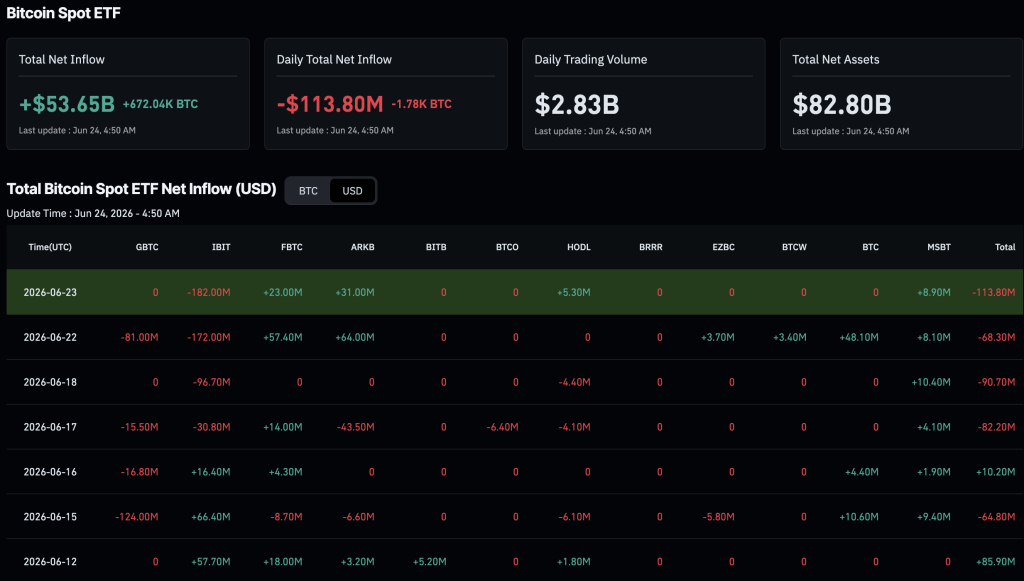
IBIT’s $62Bn in assets under management (AUM), amassed since the SEC approved spot Bitcoin ETFs in January 2024, underpins the BII’s actionable guidance.
IBIT holds about 49% of total US spot Bitcoin ETF assets, with competitors such as Fidelity’s Wise Origin Bitcoin Fund making up the rest. This concentration means advisor-channel adoption of the 1–2% framework heavily favors IBIT.
BlackRock reported $13.9 trillion in AUM at the end of Q1 2026, highlighting that even small allocations can have significant market impacts. If wealth management platforms adopt the 1–2% Bitcoin benchmark, as suggested by BlackRock research, demand for IBIT units could increase significantly.
Currently, institutional investors account for about 38% of total spot ETF assets, up from 24% the previous year, a trend likely to accelerate with formal BII guidance.
Advisor Channel and Institutional Crypto Adoption: What the June 23 Communication Formalizes
The delivery mechanism is as crucial as the content itself. By pushing “Sizing Bitcoin in Portfolios” through advisor communications instead of just as an institutional research document, BlackRock targets advisors and wealth managers, key players for trillions in retail and high-net-worth assets lacking a formal Bitcoin benchmark.
Many advisors previously faced a fiduciary gap; they could access Bitcoin through IBIT but couldn’t justify allocations to compliance departments or clients without a solid framework.
BlackRock positions Bitcoin as a “complementary diversifier,” providing a compliance-friendly anchor, especially when compared to the Magnificent Seven’s risk contribution.
This helps advisors document suitability using familiar terms without needing a new analytical category. Meanwhile, Morgan Stanley’s involvement in the Bitcoin ETF space, as revealed in 13F filings, shows a similar trend of legitimization that BlackRock is now bringing to the broader advisor channel.
Disclaimer: The author does not hold or have a position in any securities discussed in the article. All stock prices were quoted at the time of writing.

Tim Baker
Tim Baker is a Senior Market Analyst at Tokenist with over a decade of experience educating readers about traditional finance, crypto and DeFi. A former equity researcher turned on-chain analyst, Tim specializes in regulatory framework shifts and institutional DeFi adoption. His work focuses on distilling complex liquidity cycles and the macro environment into actionable intelligence for the modern DIY investor.


