














 BTC+0.59%
Market Analysis
BTC+0.59%
Market Analysis
Kalshi Targets $40Bn Valuation Seven Weeks After $22Bn Series F
Kalshi is in talks to raise at a $40Bn valuation, almost doubling its $22Bn Series F price in seven weeks, as $2Bn revenue and institutional demand reshape prediction markets.


Editorial disclosureRead more
All reviews, research, news and assessments of any kind on The Tokenist are compiled using a strict editorial review process by our editorial team. Neither our writers nor our editors receive direct compensation of any kind to publish information on tokenist.com. Our company, Tokenist Media LLC, is community supported and may receive a small commission when you purchase products or services through links on our website. Click here for a full list of our partners and an in-depth explanation on how we get paid.
Kalshi, the regulated prediction market platform, is reportedly in talks to raise a new funding round at an approximately $40Bn valuation, nearly doubling its recent $22Bn valuation from a $1Bn Series F just seven weeks ago, according to the Financial Times.
This new round, potentially closing by Q3 2026, would increase Kalshi’s total equity raised to about $3.7 billion since its inception.
The May 2026 Series F was led by Coatue, with participation from Sequoia Capital, Andreessen Horowitz, Morgan Stanley, and ARK Invest.
In contrast to struggling crypto and fintech firms, Kalshi’s rapid valuation increase highlights the market’s positive outlook on regulated prediction markets.
Kalshi Volume and Revenue Deep-Dive: $16.81Bn in May, $178Bn Annualized, and an 800% Surge in Institutional Trading
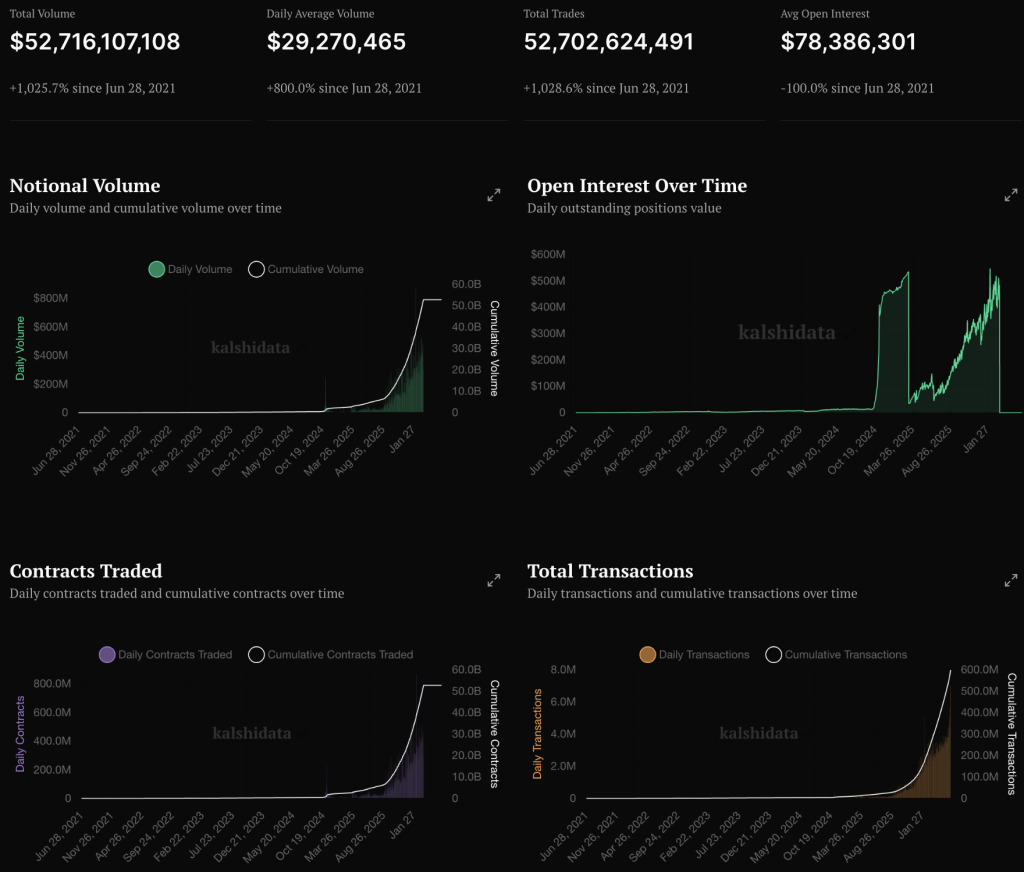
Kalshi’s annualized trading volume surged to $178Bn by April 2025, a 32x increase from the previous year, highlighting growth in the prediction market space over the past 12 months.
In May 2026, monthly volume reached $16.81Bn, with annualized revenue at $2Bn, a significant rise from the previous year. Institutional trading volume grew 800% in six months, with Kalshi claiming over 90% of US prediction market activity.
Sports contracts drove the majority of volume, with $5.1Bn recorded during the FIFA World Cup’s first week, the highest for any prediction market. The platform generated over $23Bn in sports contract volume in 2025.
Additionally, crypto perpetual futures, launched in June as the first CFTC-regulated product in the US, added $5.5Bn in volume in their initial two weeks, positioning them as a key tool for customer acquisition.
Valuation Multiple Analysis: $40Bn on $2Bn Revenue Is a 20x Multiple That Prices Kalshi as an Exchange Infrastructure Play, Not a Consumer App
Kalshi, valued at $40Bn with $2Bn in annualized revenue, has a 20x revenue multiple. This positions it closer to CME Group’s exchange-infrastructure premiums than to the consumer fintech sector, which has declined since 2021.
The valuation aligns with Sacra’s view of Kalshi as a “new asset class” operator, bolstered by its CFTC DCM designation. Philippe Laffont of Coatue suggested that “event contracts could become a trillion-dollar market,” implying that the 20x revenue multiple may be conservative.
However, public-market investors face uncertainty about the sustainability of this multiple, especially given that up to 90% of Kalshi’s revenue comes from sports contracts, which carry regulatory risks. Mansour has noted that an IPO is being discussed, but it’s unlikely before 2027.
Legal and Regulatory Risk: 12+ State Lawsuits and a Jurisdictional Fight That May Reach the Supreme Court
More than a dozen US states have sued Kalshi and Polymarket, alleging they operate unlicensed sports betting operations in violation of state gambling laws.
Kentucky’s attorney general alleged that 89% of Kalshi’s trading activity related to sports betting, with over $23Bn in sports contract volume in 2025.
Illinois passed a law requiring prediction market operators to obtain a state license, prompting Kalshi to file a federal lawsuit asserting that the CFTC has exclusive jurisdiction over exchange-traded derivatives.
The CFTC has sued nine states to block such enforcement actions. CFTC Chairman Michael Selig emphasized that states can’t undermine federal law, while Kalshi’s DCM status forms a key part of its defense.
This jurisdictional issue may escalate to the Supreme Court, and a negative ruling on the classification of sports betting could significantly impact Kalshi’s business, as sports contracts account for up to 90% of its revenue.
Prediction Markets as an Asset Class: $11Bn to $22Bn to $40Bn in Under Twelve Months Signals Institutional Capital Is Treating Event Contracts as a Distinct Category
Kalshi’s rapid valuation growth from an $11Bn Series E to a $40Bn target within a year, raising $2.685Bn across five rounds since June 2025, highlights institutional interest in regulated prediction markets rather than specific companies.
Bernstein notes that demand stems from bespoke trades and custom event contracts used by hedge funds to manage macro and geopolitical risks, distinct from retail sports betting.
Kalshi’s introduction of CFTC-regulated crypto perpetual futures marks a significant step toward full US compliance, a major advance for prediction market regulation.
As competition intensifies, with Kalshi generating $21.1Bn in volume in June 2026, compared to Polymarket’s $9.7Bn, fundraising becomes increasingly urgent.
Meta’s development of a competing prediction-market app, Meta Arena, further accelerates the need for Kalshi to solidify its market position.
The author does not hold or have a position in any securities discussed in the article. All prices were quoted at the time of writing.

Tim Baker
Tim Baker is a Senior Market Analyst at Tokenist with over a decade of experience educating readers about traditional finance, crypto and DeFi. A former equity researcher turned on-chain analyst, Tim specializes in regulatory framework shifts and institutional DeFi adoption. His work focuses on distilling complex liquidity cycles and the macro environment into actionable intelligence for the modern DIY investor.
Related Stories
 Market Analysis
Gasoline Drives June CPI Data Down 0.4%, But Core Inflation Limits Fed’s Hand
 Market Analysis
HM Treasury’s Tokenization Push: £33bn Target, and a 54-Firm Coalition that Includes BlackRock
 Market Analysis