The Investor’s Guide to Liquidating Dividends


All reviews, research, news and assessments of any kind on The Tokenist are compiled using a strict editorial review process by our editorial team. Neither our writers nor our editors receive direct compensation of any kind to publish information on tokenist.com. Our company, Tokenist Media LLC, is community supported and may receive a small commission when you purchase products or services through links on our website. Click here for a full list of our partners and an in-depth explanation on how we get paid.
What happens when a company pays a dividend that isn’t really a dividend at all?
That’s the case with liquidating dividends. Instead of rewarding shareholders with profits, these payouts return part of the original investment—usually when a company is shutting down, selling major assets, or restructuring.
For investors, liquidating dividends may bring large one-time payments but often reduce long-term stock value. For traders, they create short-term opportunities and risks as markets react. Knowing how these payouts differ from regular dividends is essential for smarter decisions.

- The Liquidating Dividend Concept
- Liquidating Dividend Triggers
- Liquidating Dividends vs. Regular Dividends
- Tax Treatment
- Impact on Stock Price
- Opportunities and Risks
- Examples
- Liquidating Dividend Announcements
- Conclusion
- FAQs
Understanding the Liquidating Dividend Concept
Liquidating dividend A liquidating dividend is a shareholder distribution representing the repayment of invested capital as opposed to a distribution of corporate earnings. These payments, as opposed to regular dividends that are based on profits, are financed by assets of the company, frequently associated with liquidating operations or restructuring. Simply put, the business returns a portion or the entire amount of the initial investment of the shareholder, diluting his/her ownership in the business.
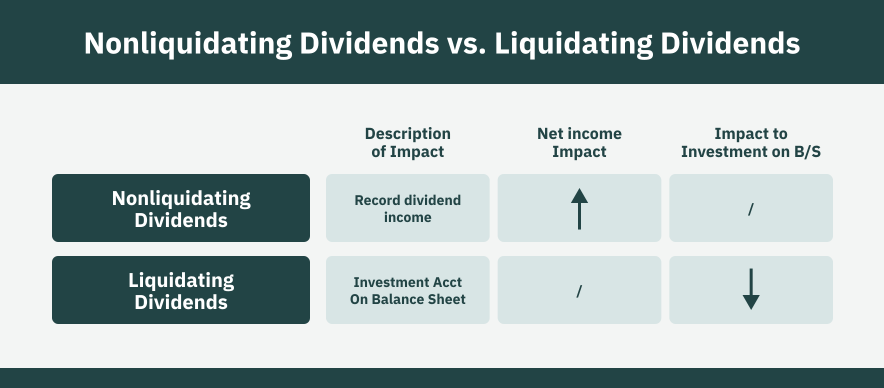
There are a few cases when companies can pay off liquidating dividends: when a sale of large assets is made, when the company merges with another company, or dissolves altogether. It is also able to implement a strategic decision to leave a market or sell a division and pay cash directly to the shareholders. Such actions are voluntary at times in order to maximize shareholder value and at other times due to financial distress or legal factors to liquidate.
The tax treatment is different to the shareholders. A liquidating dividend decreases the basis of the stock by the amount of the distribution; after the basis is zeroed out, the rest of the distributions are taxed as capital gain. This differentiates them from regular dividends, which are designed to provide income for holders of dividend stocks based on ongoing operations.
It is important to be aware of such a difference. Liquidating dividends are not only an indicator that the company is undergoing significant changes but could create a lasting impact on the stock value and the long-term potential of an investment, and therefore it is important that the traders, as well as the investors, are aware of them.
Common Situations That Trigger Liquidating Dividends
Liquidating dividends may occur in many corporate activities where capital is given back to the shareholders rather than the profits. The typical case is the merger or acquisition, when the acquired firm returns the proceeds of the transaction to the shareholders and then goes out of business or into the purchased company. In this situation the dividend is considered as a component of the ultimate ownership settlement.
The other common precipitant is sale of key assets. A firm may pay some or all of the proceeds of a divestment of a core division, real estate, or other assets of high value as a liquidating dividend. When the assets constitute a major part of the business value, the operating scope of the company becomes reduced in effect.
Liquidating dividends are also caused by the closure of businesses, voluntary and obligatory. Voluntary closures are usually based on strategic realignment or low growth prospects, whereas involuntary closures may include bankruptcy, as seen recently when Spirit Airlines reeled from costs after a quick-fix bankruptcy plan fell short, or being forced into liquidation by a court. Common shareholders in such cases are usually at the end of the queue to receive payments after creditors and preferred shareholders.
Partial liquidations also occur during restructuring and the proceeds of the assets divested are sent back to the investors. In either case, the liquidation of dividends indicates that shareholder equity will be decreased or eradicated altogether, a vital occurrence that traders and investors will want to monitor carefully on account of its effects on share price and future prospects.
How Liquidating Dividends Differ from Regular Dividends
Liquidating dividends are not similar to regular dividends in many aspects, and the first of them is the purpose. Regular dividends are given to the shareholders as a profit sharing measure and liquidating dividends pay back the invested money, which is usually an indication of decreased operations or a total liquidation.
They are also differentiated by their source of funds. Retained earnings result in regular dividends, which are evidence of profitability. Dividends which are liquidated however are funded through sales of assets and other sources of capital. They are a form of semi-payment of the initial investment of the shareholders as opposed to income.
The other significant difference is the tax treatment. Typical dividends from dividend stocks are taxed either as regular income or at advantageous rates in the case of qualification. Liquidating dividends, however, lowers the cost basis of the stock for the shareholder; only after the basis is brought to zero do subsequent payouts become capital gains. This produces different tax planning considerations.

Lastly, they have a large influence on shareholder equity. The regular dividends do not change ownership structure other than the dividend payment. Liquidating dividends, on the contrary, reduce net assets of a company directly and diminish the value of undistributed shares, a fact that indicates proximity to closure.
It is important to note such contrasts as a trader and investor. Although the two create cash to shareholders, their origin, implications, and tax consequences are fundamentally different, and determine how each would influence the value of stock and long-run strategy.
Tax Treatment of Liquidating Dividends
Regular dividends and liquidating dividends are different since liquidating dividends are treated as a return of capital and not as income. Upon receipt, the payout will lower the shareholder cost basis that constitutes the original investment amount including commissions or fees. The investors instead of paying the immediate income tax reduce the recorded value of their shares.
In the case of an investor purchasing a stock at 10,000 dollars and subsequently gets a liquidating dividend of 2,000 dollars the cost basis will decrease to 8,000 dollars. This goes on till base comes to zero. After the full depletion, all other payouts are subject to tax as capital gains- short- or long-term depending on the holding period.
This can allow deferment of taxes on capital gains in the event that you wait when the original investment will be made back. But there is a need to track closely its cost basis to avoid problems in reporting. There are also different regulations by jurisdiction thus professional guidance is important.
By planning, investors can incorporate liquidating dividends into their more comprehensive tax planning, maximizing when to receive it and minimizing the total liability-particularly when used in concert with other capital transactions within a dividend portfolio.
Impact on Stock Price and Trading Behavior
Liquidating dividend announcements can usually impact stock prices right away. Since such payouts occur when assets are sold or operations shut down, the markets will generally discount the expected payout within a short time. Prices tend to fall before the payment date as the capital is being repaid, in the same way as an ex-dividend action but often of a greater magnitude.
There is always short-term volatility, because these events are interpreted by investors differently. Income-based holders might be happy to receive the dividend while others exit due to reduced growth prospects. This creates both opportunity and risk for active traders. Momentum traders may target short-term swings, arbitrage traders analyze payout per share against price to spot mispricing, and some employ dividend capture strategies to profit from price adjustments around the ex-dividend date.

Liquidating dividends, unlike routine dividends, are usually accompanied by uncertainty about future operations. This intensifies market sensitivity to updates such as asset sale progress or changes in liquidation plans. Traders often pair this monitoring with valuation tools like the dividend discount model to gauge whether price adjustments reflect underlying value. Participating traders should not only track payout announcements but also broader corporate news, as new data can quickly shift sentiment and trigger sharp price changes.
Opportunities and Risks for Day Traders
Liquidating dividend announcements can be viewed as a chance to make money by day traders who see them as opportunities to profit from quick price movements. The news can spark buying activity as traders position ahead of payouts, with short-term rumors or confirmations creating momentum for rapid entries and exits before the ex-dividend date. Unlike longer-term approaches such as dividend growth, this style of trading relies on speed and timing rather than compounding returns over years.
The hazards are however high. Upon payment of dividend, the stock price will usually reset downward, often sharply, to reflect the capital that was returned. Traders caught holding through the payout can face losses that erase prior gains. Added uncertainty from corporate developments—such as changes in liquidation plans, slow asset sales, or litigation—can also drive sudden volatility. To help manage these risks, many traders turn to well-regarded investment newsletters that highlight market setups and provide timely guidance.
Due to the rapid nature of the changes that occur in these situations, timing is critical and it is important to keep an eye on the news and filings. A configuration that is successful in one instance will not be successful in another when market parameters change or the financial outlook of the company changes. Because of this, tight risk management, such as precise exit plans and position sizing that restricts exposure to shocks in the opposite direction, should be employed by day traders.
Examples of Liquidating Dividend Events
A particularly recent example was one in which a biotech firm announced a complete dissolution and liquidating dividend after it failed in a pathway to further milestone payments. One investor was paid a return of capital of around $15.10 a share just before delisting, which was obviously not a profit-based payout.
A similar case is that of a regional bank where a liquidating dividend of $22.00 per share was declared as it went through dissolution. A second, smaller payout was expected later, bringing the total to nearly $23 per share. The announcement also involved delisting of the shares on Nasdaq, which recently announced removals of several companies including Blue Star Foods Corp and Altamira Therapeutics Ltd, highlighting how liquidation often coincides with delisting and the suspension of reporting.
These practical examples demonstrate that liquidating dividends are not ordinary income but the recovery of investment and usually mark the death of a firm in terms of trading, triggering abrupt changes in market behavior. Such events are closely watched by traders and investors both for risk management and short-term positioning.
How to Identify and Monitor Liquidating Dividend Announcements
By following credible sources of corporate information, traders are able to identify the possible announcements of liquidating dividends. The most reliable is the EDGAR database of the U.S. Securities and Exchange Commission, in which companies are required to report material events, usually in Form 8-K, of asset sales, mergers, or shutdowns that could result in a payout. These filings provide an early preview of the size of distributions and when they will be paid.

Tracking tools and market data platforms that track the dividends also offer filters to special and liquidating dividends, and this makes it easier to track future opportunities. In many broker platforms, it is possible to sort by type of dividend, and third-party research services will publish payout schedules.
The integration of such resources as SEC filings, press releases—such as a recent statement from the U.S. Department of Health and Human Services—special tools, and watchlists provide traders with the full picture of possible events. Such an initiative can not only assist in detecting opportunities early, but also allows sufficient time to review financials, assess the validity of payouts, and set strategies that maximize returns while mitigating the risks such announcements often attract.
Conclusion
The liquidation of dividends is the indication of significant changes in the structure or existence of a company. They are not regular dividends but bring back the invested capital and present both opportunities and a warning, unlike undervalued dividend stocks that offer potential for steady compounding and portfolio growth.
Unlike traditional dividend investing, which relies on steady profit-based payouts, liquidating dividends mark a return of capital and require understanding of mechanics, tax treatment, and market impact.
These dividends can provide some immediate returns but there is also the risk of big price falls or corporate twists. The traders that monitor the announcement and design decisive strategies are more capable of tapping into the opportunities and controlling downside.
Finally, the liquidation of dividends are not quite basic occurrences, but redistribution of values and turning points. They can be tackled with focus and precision by traders when there is good awareness and risk management discipline.
Liquidating Dividend: FAQs
-
Are Liquidating Dividends Taxed as Regular Income?
No. They are initially classified as a return of capital, reducing the shareholder’s basis. Once the basis reaches zero, additional payments are taxed as capital gains. Unlike regular dividends that contribute to dividend yield and ongoing income, liquidating dividends simply return invested capital, so the tax effect depends on how much was invested versus what is returned.
-
Why Would a Company Issue a Liquidating Dividend?
They are given when a company is being wound down, a sale of significant assets, a merger or a restructure. For example, recent headlines noted Meta shares falling on an AI restructuring report, showing how such events can unsettle investors. Payout is the capital compensation, usually in lieu of profit, and in many cases the payout indicates the scaling back or shutdown of business.
-
How Do Liquidating Dividends Affect Stock Prices?
The share prices tend to decrease by a value close to that of the dividend on the ex-dividend date because the company’s assets are reduced. Sentiment can improve if investors view it as value returned, or it can decline sharply, as seen recently when sentiment on stocks collapsed more than at any point since the February market top, signaling concerns of decline or closure.
-
Can I Trade Around Liquidating Dividend Announcements?
That is true, however, at a risk. There is a tendency to have sharp swings in the prices following payouts. Timing, knowledge of corporate activity, and news vigilance are the requirements of traders.
-
Where Can I Find Details on a Company’s Liquidating Dividend Plans?
In a form 8-K SEC filings, company press releases, and investor relations posts. Timely alerts are also provided by dividend trackers, financial news websites and broker websites with dividend filters.
All reviews, research, news and assessments of any kind on The Tokenist are compiled using a strict editorial review process by our editorial team. Neither our writers nor our editors receive direct compensation of any kind to publish information on tokenist.com. Our company, Tokenist Media LLC, is community supported and may receive a small commission when you purchase products or services through links on our website. Click here for a full list of our partners and an in-depth explanation on how we get paid.

 Back to