Trader’s Guide to Falling Wedge Pattern


All reviews, research, news and assessments of any kind on The Tokenist are compiled using a strict editorial review process by our editorial team. Neither our writers nor our editors receive direct compensation of any kind to publish information on tokenist.com. Our company, Tokenist Media LLC, is community supported and may receive a small commission when you purchase products or services through links on our website. Click here for a full list of our partners and an in-depth explanation on how we get paid.
Have you noticed a stock sliding lower but losing steam as it does?
That’s often the sign of a falling wedge. This bullish pattern forms when price drifts downward within a narrowing channel, with each push lower growing weaker and rebounds finding stronger support. The contracting range signals that selling pressure is fading and a breakout may be near.
The falling wedge can appear as a reversal after a long decline or as a continuation within an uptrend, making it a versatile tool. For dividend investors, spotting this setup can highlight attractive entry points before broader momentum returns.

- The Falling Wedge Formation
- Market Psychology
- Key Features
- Falling Wedge vs Rising Wedge
- Importance
- Advantages
- Risks and False Breakouts
- Tools and Indicators
- Conclusion
- FAQs
Defining the Falling Wedge Formation
The falling wedge is a chart pattern that involves descending prices that are contained within two slanting, converging lines. The former joins a series of higher highs, the latter series of lower lows. Unlike a steep decline suggesting strong selling the wedge will be a more measured drift down. Each decline to new lows is getting less and less intense, as can be seen by the reduction in the width of the peak and trough between them.

This contracting pattern is responsible for the bullish nature of the falling wedge. This is an indication of a loss of conviction from sellers, and a consistent increase in buyers, albeit not yet dominant, to limit the magnitude of declines. The wedge is approaching its apex, with declining volatility and squish for new lows signaling an end to the downtrend.
Breakouts usually happen upwards, confirmed by price piercing the upper line of resistance on increasing volume. This trend means buyers have reclaimed their power and sentiment is getting positive. As such, the falling wedge can occur at the end of long downtrends as a reversal pattern, or in the middle of long uptrends as a continuation after a pullback, as seen recently when tech stocks led a broad market pullback. In both cases, due to its shape and the psychology behind it, it is one of the more predictable bullish patterns for traders and investors to watch.
Market Psychology Behind the Pattern
The psychology of the falling wedge shows a steady decline in the bearish sentiment. Early in the pattern, the sellers are in control trying to press the price lower with each wave. However, their strength decreases with time. Each subsequent low is only a bit lower than the previous, and sellers are quietly selling off the stock while buyers quietly absorb the selling pressure. The narrowing shape of this wedge captures this shift – momentum is still down but not with the power of a strong trend.
Volume provides a clear picture of this change. In the early stages, trading is usually heavy as pessimism dominates and short-term participants pursue quick payout investing. As the wedge develops, volume often decreases, showing fewer traders are willing to sell aggressively. This tapering activity signals exhaustion and suggests the downtrend is running out of energy.
The final straw is that the buyers finally tip the balance. A breakout above the upper resistance line and it has been accompanied by increased volume – this confirms demand has overcome weakening supply. What appeared to be an extension of decline is in fact a setup for reversal.
This shift in psychology—from fear-driven selling to confident accumulation—is why the falling wedge often precedes a sustained move higher. Recognizing these behaviors, and using insights from leading stock research platforms, helps traders and investors anticipate the breakout rather than react after it occurs.
Key Features That Confirm the Setup
Confirming a falling wedge involves keeping an eye out for definitive and clear characteristics that make it different from a straight downtrend. The defining characteristic is a pair of downward sloping converging trendlines. The upper line plots a series of lower highs while the lower plots lower lows. What makes the wedge distinct is that each successive low is less steep and this creates a narrowing channel and is an indication of weakening selling pressure.
Another clue could be the slow contracting of price movement. As the wedge forms, swings between highs and lows are tightening, which means falling volatility. This shrinking range indicates that the sellers are losing momentum and the buyers are beginning to stabilize the price, even before you can see a breakout in the price. The wedge is most critical towards its apex, in which pressure is built for the hurried move.
Understanding the movement of trading volume also helps traders spot the pattern. Trading activity typically decreases as the wedge develops, to consolidate the theory of seller exhaustion. When there is an upside breakout, higher volume is confirmation that the buyers have taken back control.
Together—converging trendlines, weaker lows, contracting swings, and declining volume—the falling wedge signals a market where selling power is spent. Spotting these features in real time increases confidence for traders and investors, particularly those focused on dividend based stock pricing, to anticipate a bullish reversal.
Falling Wedge vs Rising Wedge
The falling wedge and the rising wedge are inverse chart patterns as they generate opposite market movements. A falling wedge formation is when prices are falling between two converging downward sloping lines. Although it appears to be a bearish pattern, the narrowing pattern indicates the sellers are losing momentum. When the price finally breaks out of the top line, the pattern typically results in a bullish breakout. Conversely, a rising wedge occurs when prices move up within two converging rising slanting lines. The contracting shape indicates that buyers are weakening while a breakdown through the lower line usually initiates a downward move.

The major distinction is momentum. A falling wedge signals that selling pressure is disappearing and that the market is ready for buyers to return, making it one of the most reliable buy signals, particularly useful in dividend trading strategies. A rising wedge, on the other hand, reflects waning demand and the potential for a reversal to lower prices. Traders and investors need to distinguish between them, as the two patterns can appear similar at first glance.
For dividend investors, the difference makes a difference. Purchasing a share in a falling wedge can secure strong prices prior to potential upside from a long-term income perspective. Confusing it with a rising wedge will lead to buying at the wrong time – just before the decline, which will be devastating to capital and confidence. Technical analysis is more in line with the goal of building stable dividend-focused portfolios if properly understood.
Importance for Dividend Investors
For the dividend investors, the falling wedge can be more than a chart pattern – it helps in timing the entry better. Dividend stocks are valued for stability and reliability of income, but the price paid by shareholders directly impacts the return. Aiming to buy at the top of a dip also locks your capital into a downtrend while waiting too long may result in losing out on good returns. The falling wedge shows the end of selling pressure and the possibility of a reverse move.
When the pattern appears, it often means that dividend stocks are temporarily undervalued. Lower prices force yields up, and this creates an opportunity for you to lock in income rates. Long term investors benefit from the higher yields, plus the possible capital appreciation of the investment after the breakout occurs. Entering the market at this point allows you to benefit from combining reliable dividends with the benefit of buying at a moment before the momentum turns positive.
This timing is useful for investors in particular to compound returns for income growth. By avoiding purchases in the midst of strong downward moves and waiting until confirmation of the falling wedge, investors reduce their cost basis and minimize downside risk. Therefore, the pattern is more than a technical signal; it provides a strategic edge for designing portfolios that balance income and growth.
Advantages of Trading Falling Wedges
The falling wedge is a common tool for traders and investors because of the signals that it gives out. As the pattern unfolds, a clear breakout can be observed when price breaks the upper resistance line. This provides a hard entry point, and coupled with predefined brackets for stop-losses and profit takes, this makes trade planning easy. The falling wedge provides a framework for making decisions in a much more stable way than in more chaotic structures.
One more benefit comes from the pattern behavior with volume. The wedge is almost always formed in a decrease in volume, which shows the sellers have lost momentum. When a breakout occurs on an increase in volume, it indicates that buyers are stepping in, strengthening confidence in the move. Pairing structure with volume allows for traders to filter out false breakouts and add strength to the overall setup.
The falling wedge also does a wonderful job of identifying major trend reversals. Because it reflects seller exhaustion, a breakout can mark the end of a long decline and the start of a new uptrend. Traders can recognize these instances early, with many popular investing publications noting them as key signals, and position ahead of the broader market. Whether used for short-term trading or long-term dividend investing, the falling wedge blends technical clarity with practical strategy.
Risks and False Breakouts
Despite the fact that the falling wedge is generally considered to be a bullish sign, it does have its drawbacks. The most basic is the false breakout: price briefly breaks resistance, but quickly loses steam and falls back within the wedge. Early jumpers are then exposed to renewed downside, and a win could then become a loss. The danger is increased if the move fails to be accompanied by volume increase, since true breakouts are typically accompanied by trading intensification.
Another challenge is the broader market backdrop. Even when a falling wedge forms correctly, heavy bearish pressure can outweigh it. Recently, Wall Street indexes slipped as investors reacted to Powell’s remarks, a reminder that external forces can easily disrupt technical setups. In such cases, a potential reversal may prove weak or short-lived while downward pressure continues. Depending solely on the chart without factoring in the wider environment can lead to costly mistakes.
For investors who purchase dividend shares, both technical and fundamental analyses are necessary. A falling wedge can indicate an opportunity for buying, but checking dividend health—steady payout ratios, earnings stability, and cash flow—ensures confidence in the position. Strong earnings reports, such as Micron’s recent 46% sales surge on the back of the AI boom, highlight how fundamentals can reinforce technical signals. A breakout backed by solid results is far more reliable than one based on price action alone. Combining both outlooks helps investors avoid false signals and align decisions with long-term income objectives.
Tools and Indicators for Confirmation
If you add other tools to a falling wedge setup, you gain more confidence and filter out false signals. One of the best tools is the Relative Strength Index, or RSI. If the price breaks lower inside the wedge but the RSI makes higher lows, it signals bullish divergence. That divergence shows selling pressure is weakening and a breakout is near, though it’s also worth noting that market breadth has been poor lately—even in tech—which some analysts view as an ominous signal.
Another useful tool is the Moving Average Convergence Divergence or the MACD. A bullish crossover occurs when the MACD line crosses over the signal line and implies the buyers are taking charge. Look at the histogram also, shrinking negative bars confirms that downside momentum is fading. Short and medium term moving averages can be used to confirm the pattern as well. When the price breaks out and moves above the 20 day or 50 day average, the move is stronger.
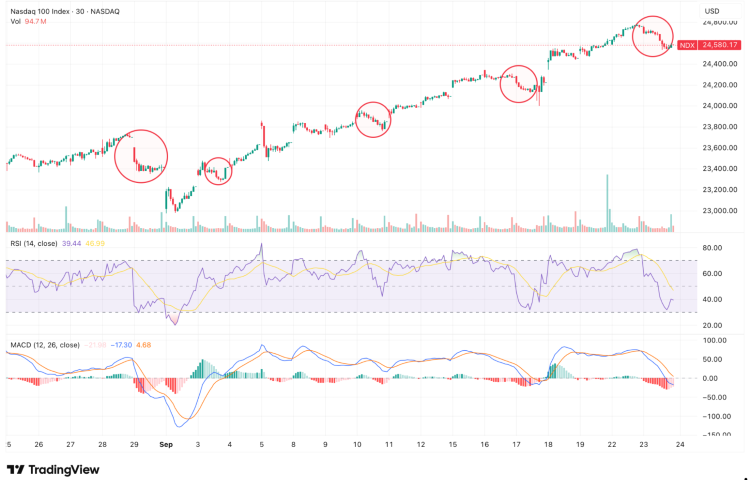
Dividend investors require both the technical and the fundamental checks. A falling wedge breakout is preferable when the company has a sustainable payout ratio, good free cash flow and steady earnings growth. That way you aren’t merely filling in a technical pattern, but purchasing stock in a firm that is capable of paying or increasing its dividend. Combining the two methods makes entry points more formidable and keeps strategy consistent with long-term portfolio objectives.
Conclusion
The falling wedge is a highly useful chart pattern which indicates a buying opportunity. Although the shape of the narrowing indicates sellers losing strength and buyers slowly moving back in, it appears to be a shortening downtrend. For traders and longer term investors it can point out a reversal pretty early and open up opportunities that are not yet obvious.
Dividend investors can take greater advantage. Buying at a low price and receiving high dividends can result in higher long-term cash flow but only if the timing is right. The falling wedge is a great tool to trade on the move, allowing you to position yourself ahead of a rally, which gives you a steady payout along with the potential for capital appreciation.
No organization pattern can assure success. That is why you should cross-check signals with other instruments. Use RSI, MACD, and moving averages with good dividend payments and good financial health. Fusion of technical and fundamental data provides you with a stronger feeling of confidence and helps to protect your long-term income goals.
Falling Wedge Pattern: FAQs
-
What Does a Falling Wedge Pattern Indicate?
A falling wedge typically indicates that selling pressure is dissipating. Even though prices continue to fall in the “undefined” area of the wedge, the narrowing shape shows sellers losing confidence, much like when analysts note that political pressure on the Fed—such as Trump’s recent push—won’t have a huge impact on key stocks. When the top of the wedge breaks, we usually see a bullish breakout and a new uptrend.
-
How Is the Falling Wedge Different From the Rising Wedge?
The falling wedge is falling and generally bullish. It indicates that sellers are running out of steam and an upturn in prices could be on the horizon. The rising wedge is the inverse of the Triad Pattern: it slopes upward, is bearish and indicates buyers are weakening and breakdown is imminent. The lines of both patterns are converging but the meanings are opposite.
-
Why Should Dividend Investors Pay Attention To Falling Wedges?
The falling wedge can be used by dividend investors to identify good entry points for income stocks. Prices tend to be low as the wedge happens that can increase dividend yield. Investors who buy near the breakout will not only capture income but also any price appreciation as the stock bounces back.
-
What Indicators Confirm a Falling Wedge Breakout?
Some of the common tools that can be used to confirm falling wedges are RSI, MACD and moving averages. Bullish RSI divergence, positive MACD cross, or moving average price move above support moving average all support the breakout. Volume is also important; if volume is up through the breakout, then buyers are gaining control.
-
Can a Falling Wedge Pattern Fail To Signal a Reversal?
Yes, a falling wedge can fail, especially in strong bearish markets. Earlier in this year, for example, tariff fears sent the market plummeting, showing how external shocks can overwhelm technical setups. In such cases, the breakout might be weak or short-lived, and prices may continue to fall. That’s why it is so important to confirm the pattern with technical indicators and also review dividend fundamentals to ensure the stock’s income stream remains solid.
All reviews, research, news and assessments of any kind on The Tokenist are compiled using a strict editorial review process by our editorial team. Neither our writers nor our editors receive direct compensation of any kind to publish information on tokenist.com. Our company, Tokenist Media LLC, is community supported and may receive a small commission when you purchase products or services through links on our website. Click here for a full list of our partners and an in-depth explanation on how we get paid.

 Back to