Beginner’s Guide to the Ex-Dividend Date in Stock Investing


All reviews, research, news and assessments of any kind on The Tokenist are compiled using a strict editorial review process by our editorial team. Neither our writers nor our editors receive direct compensation of any kind to publish information on tokenist.com. Our company, Tokenist Media LLC, is community supported and may receive a small commission when you purchase products or services through links on our website. Click here for a full list of our partners and an in-depth explanation on how we get paid.
When does a stock need to be in your portfolio to earn the dividend?
That’s exactly what the ex-dividend date tells you—and getting it wrong can cost you. If you buy too late, you miss the payout. If you hold through it, the price may drop. Whether you’re aiming for passive income or short-term trades, the ex-dividend date can affect your returns.
This guide breaks down what the ex-dividend date means, how it works, and how to use it to your advantage—so you’re not surprised by missing income or sudden price shifts.

- What Is the Ex-Dividend Date?
- How the Dividend Timeline Works
- Trading Around the Ex-Dividend Date
- Day Trading and the Ex-Dividend Strategy
- Real-World Example
- Risks and Missteps
- Taxes and the Ex-Dividend Date
- Useful Tools
- Conclusion
- FAQs
What Exactly Is the Ex-Dividend Date?
The date of ex-dividend occurs when an equity begins to trade without the worth of the following dividend. In case you purchase the stock any time on and after this date, you will not be entitled to the next dividend. The money is paid instead to whoever owned the stock prior to the ex-dividend date. Who is to receive the payout is determined in this one trading day.
To earn a dividend, timing your purchase is critical. You must be listed as a shareholder by the record date, and since trades settle in two business days, that means buying the stock at least one day before the ex-dividend date. Miss that window, and you miss the payout—because once the stock goes ex-dividend, it no longer carries the dividend value.

A stock price normally decreases by approximately equal to the dividend on the day that a stock goes ex-dividend. This is indicative of the fact that new buyers will not get the payout. Nonetheless, this decline is not always accurate, it is influenced by the conditions on the market or the moods of investors.
To the traders and the income investors, the ex-dividend date is essential in timing the entry and exits. It can prevent you from missing expected dividends, make short-term price movements easier to anticipate and allow you to ensure your trading strategy is more in line with dividend opportunities.
How the Dividend Timeline Works
There are four significant dates in the dividend timeline that specifies when a dividend is paid- and by whom. The first is the date of declaration of dividend when a firm board announces the dividend. This encompasses the amount of dividend, record date, payment date and ex-dividend date thus making the payout official and expectations of shareholders.
The next is the ex-dividend date, which is normally one business day prior to the record date. Assuming you purchase the stock on or after the ex-dividend date, you will not be entitled to receipt of the forthcoming dividend, as the exchange will not settle on time. It has to be bought prior to this date to qualify. This timing is especially important for those using a dividend capture strategy, where traders buy shares just before the ex-dividend date to collect the dividend and sell shortly after.
At the record date, the company runs through its shareholders list in order to identify those who will receive the dividend. Those listed by that day will be only paid. Finally, there is the payment date, at which the dividend is physically paid out, most often by direct deposit or by check sent through the mail.
Realizing the way these dates interact can help an investor avoid timing errors. Buying after the ex-dividend date means no payout. Holding through it can lead to a price drop as the stock adjusts—especially when broader market pressure builds. Even Wall Street strategists are warning of a possible stock market correction, adding a layer of risk to dividend timing plans . Mastering this sequence is key for both traders and long-term investors seeking better positioning around dividend events.
Trading Around the Ex-Dividend Date
The price of a stock normally declines by a similar value of the dividend when a stock goes ex-dividend. This is indicative of the fact that payout no longer belongs to the new buyers. An example of this could be a stock of $50 share that pays a dividend of $1, this stock could open at approximately $49 on the day of the ex-dividend date. Although the correction does not always occur as accurately as it should be because of the situation in the market, it is one of the tendencies the traders expect.
Other traders attempt to capture the dividends by purchasing them before the ex-dividend date and selling them soon afterward. The thought is to receive the dividend and minimize being exposed to the stock. Such an approach is risky, however. The dividend might be offset by a decrease in the price and short holding periods are likely to result in an increase in tax rates as the payment might not be eligible to receive a favorable tax rate. Expenses such as commissions, bid-ask spreads and price volatility can also chew up returns.
Chasing after dividends without consideration of the tax, timing, and market behavior may result in a disappointment. The tradeoff of short-term profits against wider risks are issues that traders should take into consideration. In many cases, a better game is to long-term hold dividend-paying stocks, where ex-dividend dates are useful to plan, not to make a fast-profit. Dates are important when it comes to pricing and eligibility and therefore knowing them is the only way of making better decisions at the right time.
Day Trading and the Ex-Dividend Strategy
Depending on the strategy and risk tolerance, day traders approach the ex‑dividend date with either caution or opportunism. Since stocks often decline on the ex‑dividend date in anticipation of the dividend, it can create short‑term trading opportunities—plus sudden volatility that may disrupt trades, even though broader market volatility remains muted despite looming tariff deadlines.
Other traders do not trade ex-dividend stocks at all; they wish to avoid the fictitious change in price, which is liable to warp chart formations. In the case of strategies based on momentum or clean technical set ups, such disruption can be a deal breaker. Others, however, are out to ensure that they earn on the event, after the dividend value is removed from the price or getting the rebounds after the initial decline.
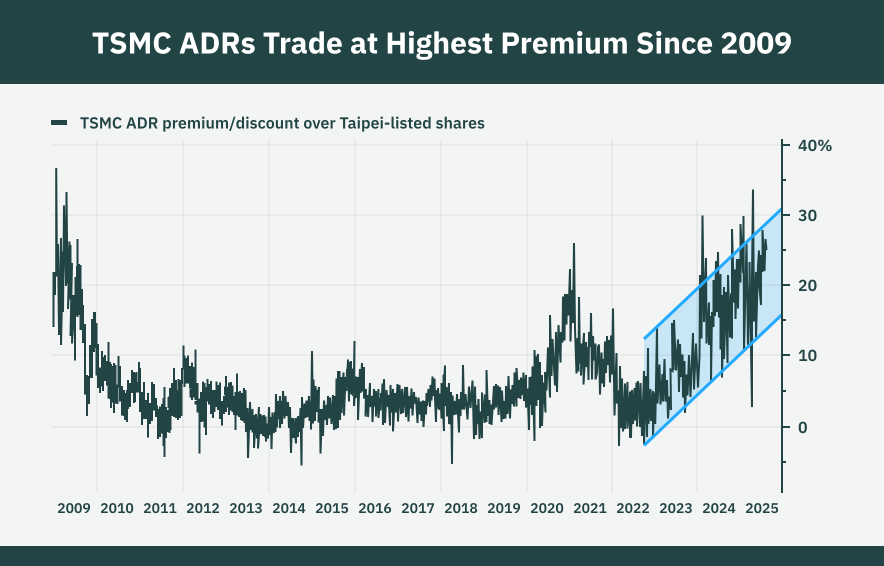
Timing matters—just minutes can change outcomes. Entries and exits around the ex-dividend date can be tricky, thanks to price gaps, volume spikes, and spread widening. Similar dislocations, such as the recent TSMC stock reaching its widest premium over its Taiwan listing in 16 years, highlight how unexpected gaps can upend even well-structured trades. Without a solid plan, these setups are prone to errors.
Those who do trade must do so in a disciplined way: stop-losses must be used, timing verified and the impact of the mechanics of dividend payment understood in relation to the short term. To many, the wiser action is to be monitoring these dates as a trade prep measure–alerting to possible volatility, not being compelled to act in an environment of uncertainty.
Real-World Example of an Ex-Dividend Setup
Take the example of Pfizer Inc. (PFE), a popular dividend stock that’s on the radar this week as it reports earnings—investors are tracking its performance alongside names like Palantir, Advanced Micro Devices, Walt Disney, and ZoomInfo as part of a broader group of stocks to watch. The company’s record date is set, placing its ex-dividend cutoff in line with the current T+2 settlement cycle (soon shifting to T+1). Based on the latest schedule, Pfizer’s ex-dividend date falls just ahead of its earnings release.

An investor who purchased shares on January 23 would receive the dividend, since the trade would settle before the record date. Anyone buying on or after January 24 would not, as the stock begins trading without dividend value on the ex-dividend date. Pfizer’s share price typically adjusts downward by approximately $0.41 on the ex-dividend date to reflect the dividend payout.
This decline had nothing to do with company performance—it simply represented the cash flowing out to shareholders. Traders may use this setup to time entries, pursue dividend capture strategies, or anticipate short-term rebounds if sentiment remains bullish.
Long-term investors, meanwhile, likely held through the date, focused more on Pfizer’s steady yield and reliable dividend history. Understanding where the ex-dividend date fits within the dividend timeline helps both traders and investors make better decisions around timing, eligibility, and short-term price movement.
Risks and Missteps Traders Should Avoid
Another error that traders who are ignorant of the ex-dividend date often do is purchase a stock just before the ex-dividend date, expecting to get the dividend-but then being too late to get it. Whenever a stock is bought on or after the ex-dividend date, then the buyer no longer qualifies. This basic timing mistake may be not only irritating but also expensive to those who do not know about the timeline of dividend.
The other common error made is misinterpreting the price decline that tends to take place on the ex-dividend date. The decline in price is seen by some traders as a piece of bad news or negative market mood but in reality, it is just a routine correction that shows the price paid out in the form of a dividend. Failure to forecast this may lead to ill-timed trades or stop-losses that may dampen profits.
Among the greatest fallacies is considering dividends as free money. Another is ignoring the dividend payout ratio—an elevated ratio can signal pressure on future payouts, undercutting timing-based strategies. Although they yield actual income, the dividends are generated by the earnings retained by the business—in other words, the value is transferred, not created. The net increase in value happens only when the stock appreciates beyond the adjusted post-dividend price, which is the core idea behind long-term dividend growth investing.
To pursue dividends without the whole picture in mind (timing, price, and tax) can be a backfiring decision. When it comes to traders, planning around such events is critical in order to prevent the unintentional loss and ensure that dividend policies indeed enhance the total performance.
Taxes and the Ex-Dividend Date
The taxes have a significant effect on treating of dividends particularly when trading around the ex-dividend date. Whether a dividend is qualified or ordinary makes the difference in the amount of tax you will pay. Qualified dividends are given a lower tax rate of taxation as the long-term capital gains rate whereas the ordinary dividends are given a higher rate of taxation as regular income.
To qualify for the lower tax rate on dividends, you must hold the stock for more than 60 days within the 121-day period that begins 60 days before the ex-dividend date. If you buy just before the ex-dividend date and sell shortly after, you likely won’t meet this requirement. In that case, the dividend is taxed as ordinary income—which could be much higher, depending on your tax bracket.

The difference is particularly significant to traders who are planning on short-term dividend captures. The thought of receiving an immediate payout through a dividend can be appealing, yet the absence of taking into consideration the effect of the tax can erase the intended profits.
It is necessary to understand the relation between the ex-dividend date and the IRS holding period requirements. Lack of such information can result in surprise taxes by traders that can undermine their strategy. Models like the dividend discount model offer a theoretical way to estimate a stock’s value based on expected dividends, but without factoring in taxes and timing, even a well-valued trade can fall short in real returns. Understanding these rules will aid in making sure that the dividend trades are profitable once you take your taxes out—not just on paper.
Tools to Track and Plan for Ex-Dividend Dates
Knowing ex-dividend dates is crucial in trading to allow one to take the dividend or avoid the unexpected share price decline. Luckily, there are a wide range of tools that can be used to assist. The dividend calendars provide a summary of forthcoming ex-dividend dates, payment and yield. They are wonderful to map entry and exit points relative to trades involving dividends.
Most brokerage websites offer alerts to be set up which inform the user when a stock is near its ex-dividend date. This allows traders to react fast without keeping an eye on the news. Watchlists may also be customized to incorporate dividend measures, and it is simpler to identify income opportunities when carrying out daily reviews—especially when combined with insights from trusted stock picking services.
Stock screeners put yet another measure of control. A trader can sort the stocks according to dividend yield, history, sector and future dividends. On some platforms one can even screen according to how often the dividend is paid, how consistently, or whether or not it appears in income-oriented indices. Such tools can be used to determine stocks that fit with the income objectives as well as the overall trading plans.
Having calendars, alerts, and screeners altogether, traders will be better at timing and being less prone to errors. To make the capture of a dividend or to prevent the price fall after the payout, being ready will render a better outcome. Consistent application of these tools, along with guidance from reputable investment newsletters, can convert dividend awareness into actual timely trades that aid a more disciplined and income-oriented trading style.
Conclusion
The ex-dividend date is something that should be known by anyone who is gaining an income in the form of different stocks that pay dividends. It states what shareholders are entitled to receive as payout and therefore is imperative to income investors as well as active traders. A day late and the dividend may be missed.
Stock price behavior also is influenced by the ex-dividend date. The price tends to fall by the amount of dividend on this day, which affects short term movement, trading tactics and tax treatment. A trader, who understands these dynamics, is able to enter and exit at a better time.
With the assistance of such tools as dividend calendars and stock screeners, the chances of surprise are reduced, and planning becomes more intelligent. Although dividends may increase income, timing, tax and price changes have to be considered in your wider strategy. Properly handled, ex-dividend dates can be used to generate consistent income, and trading profits as well.
Ex-Dividend Date: FAQs
-
What Happens if I Buy a Stock on the Ex-Dividend Date?
When you purchase a stock after or the same day that it is an ex-dividend date you will not get the next dividend. The proceeds are paid to the seller who at the cutoff date owned the stock. Although the stock may appear to remain the same the right to the dividend has been already provided.
-
Can I Sell a Stock on the Ex-Dividend Date and Still Get the Dividend?
Yes. As long as you were in possession of the stock prior to the ex-dividend date, then you are entitled to the dividend-even though you may sell it that day, or even after that date. The thing that counts is ownership prior to the cutoff.
-
Do All Stocks Have Ex-Dividend Dates?
No. It is only these dividend-paying stocks that are marked ex-dividend. In case of a company that does not pay dividends then the ex-dividend date is non-existent. The ex-dates of stocks paying one-time or special dividends will be the date of such payment.
-
Why Does a Stock’s Price Drop on the Ex-Dividend Date?
The stock usually falls by some amount of the dividend on the ex-dividend date. This is an indication that the new buyers would not enjoy the payout, hence the price adjusts to reflect the lost value. For those engaged in long-term dividend investing, this drop is expected and does not signal anything negative about the company’s fundamentals.
-
How Can I Find Upcoming Ex-Dividend Dates for Stocks I Follow?
Go to stock screeners, stockbrokers, financial news or dividend calendar websites. In most sites you can set alerts or watch ex-dividend activity in those watchlists.
All reviews, research, news and assessments of any kind on The Tokenist are compiled using a strict editorial review process by our editorial team. Neither our writers nor our editors receive direct compensation of any kind to publish information on tokenist.com. Our company, Tokenist Media LLC, is community supported and may receive a small commission when you purchase products or services through links on our website. Click here for a full list of our partners and an in-depth explanation on how we get paid.

 Back to