EPS vs DPS: What Investors Need to Know


All reviews, research, news and assessments of any kind on The Tokenist are compiled using a strict editorial review process by our editorial team. Neither our writers nor our editors receive direct compensation of any kind to publish information on tokenist.com. Our company, Tokenist Media LLC, is community supported and may receive a small commission when you purchase products or services through links on our website. Click here for a full list of our partners and an in-depth explanation on how we get paid.
Which matters more for your portfolio—Earnings Per Share (EPS) or Dividend Per Share (DPS)?
EPS measures how much profit a company generates for each share, while DPS shows how much of that profit actually gets paid out as dividends. Both are key numbers, but they reveal very different sides of a company’s performance.
For investors, EPS is a growth signal and a major driver during earnings season, when results can swing stock prices quickly. DPS, meanwhile, highlights how much management prioritizes returning cash to shareholders—vital for income strategies and dividend capture plays.
Looking at EPS and DPS together gives traders and investors a clearer view of whether a company is focused on reinvestment, payouts, or striking the right balance.

- Understanding EPS
- Breaking Down DPS
- Key Differences
- The Payout Ratio Connection
- EPS and DPS in Market Reactions
- Use in Day Trading
- Risks
- Tracking Tools
- Conclusion
- FAQs
Understanding Earnings Per Share (EPS)
Earnings Per Share (EPS) represents the fundamental measurement of the profitability of a company that is estimated by dividing the net income with the number of shares outstanding. Net income is income after expenses, taxes and interest. When written per-share, EPS allows investors to compare companies with different sizes and monitor the trends of their performance over the years.

Increase in EPS indicates greater earnings power, whereas a decrease may reflect weaker profitability, rising expenses, or slowing revenue. Reported quarterly and annually, EPS is a central part of earnings announcements and often drives short-term stock price reactions, as seen when headlines note cases like when Walmart stock fell recently despite a higher earnings forecast.
The traders focus on EPS because it presents opportunities and alarming signs. The EPS, which has increased steadily, is an indicator of good management, efficiency in its operations and a viable business model, which augers well with higher valuations. Conversely, sharp decreases are capable of triggering selling sprees, especially in cases where the results fall short of analyst expectations.
Market responses are often determined not only by the level of the EPS but also the level relative to expectation. A company that surpasses the projections is likely to have its stock blast up, whereas the one that just meets or fails to meet can be under pressure. EPS is an essential indicator as far as long-term investors and active traders are concerned due to its importance in assessing the strength of a company and making market predictions.
Breaking Down Dividend Per Share (DPS)
Dividend Per Share (DPS) reflects the amount of income that a company pays to its stockholders as dividend. It is estimated by dividing the total dividends paid in a period by the number of outstanding shares. The outcome is the dividend entitlement per share and is normally given on a quarterly or annual basis depending on the payment frequency.
DPS indicates the dividend policy of a company and its ability to share with its shareholders. A stable or increased DPS indicates good earnings and cash flow that can be used to sustain the distributions or even increase them, which attracts income-seeking investors. On the other hand, a decreasing or unstable DPS can indicate the pressure on finances or reinvestment focus, or switch in management philosophy.
Investors and traders will find in DPS the concrete cash payoffs of owning a stock, over and above price appreciation. It also assists in comparing the companies in the same industry, particularly those fighting over the income-oriented capital. A high DPS is tempting but should be considered against earnings, payout ratios and the overall financial health in terms of sustainability.
When viewed with EPS, DPS gives a picture of how profits are used, be it reinvested or paid out as dividends. Collectively, they provide a more holistic view of the financial condition of a company, its capital structure policy and its balance between shareholder pay-offs and long-term growth.
Key Differences Between EPS and DPS
Although both the EPS and DPS are reported on a per share basis, they actually measure very dissimilar parts of the performance. EPS measures the profit-making ability as it indicates the amount of net income per share and can be used as a measure of profitability and future growth. DPS is an indicator of how a company is distributing its profits and the extent to which it is paying up some of its income to the shareholders in terms of dividends.

The connection between the two is the payout ratio which is obtained by dividing DPS by EPS. This diagram indicates the portion of profits which are distributed and not distributed. As an example, a 50 percent payout ratio would require half of earnings to be paid out as dividends and the remainder reinvested, paid off debt, or otherwise used. A low ratio may indicate a low use of current income and limit the possibility of reinvestment, whereas a high ratio may indicate a bottom heavy investor base and less ability to grow.
The difference between the two and the interaction between them through the dividend payout ratio can help traders and investors assess both the earning power of the company and the policies of the company in relation to its shareholders. EPS does not alone suggest anything about the utilisation of profits, whereas DPS does not alone suggest anything about overall profits. Taken in combination, they give a fuller view of financial well-being, executive priorities and the trade-off between rewarding shareholders and maintaining growth.
The Payout Ratio Connection
The payout ratio-Dividend per share (DPS) divided by earnings per share (EPS) indicates how much of a company’s earnings are paid out to the shareholders. To illustrate, EPS of $4 and DPS of $2 translates to a payout ratio of 50 percent, where half of the profits are devoted to dividends and the remaining portion is reinvested in the business, or used to pay back the loans, or other things.
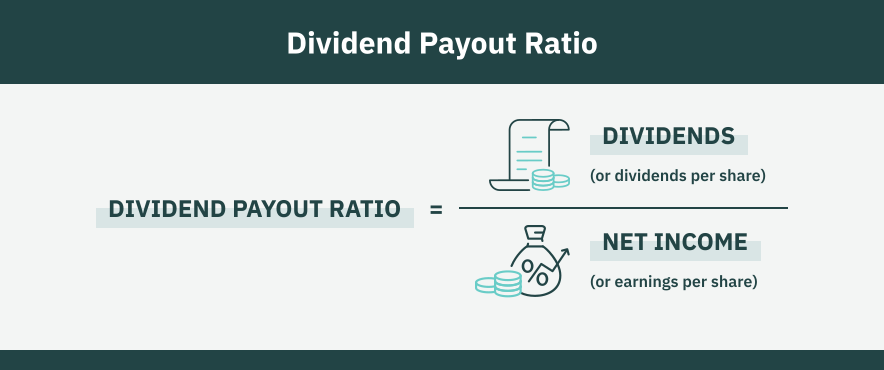
This is a ratio to evaluate the viability of dividends. A modest payout ratio is an indication of balance: rewarding shareholders, and not letting too much money leave the company. A very high percentage, particularly over 100, is an indication that the company is paying out almost all its profits or even dipping into its reserves- a situation that casts doubt on the future sustainability of the company. A very low ratio, in its turn, suggests substantial reinvestment or financial conservatism that can restrict short-term income but ensure growth.
For traders and investors, payout ratios offer clues to dividend reliability. Firms with steady earnings and modest ratios are viewed as sound payers, while those with volatile earnings or persistently high ratios risk future cuts. These risks are often reflected in market sentiment—headlines like US stocks ending lower on trimmed rate cut bets before Powell’s speech, show how quickly earnings and policy expectations can reshape confidence. When combined with EPS and DPS trends, payout ratios help identify both opportunities and risks in dividend-based strategies.
EPS and DPS in Market Reactions
Earnings announcements have a direct effect on EPS, giving the profit per share in the period. When results meet or beat analyst expectations, stocks often rally in the short run. Misses can trigger sharp declines, signaling weaker profitability or operational issues. During earnings season, traders monitor developments closely, often guided by top rated financial newsletters that flag earnings surprises, since even small divergences from forecasts can spark heavy intraday volatility.
Dividend declarations impact DPS by confirming shareholder payouts. Increases usually lift sentiment because they signal management’s confidence in financial strength and future earnings. Conversely, dividend cuts or suspensions often drive selling among income-seeking investors. While DPS changes rarely create the same short-term price swings as EPS surprises, they can reshape long-term attractiveness by influencing a company’s share income yield.
Different traders respond to each of the metrics differently. The EPS adjustments are linked to the short-term performance and momentum, which makes them the major drivers of volatility and trading opportunities. DPS changes indicate a wider capital allocation and long-term financial condition, which are more pertinent to income approaches, dividend capture or portfolio management.
Both EPS and DPS ultimately influence market sentiment-EPS by sending the market signals through quick reactions to earning and DPS by sending a message about stability and shareholder policy. Collectively, they offer a more complete picture of the way companies are seeking to balance short-term performance and long-term commitments to investors.
Using EPS vs DPS in Day Trading
For day traders, EPS and DPS act as triggers in different contexts. EPS gains prominence during earnings season because results often drive sharp short-term swings. A strong beat can spark rallies as traders buy into momentum, while a miss may trigger rapid sell-offs. Many day traders position ahead of announcements or trade immediately after, using price action and volume spikes for intraday moves, while longer-term investors may frame these moves within broader income investing strategies.
DPS is less likely to produce dramatic swings but plays a bigger role in dividend-related tactics. A common dividend capture strategy involves buying shares before the ex-dividend date to collect the payout and then selling shortly after. In these trades, the size and reliability of DPS determine whether the return justifies the risk. DPS trends also highlight consistency in dividend paying equities, guiding short-term strategies for traders who focus on stable income opportunities.
Traders wanting volatility and momentum tend to follow EPS news, and those who focus on predictable dividend activity, quick payout investing, or short-term yield plays tend to follow DPS data. The times when each metric is most influential can help day traders align their strategies with their objectives, whether they prefer fast-moving earnings-driven swings or steadier income-oriented setups.
Risks of Misinterpreting the Metrics
The first pitfall is assuming that a high EPS automatically means a high DPS. Although strong profits create the capacity for dividends, companies are not required to pay them. Management may instead reinvest in growth, reduce debt, or build reserves, leading to modest DPS despite strong EPS. Traders relying solely on expectations, or even on signals from trusted stock recommendation providers, can be misled if they overlook payout policy and strategy.
A high DPS is not always a sign of strength either. A firm may maintain or raise dividends even as earnings decline, pushing payout ratios to unsustainable levels. In such cases, dividends might be financed from reserves or borrowing, raising the likelihood of future cuts. Dividend reductions can hit stock prices hard and erode confidence among income-focused investors, particularly those relying on a reinvested dividend approach to compound long-term returns.

Such mistakes tend to arise when EPS or DPS is viewed in isolation. It is crucial to evaluate supporting factors such as cash flow, debt levels, earnings stability, and industry conditions to judge sustainability. Headlines noting that certain names have solid cash flows and are buying back stock highlight why EPS growth must rest on sustainable profitability, while DPS should remain aligned with financial capacity.
When looked at as a combination, EPS, DPS, payout ratios, and the rest of the fundamentals make the financial health quite obvious. This moderate method of thinking prevents the numerous cases of getting led astray by headline numbers that do not reflect the complete picture.
Tools for Tracking EPS and DPS
The traders, as well as investors, have a variety of tools to track EPS and DPS. Most brokerage systems offer real-time earnings information, dividend track records and payout ratios often with graphs showing the trend. Most of them also enable the user to set alerts to earnings releases or dividend declarations, giving the trader an opportunity to respond promptly to new information.
Individual company data and financial websites (including Bloomberg, Reuters, Yahoo Finance, and MarketWatch) provide current and historical EPS and DPS data along with analyst estimates, industry comparisons, and commentary. These sources help put raw figures into perspective by highlighting market reactions and past performance. Monitoring them during earnings season is especially important, as headlines warning investors to avoid stocks that saw double misses show how quickly sentiment can shift. Dividend announcements can be just as pivotal for traders looking to time moves.
Another credible source of information is company filings; details on earnings and dividends in 10-Q or 10-K reports are far more comprehensive, while press releases and investor presentations explain policy changes or management decisions. Going directly to investor relations sites ensures accuracy and official context, and even in areas like crypto-treasury stock, investors brace for routine SEC filings as part of their due diligence.
When looked at in combination, EPS will indicate profit per share whereas DPS will indicate the amount that is distributed. Combining the two, and the payout ratios, provides a more complete view on performance and dividend sustainability. Using several trusted sources will enhance accuracy, and help make better informed trading and investment decisions.
Conclusion
Earnings Per Share (EPS) and Dividend Per Share (DPS) are indicators that point at two aspects of performance, the profitability and how much is given back to the shareholders respectively. Taken collectively, the two portray a clearer picture as compared to one of them.
In the case of traders, EPS is the short-term volatility during earnings season, whereas DPS has more relevance to income strategies and stability of dividends. The payout ratio, in turn, connects the two and can provide the information on sustainability and risks of losing money in the future.
Using these metrics in context with cash flow, debt, and industry trends can help traders and investors make smarter choices to pursue short-term opportunities or long-term income, as sudden moves—like when the Nasdaq tumbled on Jackson Hole jitters hitting tech stocks—can create openings for investors who react quickly.
EPS vs. DPS: FAQs
-
Can a Company Have High EPS but Low DPS?
Yes. A company may show high earnings per share but reinvest the earnings into expansion, paying down debt or acquiring other companies instead of paying out through dividends. Take, as an example, Guess? The move by Inc. to go private in an acquisition depicts the way earnings can be diverted to advantageous transactions instead of dividends. In this instance EPS may look healthy but DPS may be low or negligible, all of which may be reported when analysts apply a discounted dividend valuation to determine long-term returns.
-
Does a Higher EPS Always Lead To Higher Dividends?
No. Although increased EPS may fuel greater dividends, dividend policy is dependent on the capital, capital requirements and financial strategy of the company. Other firms place a greater emphasis on reinvestment than payouts, so that dividends may not increase in proportion to profits.
-
How is DPS calculated from EPS?
DPS is not directly computed out of EPS but the payout ratio connects the two. By multiplying EPS by the payout ratio you will be able to estimate DPS. To illustrate this point, suppose that the EPS is 5 and that the payout ratio is 40 percent, then the estimated DPS will be 2.
-
Which Matters More for Traders—EPS or DPS?
It depends upon trading strategy. EPS is typically more significant to traders interested in shorter-term price action, particularly during earnings periods, whereas DPS is more relevant for strategies that focus on income generation, such as dividend capture, measuring yield stability, or targeting cash distributing stocks. A number of traders monitor both to maintain a broader picture.
-
Can DPS Be Higher Than EPS?
Yes, but it is hard and usually unsustainable. This can be the case when a firm distributes dividends out of reserves, the sale of assets, or new lending instead of out of current profits. A higher DPS than EPS is always an indication of a financially-strained company that might have to reduce dividends in the future.
All reviews, research, news and assessments of any kind on The Tokenist are compiled using a strict editorial review process by our editorial team. Neither our writers nor our editors receive direct compensation of any kind to publish information on tokenist.com. Our company, Tokenist Media LLC, is community supported and may receive a small commission when you purchase products or services through links on our website. Click here for a full list of our partners and an in-depth explanation on how we get paid.

 Back to