What Investors Need to Know About Cum Dividend


All reviews, research, news and assessments of any kind on The Tokenist are compiled using a strict editorial review process by our editorial team. Neither our writers nor our editors receive direct compensation of any kind to publish information on tokenist.com. Our company, Tokenist Media LLC, is community supported and may receive a small commission when you purchase products or services through links on our website. Click here for a full list of our partners and an in-depth explanation on how we get paid.
When you buy a dividend stock, how do you know if you’ll get the next payout?
That’s where “cum dividend” comes in—it means the stock is trading with the right to its upcoming dividend. Buy during this period, and you’ll collect the payout; buy after, and the seller gets it instead.
For traders, timing the cum dividend date can capture income without a long hold. For long-term investors, it guarantees the current payout. Since the switch to ex-dividend often sparks quick price moves, knowing this term helps plan entries, exits, and manage volatility.

- Cum Dividend Terms
- Cum Dividend vs Ex-Dividend
- Dividend Timeline
- Price Behavior
- Cum Dividend Opportunities
- Tax Considerations
- Risks and Misconceptions
- Tools and Resources
- Conclusion
- FAQs
Defining Cum Dividend in Simple Terms
A stock with rights to receive its next scheduled dividend payment is a cum dividend or cum, Latin for with dividend. Purchasing shares at this time means that the new owner is entitled to the next payout, regardless of whether it was announced prior to his or her purchase. The right is lost by the seller and becomes that of the buyer.
Such is its status prior to the ex-dividend date. When a trade is settled when the stock is cum dividend, the buyer has been recorded as shareholder of record, and is entitled to the distribution. This renders it significant to traders who want to take advantage of dividends as well as income investors who want to be assured that their investments are eligible to receive payouts—even in turbulent periods when markets whipsaw but some observers shrug off the volatility.
The understanding of the meaning of cum dividend avoids the wasteful timing mistakes and the nature of the dividend entitlement. It points out that the eligibility is not defined based on long-term ownership but based on settlement of dividends as per the dividend schedule. This timing can formulate short-term strategies to active traders and to long-term holders; it is just another confirmation that the investment will help to dividend yield the anticipated income during the existing cycle.
How Cum Dividend Differs From Ex-Dividend
The distinction between cum dividend and ex-dividend lies in who is going to get the following dividend. A stock trading cum dividend continues to have the right to the next dividend so purchasing prior to the ex-dividend date makes you the shareholder of record and entitled to it. After the stock has gone ex-dividend, the right will remain with the seller and the buyer of the stock after the cutoff will not receive the current dividend.
The ex-dividend date is the cutoff date; most often established one business day prior to the record date to align with typical settlement dates. Failing to capture this window implies that one will be forced to wait until the next announced dividend to get income.
This difference is important both to traders and to long-term investors. Income-oriented traders can use it to formulate short term strategies like dividend capture. To buy-and-hold investors, it gives a reason that an expected payment may not come. In both situations, it means not having to worry about when to buy or sell stock, because you are informed exactly when a stock will change its status to cum or ex-dividend, and thus not having to worry about getting into a timing trap, or having trading activity out of step with the income objectives.
Dividend Timeline and Cum Dividend Period
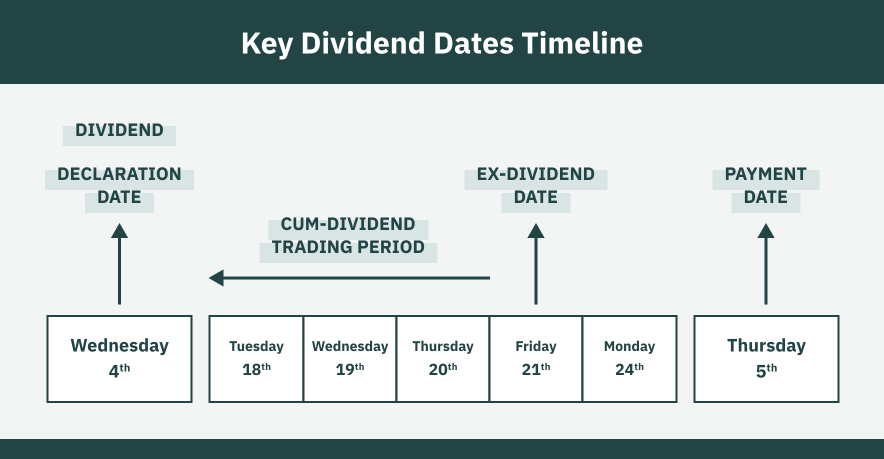
The process of paying dividends has a prescribed order, and knowing when the dividend period occurs determines when a buyer is entitled to receive the next payout. It starts with the declaration date, when a company’s board announces the dividend amount, record date, and payment date. Between that announcement and the ex-dividend date, dividend paying stocks are said to be trading cum dividend—meaning buyers during this period will still receive the announced payout.
The cum dividend period will close a day prior to the ex-dividend date. This is based on market settlement rules that trades have to settle in time before record date which is usually two business days after. The ex-dividend date will not be recorded as shareholder positions in time after it occurs and the next dividend will in turn become the property of the seller.
The company identifies which shareholders are entitled on the record date and shares are paid on the payment date. To traders, it is important to know the precise time when the cum dividend period begins and when it ends as it is important to time entry and exit particularly in dividend capture strategies where a failure to meet the cutoff by just one trading day leads to another waiting period till the cycle comes around. To long term investors, it just means that their investments will pay off as intended with regard to the current dividend policy.
Price Behavior of Cum Dividend Shares
The price of a stock that is traded cum dividend tends to take into account the amount of the dividend payment that is about to be made. The shares during the period are generally traded at a premium over the same value ex-dividend, most often nearly equal to the stated dividend, since the buyers of the stock are eligible to receive the dividend payment, a short-term intrinsic value, until ex-dividend date.
This relationship is not always exact. Broader market forces, sentiment, and investor expectations can cause deviations from the textbook adjustment, which is sometimes analyzed using valuation methods like the dividend discount model. The stock’s price is generally expected to fall by roughly the dividend amount when it becomes ex-dividend, reflecting the loss of eligibility for the payout.
Such a forecasted adjustment may present risks and opportunities to active traders. The strategies of dividend capture entail the purchase at the cum dividend period followed by the sale within a short time, in the hope that dividend will cover the price decrease. But after ex-dividend drops may be higher than the dividend itself in a poor market. Consequently, traders have to compare the possible payout with the chances of short-term volatility around the dividend dates.
Cum Dividend Opportunities for Day Traders
This is because among the day traders, the cum dividend period can cause short-lived price action which has the potential of providing instant profits. One such strategy is called a dividend capture strategy whereby an investor will buy dividend stocks in the cum dividend period and sell before the ex-dividend date. It is hoped that the dividend will help to cover or surpass any decline in price after the ex-dividend date.
It is optimal with highly liquid stocks having tight spreads and in and out of easier. The traders might consider cases when momentum or good news—such as recent rallies in both stocks and bonds on September Fed-cut expectations—might assist in supporting the prices following the ex-dividend adjustment. Timing is of the essence and time can be wasted once it has become eligible, which introduces unwarranted risk.

There are risks which are high. The ex-dividend fall can be greater than the dividend amount, especially in volatile markets or when the market mood turns negative—though the opposite can also happen, as seen recently when the Dow posted back-to-back strong gains and the S&P 500 closed at yet another record high. Profits may be eaten away by transaction costs, taxes, and spreads. Such an operation needs a good understanding of the dividend schedule and a strict methodology of position management, cost control, and protection against unfavorable movements.
Tax Considerations for Cum Dividend Purchases
Purchasing in the cum period assures the future payment, but it also involves tax implication. The dividends could be categorized as qualified or ordinary ones and this would define the rate of tax. Qualified dividends normally are taxed at lower rates of long-term capital gains, which in turn often requires a minimum holding period, depending on the jurisdiction.
Otherwise, i.e. when the holding period is not satisfied, the dividend is taxed as ordinary income, which may be at a higher rate, commonly in short-term trading. This may diminish the attractiveness of dividend capture transactions, particularly to active traders. The withholding taxes could also be imposed on the non-resident investors on the basis of the issuing country.
It is common after the ex-dividend date that the stock price will fall by approximately the dividend amount. Although the payout is taxable, selling at the reduced price may produce a realized loss, which in certain situations may counter gains in other areas–but only with careful record keeping.
Because tax treatment varies by jurisdiction and account type, such as taxable brokerage accounts versus tax-advantaged retirement accounts, traders—along with those pursuing long-term dividend growth strategies—should confirm their obligations before making cum dividend trades.
Risks and Misconceptions About Cum Dividend Trading
Many people have the misconception that purchasing shares before the ex-dividend date will gain them free money. As it turns out, most or all of the payout is normally offset by the fall in price of the share on the ex-dividend day to an amount equivalent to the dividend amount. Another type of profit tends to depend on the other conditions such as market momentum or good company news.
Another obstacle is transaction costs. To take advantage of dividends, it may be done frequently and this may lessen returns due to fees and bid-ask spreads. The taxes compound the effect-dividends, received as ordinary income because of their short holding periods, can dramatically reduce net gains, and the cost may exceed the payout itself.

There is also the increased risk because of market volatility around dividend dates. Prices can swing sharply due to investor positioning, unexpected news, or shifts in sector sentiment, and losses can sometimes exceed the dividend itself. Lower-liquidity shares, such as many small caps, can be even more unpredictable—something seen recently as smaller companies surged while several of the high-profile “Magnificent 7” names lost momentum in a broader market rotation. Many traders turn to credible investment newsletters to better understand these risks and adjust their strategies accordingly.
Ignoring the costs, taxes and volatility, traders might come to the realization that the cum dividend strategies are less profitable in the long run, or even unprofitable. It is necessary to take into consideration these aspects to avert the trappings of this seemingly simple yet misrepresented tactic and to manage it through a disciplined approach.
Tools and Resources to Identify Cum Dividend Stocks
Cum dividend stocks can be identified by traders in a number of ways. Most current brokerage websites offer real-time dividend details, including whether a stock is trading cum dividend and the next ex-dividend date. Many also provide filters or screeners for upcoming dividend events, which can be particularly useful for those employing a dividend capture strategy to target payout opportunities.
Financial news sites and market data suppliers publish dividend calendars showing declaration, record, and ex-dividend dates, clearly indicating when the cum dividend period begins and ends. Official announcements on corporate investor relations pages also confirm dividend details directly from the source.
Powerful screening options and alerts are available on advanced tools such as Bloomberg, Reuters, and Morningstar. Traders can monitor opportunities using automated notifications instead of constant manual searching. Many also turn to respected stock picking services to identify high-probability setups. Active traders can stay on top of payout dates through curated lists of upcoming cum dividend stocks in newsletters and subscription services that specialize in dividend investing.
The incorporation of brokerage data, public filings, calendars, and market news feeds can easily enable traders to discover dividend opportunities and trade more precisely.
Conclusion
Cum dividend is the time when a purchase of a stock gives the investor rights to its forthcoming payout that would determine the price dynamics and short-term possibilities. Knowledge of such a window enables traders to make strategies in accordance with market trends and the profit they may get.
The trading around the dates is risky–the price can decline, taxes and volatility can undermine or overwhelm the value of the dividend. It is necessary to analyze it carefully.
Combining the understanding of the dividend timeline and the power of the research tools, traders will be more efficient in detecting and fulfilling the opportunities. The alignment of profit potential and risk develops a disciplined process, whether the goal is to generate income, strategic positioning, or to take advantage of inefficiencies in the market.
Cum Dividend: FAQs
-
What Does Cum Dividend Mean in Trading?
Cum dividend In trading, cum dividend is the indication that the stock is traded where the owner has a right to getting the next dividend declared. When you buy shares during this time you will qualify to get the next payout, although they may be paid later.
-
How Long Does the Cum Dividend Period Last?
A cum dividend period begins at the day of declaration of dividend and ends one day before the ex-dividend day. After the stock becomes ex-dividend, the new purchasers do not become entitled to the declared dividend.
-
Can I Sell My Shares Before the Payment Date and Still Get the Dividend?
Yes. So as long as you hold the shares prior to the ex-dividend date and pass the requirements of the record date, you will get the dividend payment-even though you sell the shares prior to the payment date itself.
-
Is Buying Cum Dividend Shares Always Profitable?
No. You might get the dividend, but the stock will usually drop in price by roughly the dividend amount on the ex-dividend date. Any short-term gains can be eroded or outweighed by taxes, transaction costs, and market volatility—which can shift quickly, as seen recently when stocks soared and volatility disappeared.
-
Where Can I Check if a Stock Is Currently Cum Dividend?
This information is available in brokerage websites, websites that track dividends, investor relations websites of the company and market news websites. Whether a stock is in cum dividend or not is also evident as it is indicated using dividend calendars and corporate announcements.
All reviews, research, news and assessments of any kind on The Tokenist are compiled using a strict editorial review process by our editorial team. Neither our writers nor our editors receive direct compensation of any kind to publish information on tokenist.com. Our company, Tokenist Media LLC, is community supported and may receive a small commission when you purchase products or services through links on our website. Click here for a full list of our partners and an in-depth explanation on how we get paid.

 Back to