Investor’s Guide to Constructive Dividends


All reviews, research, news and assessments of any kind on The Tokenist are compiled using a strict editorial review process by our editorial team. Neither our writers nor our editors receive direct compensation of any kind to publish information on tokenist.com. Our company, Tokenist Media LLC, is community supported and may receive a small commission when you purchase products or services through links on our website. Click here for a full list of our partners and an in-depth explanation on how we get paid.
What happens if the IRS decides a payment you received from your company isn’t what you think it is?
That’s the issue with constructive dividends. These are benefits shareholders take from a business—like personal use of company property, overly generous salaries, or favorable loans—that aren’t declared as dividends but are taxed as if they were.
For traders who own shares in private companies or run their own corporate or LLC structure, knowing how constructive dividends work is critical. A simple misstep can turn into a taxable event and invite unwanted IRS attention.

- Constructive Dividend Defined
- Common Scenarios
- How the IRS Identifies Constructive Dividends
- Tax Treatment and Reporting Requirements
- Impact on Day Traders
- Risks and Penalties
- Preventing Issues
- Real-World Examples
- Conclusion
- FAQs
Defining a Constructive Dividend in Practical Term
A constructive dividend is an advantage or advantage a shareholder is entitled to that the IRS considers as a dividend, though it was not actually declared or recorded. Unlike a normal cash dividend which is a board-approved dividend and duly recorded, a constructive dividend is any benefit of value to a shareholder that is not a salary, loan repayment or other legitimate business expense.
The most important distinction is form and purpose. Declared dividends are open and recorded whereas constructive dividends are usually in the form of perks or personal use of company assets or transactions that are not made at market value. Taxwise, the IRS is interested in the substance of the transaction and not labels. A transaction that is mainly beneficial to a shareholder at a personal level as opposed to being beneficial to the company can be recharacterized into a dividend.

There are significant implications of such reclassification Constructive dividends are treated identically to declared dividends, and can often come as a shock to the shareholder- often in a closely-held company where there is a mixture of personal and business interest. They are also unintentional, thus, there are risks of incurring unexpected tax and penalties in case they are not identified and properly reported. Clear documentation and understanding of how personal benefits may be classified, can make it less likely that an IRS reclassification comes as a surprise.
Common Scenarios That Lead to Constructive Dividends
Constructional dividends are usually a result of general business practice that incidentally comes up with personal benefits to shareholders. One common one is a personal use of company assets- this can be a vehicle, real estate or equipment without paying fair market rent or usage fees. The IRS may view the non-business use of a shareholder as a dividend even though the property is owned by the corporation.
Another trigger is tacking too much executive compensation. Where an officer shareholder is paid or given bonuses that are vastly higher than the amount that is reasonable given his or her position, the IRS can consider the excess as a disguised profit distribution. This is particularly typical in closely held corporations where little control is given to the compensation, and it has made executive compensation an active area of legal expertise, with even recent moves such as Weil adding a Kirkland executive compensation partner in LA underscoring the focus.
There are also problems with shareholder loans especially when it is provided at an interest rate lower than the market or without stipulated terms of repayment. Where the repayment appears to be not likely, then the IRS can reclassify the loan as a constructive dividend. Similarly, any personal costs charged to company books, including travel, entertainment or home bills may have the same effect in that it is only the personal costs that do not have a specific business purpose.
The similarity in both situations is that there was a shift of value between corporation and shareholder without fair valuation, documentation, and justification. Even incidental or incidental benefits can become taxed as a dividend and cause surprise liabilities.
How the IRS Identifies Constructive Dividends
The IRS places more focus on the substance of a transaction rather than the label of a company when assessing the constructive dividends. Corporate records, including financial statements, expense reports, loan agreements and board minutes, are often the starting point of reviews, just as investors often rely on general measures like dividend stocks to gauge value. The agency seeks gains obtained by the shareholders that do not have a proper business rationale or documentation.
One of the major steps is the valuation of the benefit. The IRS identifies the amount a willing buyer would buy it off a willing seller in an arm-length transaction, the fair market value. The difference between that value and the amount payable by a shareholder can be regarded as a dividend should he pay below that value or nil. As an example, when a company owner is occupying a vacation property that the corporation owns, the benefit is quantifiable because of the market rental value forgone.
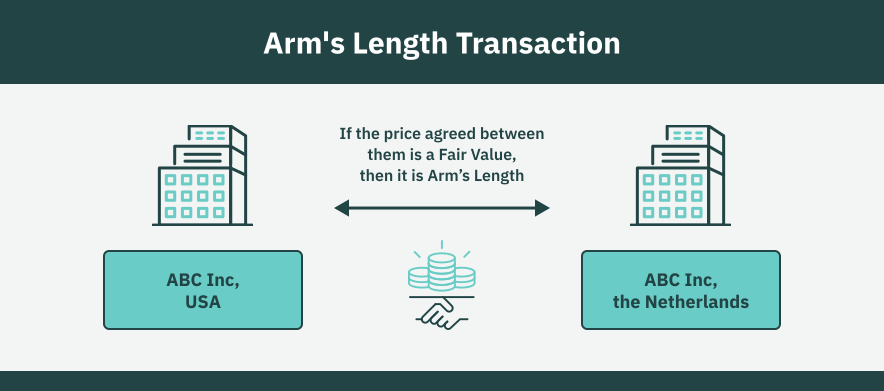
Comparisons of fair markets are used to inform much of the analysis. The compensation packages, the interest rates on loans and the rate of use of the assets are determined against what they would have accepted with normal conditions by unrelated parties. When the benefit is more than what would be reasonable in the open market, then this is a good sign of constructive dividend.
It is also the patterns of conduct that the IRS considers. Alternative distribution through personal use of company assets and other resources on a regular basis, below-market loans, and excessive compensation all indicate distributions characterized as something other than the stated dividends—resulting in reclassification and potential taxes, underscoring why disciplined approaches such as long-term dividend investing emphasize transparency and consistency.
Tax Treatment and Reporting Requirements
Constructive dividends are treated by the IRS as ordinary dividends although no cash is dispensed. Any value or benefit that has been recharacterized as a constructive dividend is taxable income in the year of receipt and this may be because of property use, excessive compensation, loan forgiveness, and other non-cash perks. To individuals, these amounts are typically reported as regular dividends on federal tax returns, and are treated and taxed the same as all other dividend income.
Proper reporting is therefore relevant in order to avoid sanctions or increased attention. Although the company may not add the benefit as a dividend, the shareholder has to add to his or her taxable incomes as soon as the benefit is identified. This necessitates the valuation of the benefit that has to be reliable in order to determine the fair market value of the benefit when received. Usage logs, contracts, or valuation reports are examples of supporting documentation that can be used to prove amounts reported are accurate and defensible in the event of a review.
A penalty of underpayment of taxes, interest on taxes not paid, and the potential of an audit can be caused by failure to report constructive dividends. By acknowledging that such benefits will be treated in the same manner as declared dividends and correctly reflecting such benefits on the tax returns, the shareholders will be in a position to comply with the obligations and reduce the risk of incurring extra liabilities.
Impact on Day Traders with Corporate Entities
Day traders who conduct as corporations or LLCs tend to focus on trading and tax planning but fail to consider how day-to-day financial choices can generate beneficial dividends. One of the most frequent errors is the personal consumption of the company money which can be the unrelated travel, individual subscriptions, or utility bills. Small charges or even occasional charges that lack a business purpose or even documentation can attract the attention of the IRS.

Another risk is personal use of assets of the company. Use of corporate equipment or office space, use of vehicles without reimbursement may be classified as value of that use as a dividend. The loans of the entity to shareholders are also a problem when they are not agreed, repayment schedules and market rate interest. The IRS may recharacterize the loan as a constructive dividend in the event repayment does not seem to occur.
These issues can be prevented in the most reasonable way by maintaining separation between business and personal finances. Traders ought to have transparent accounts, compensate market value when using the company resources personally and deal with the shareholders at arm length. The presence of a tax professional will help detect such risky practices at an early stage, retain corporate integrity and prevent expensive reclassification, releasing traders to pursue reliable dividend stocks and other opportunities.
Risks and Penalties for Misclassification
The inability to identify and declare constructive dividends can cause big problems to the shareholders. The first effect is the penalties of underpayment of tax. Since constructive dividends are tax-payable in the year of receipt, failure to report them on a return can subject them to penalties and interest charges on unpaid balances—costs that can rapidly escalate when misclassification covers multiple years, especially when investors are also comparing after-tax outcomes with more straightforward measures like dividend yields.
The other risk is that of prompting an IRS audit. Constructive dividends have a tendency to occur when closely held corporations are audited because there may be intermingling of personal and business use. After being flagged the IRS can extend the audit to previous years and other related activities and raise the price of resolution as well as questioning of corporate procedures.
Reclassification of business deduction may also be occasioned by misclassified transactions. The IRS may deny the expenses that are claimed as business-related but it is proved that such expenses are received by shareholders personally. This increases the level of taxable income to the company, and it may result in a two-fold tax impact-once to the corporation in the loss of the deduction and once more to the shareholder in the receipt of a taxable dividend.
The dangers of failing to follow constructive dividends provisions go far beyond a one year tax period. Seeking help at the initial stages prevents the agglomeration of liabilities and protects the company and the shareholder against the financial harm in the long run, just as investors often rely on reliable services for choosing stocks to avoid costly mistakes and guide long-term decisions.
Preventing Constructive Dividend Issues
Adequate records of all transactions between a corporation and its shareholders is the best defense against constructive dividend issues. Evidence must be documented in terms of invoices, receipts, agreements, and reasons why each of the expenses or transfer of value is made in the context of the business. Such a paper trail is used to make valid inferences and provides evidence to the IRS that the company works in a transparent manner.
All transactions with shareholders must be on an arms-length basis as if to be between unconnected parties. With the IRS tightening oversight, and in light of new transfer pricing scrutiny requiring transactional resilience announced recently, this implies putting in place reasonable wages, market rent on the use of property, and the use of standard rates of interest on loans. This kind of practice proves that benefits are not disguised distributions, rather they are ordinary business transactions.
It is also necessary to value benefits at rates that are fair on the market. In the case of company-owned property or asset sales, or even services, the price at which an independent party might pay or charge will minimize the IRS chance of reclassification. Strong support can be given by independent appraisals or by market comparisons.
Lastly, a review by a tax expert who is conversant with corporate and shareholder tax regulations provides an additional check. Assessments of transactions and policies can raise red flags that are before they become expensive problems. By combining the best recordkeeping, fair market valuations, arm-length practices and professional advice, corporations and shareholders can reduce the likelihood of constructive dividends and the financial impact of the constructive dividends.
Real-World Examples of Constructive Dividend Cases
An example of such a situation was a mortgage services company where the shareholders had charged personal expenses to the company without any proper records or justifications including home repairs and usage of vehicles. Following an IRS audit, these fringe benefits were classified as constructive dividends and thus shareholders had to pay more taxes and penalty in case of any misreporting, showing how even seemingly simple benefits can create unexpected tax consequences compared with deliberate approaches like a dividend capture strategy.
In a different case, shareholders of a close business corporation made extravagant travel expenses, family functions and other personal expenses using corporate credit cards. The IRS ruled that these benefits were disguised compensation or dividends as opposed to business expenses; the reclassification caused deductions not to be allowed to the company and adjustments of the shareholders on the income taxes.

Another example is excessive management fees. A company was paying big amounts to shareholder-controlled organizations with no documentation or arm’s-length conditions. IRS and the courts decided that the payments were not legitimate compensation, but were disguised distributions of profits. This led to disallowing deductions by the corporation and taxable dividends by the shareholders, a problem mirrored in recent cases where regulators fined firms such as TZP over excess fees.
These cases highlight one of the most important principles, that is, the IRS is substance-based rather than label-based. Personal perks, unreported loans and excessive remuneration are all likely to be treated as constructive dividends. Proper documentation, proper valuation and justification of business are the key to prevent reclassification at a high cost, much like valuation models such as the dividend discount model depend on accurate assumptions to avoid distorted results.
Conclusion
The knowledge of constructive dividends is very important to the shareholders, particularly in the closely held corporations or trading entities. Though they may not be officially reported, the IRS may count the benefits as taxable income resulting in surprise liabilities, missed deductions, and fines.
The level of risk can be mitigated by maintaining good records, the arm-length transaction, and putting benefits at fair market value by the shareholders. Tax advice from the professionals provides an additional form of protection as the issues are identified early enough before they can get out of hand.
Prevention is, at its most fundamental, a matter of openness and disentangling self-interest and corporate assets. Investors that abide by these rules safeguard profits, reduce their exposure to taxes, and uphold the authenticity of their activities—leaving them free to concentrate on expanding, pursuing strategic dividend investing, rather than time-consuming battles.
Constructive Dividend: FAQs
-
What Is the Difference Between a Constructive Dividend and a Regular Dividend?
A regular dividend is officially announced by the board and appears in corporate books and is executed in stock or cash, often tracked by investors through dependable investment newsletters. Constructive dividend does not get declared and instead is created due to personal benefits such as use of company assets or overly generous compensation that the IRS re-characterizes as a dividend.
-
Can a Loan From My Company Be Considered a Constructive Dividend?
Yes. Un-documented loans repayable neither by a certain term nor at market interest rates can be construed as disguised profit distributions. The IRS can reclassify them as dividends in case repayment appears not to be unlikely or in case of non-arm-length terms.
-
How Does the IRS Determine the Value of a Constructive Dividend?
At fair market value, that which a non-related buyer and seller would predetermine. Take, as an example, personal use of company property which is assessed at its fair rental rate. This figure is usually determined by means of appraisals or market comparisons.
-
Are Constructive Dividends Taxed the Same as Cash Dividends?
Yes. They are treated as ordinary dividends and taxed accordingly in the year of receipt at the same rates and reporting requirements and must be reported on the shareholders return.
-
How Can I Avoid Creating a Constructive Dividend by Accident?
Put a distance between personal and company finances. Report all transactions, make sure that they are at fair market value and establish a business purpose. The frequent tax review can allow detecting the risk and correcting it in time.
All reviews, research, news and assessments of any kind on The Tokenist are compiled using a strict editorial review process by our editorial team. Neither our writers nor our editors receive direct compensation of any kind to publish information on tokenist.com. Our company, Tokenist Media LLC, is community supported and may receive a small commission when you purchase products or services through links on our website. Click here for a full list of our partners and an in-depth explanation on how we get paid.

 Back to