Complete Beginner’s Guide to Cash Dividends


All reviews, research, news and assessments of any kind on The Tokenist are compiled using a strict editorial review process by our editorial team. Neither our writers nor our editors receive direct compensation of any kind to publish information on tokenist.com. Our company, Tokenist Media LLC, is community supported and may receive a small commission when you purchase products or services through links on our website. Click here for a full list of our partners and an in-depth explanation on how we get paid.
Want to know how cash dividends can boost your returns?
Cash dividends are straightforward payments companies make to shareholders, giving you a portion of their profits in cash. You can reinvest them, take them as income, or use them to manage portfolio cash flow. They often signal a company’s financial strength and management’s commitment to rewarding investors.
For long-term investors, they provide steady income for retirement or income-focused portfolios. Short-term traders track dividend schedules to capture quick gains or avoid tax impacts. Understanding them can lead to better, more profitable decisions.

- Cash Dividends Explained
- Cash Dividend Payout Mechanics
- Effect on Stock Prices
- Tax Considerations
- Cash Dividends and Day Trading Strategies
- Benefits
- Risks and Limitations
- Screening for Reliable Dividend Payers
- Conclusion
- FAQs
Cash Dividends Explained Simply
A cash dividend is when a company makes a payment of its net profits to shareholders who are paid directly in their brokerage accounts. It reflects income the company decides to give out as opposed to reinvesting it. The majority of dividend-paying public companies have a fixed pattern; most of them pay quarterly, others pay monthly, semi-annually or annually.

Cash dividends allow the companies to reward shareholders, communicate financial power and demonstrate the continuous profitability. They offer an assured investment income to income-oriented investors that may be plowed back or utilized as personal cash flow. The timing and level is set by the boards of directors and may vary depending on the performance of the business, economic situation or strategic requirements.
Cash dividends contrast with stock dividends, which pay new shares rather than money, and special dividends which are single payouts usually linked to extraordinary income, sales of assets or changes. Unlike special dividends, regular cash dividends are part of the ongoing expectations and are at the core of long-term income or retirement plans.
Either to receive constant revenue or to keep an eye on the yield to form a part of a bigger strategy, comprehending cash dividends is an important aspect of judging the viability and desirability of dividend-paying shares.
The Mechanics of a Cash Dividend Payout
The procedure of getting a cash dividend is a planned timeline that has some key dates. The first is the declaration date, which is the day in which the board of directors of a company declares the dividend. This notice spells out the amount, the record date and the payment date. At that stage, the market can begin to price the dividend and this can affect trading in the short term.
The important indication is the ex-dividend date. It is normally a day before the record date and this is a business day. An investor should possess the stock prior to the ex-dividend date in order to qualify. Purchasing it on or after that date will not guarantee the payout, although the stock price can fall temporarily by about the amount of the dividend.
The record date establishes who is officially on the company’s books to receive the dividend. Due to the T+2 settlement rule, trades settle two business days after the trade date, so buying before the ex-dividend date ensures inclusion by the record date—a process that may shift as markets move toward T+1 settlement, making it important to prepare for upcoming changes.

Lastly, the dividend is actually paid out at some point in the future (usually a few weeks later) on the payment date. On this day, the cash appears in the brokerage accounts of qualified shareholders in their brokerage accounts. This sequence is critical to traders who want to take advantage of the movements related to dividends and long term investors who want to schedule their income stream.
How Cash Dividends Affect Stock Prices
In paying out a cash dividend, the stock price of a firm tends to correct itself to reflect the dividend. The price usually falls by an amount close to the dividend on the ex-dividend date, the first day on which a new owner does not receive the dividend. This is the decrease in the assets of the company after the allocation of the money to the shareholders which slightly decreases the value of the share.
This movement may be an opportunity and a risk to traders. Others purchase prior to the ex-dividend date so that they receive the dividend and sell shortly thereafter; however, the expected decline in price will usually negate the advantage, particularly when taxes and trade expenses are taken into consideration.
The important thing is timing. A late purchase fails to get the dividend, and a premature sale may entail accepting the price fall but not getting the payout. It is also possible to fall in an unforeseen plunge in the absence of proper planning on the part of the traders.
The simplest form of dividend capture (buying the stock just before the ex-dividend date and selling immediately afterwards) may work but is by no means guaranteed. The general adjustment can easily be surpassed by market conditions, sentiment and volatility. The understanding of the impact of dividends on pricing enables traders and long-term investors to make an informed and better decision with regard to the entry and exit of the transaction.
Tax Considerations for Dividend Recipients
A cash dividend looks simple, but it is classified in different ways as it is taxed differently. The IRS divides them into qualified and ordinary (non-qualified) dividends. The rates used to tax the qualified dividends are the rates of the long term capital gains, 0%, 15%, or 20% depending on the income. Non-qualified (ordinary) dividends are taxed at ordinary income rates which may be a lot more.
It should be paid by a U.S. corporation or other qualified foreign entity and the investor must hold it a certain amount of time (generally more than 60 days within a 121-day period that begins on an ex-dividend date). This regulation usually does not cover short-term traders, who have their fast turnover and could not take the benefit of the lower rate.
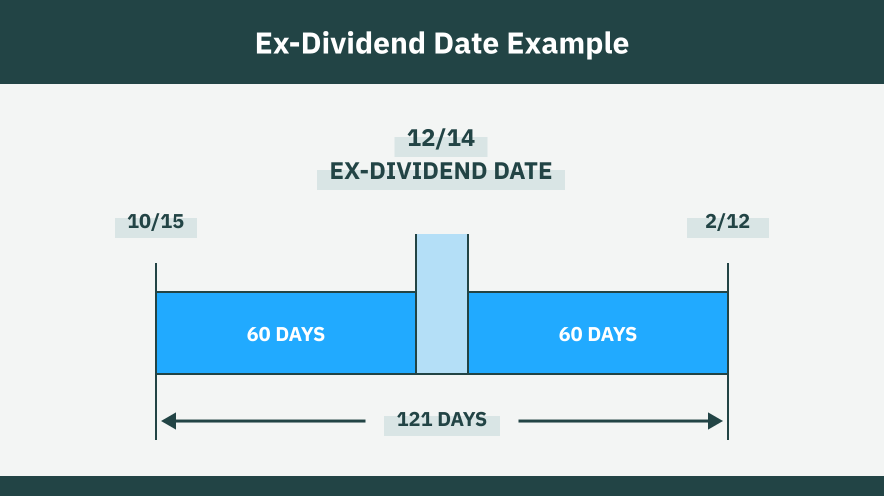
The difference can have a large impact on the net returns of traders in taxable accounts. The shorter the holding period, the greater the rate of tax that may be levied on even large payouts, and timing can be critical both in relation to price change, but also in relation to tax efficiency.
Dividend-paying stocks can be more attractive to long-term investors because in tax-favored retirement accounts, such as IRAs or Roth IRAs the dividends can compound tax-deferred or tax-free. Knowing the rules of dividend taxes is not just a filing consideration, it is part of the quest to maximize total returns of dividend paying investments.
Cash Dividends and Day Trading Strategies
Day traders also like to keep track of dividend announcements, though it is not because they want to receive the dividends, but can trade around the price action caused by the dividend. The most important factor is the ex-dividend date, because the prices of the stock tend to decrease by an approximate amount of the dividend. Others get in before this date in order to ride a pre-dividend run-up, or seek to find fast reversals when the price has adjusted and volume has exploded.
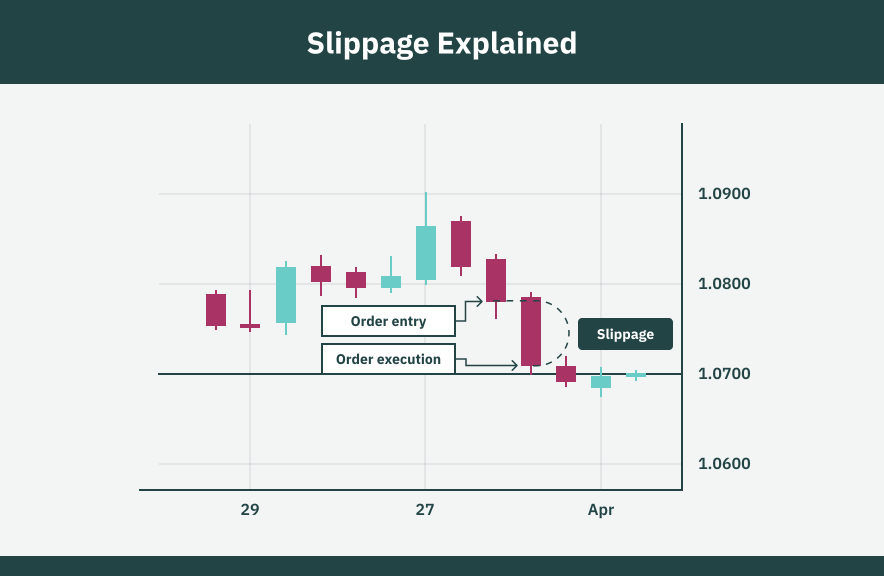
This has the potential to open up short term opportunities but at the cost of risks. There are risks that prices can become volatile on the schedule of dividend payments particularly in circumstances where the dividend appears unusually high, unsustainable or in connection to other news. Slippage, reduced liquidity and impulsive changes in sentiments can easily eradicate profits. Poor timing may also contribute to retailers remaining in a position longer than intended and to being excessively exposed in the market.
There is a complexity to the tax treatment. Catching a dividend without satisfying the qualified holding period results in it being taxed at ordinary income rates and can eat into profits in upper brackets. Any payout can also diminish capital gains potential in the case that the stock declines after the ex-dividend date and does not rise back.
Trades based on dividends do not only need good timing, but also an insight into the mechanics of dividends, price correction, and tax consequences. Otherwise, it is easy to imagine that such a trade will be profitable, but end up in a very expensive mistake.
Benefits of Earning Cash Dividends
Cash dividends bring direct and tangible benefit to shareholders, providing an immediate reward without selling the stock. Unlike capital gains, which are not realized until a position is closed, dividends give investors cash in hand—an advantage that is particularly important in dividend investing for income-oriented investors, retirees, and those managing cash flow in volatile markets.
To traders, the receipt of dividends can be used to cover losses or a regular source of funding to reinvest capital. Reinvestment may be compounded, either by the investor, or by using a dividend reinvestment plan (DRIP), thus steadily compounding returns over time even in stagnant markets, and gradually building position sizes without the need to add new outside capital.
There is even a psychological advantage. The regular payouts may serve as a shock absorber in case of turbulence and will strengthen the profitability and shareholder commitment within the company. It is this consistent cash flow that can be reassuring when markets are experiencing a market drawdown and may serve to maintain discipline in those who are inclined to overtrade or to trade based on short-term market moves.
Also, dividends are practically flexible. They may be saved to buy more dividend stocks or it may be utilized in payment of tax or it may even be saved as a reserve against leaner times. Such predictability, reinvestment ability and financial flexibility show that cash dividends are part of long-term wealth-building strategies, as well as active trading strategies.
Risks and Limitations of Cash Dividends
Although cash dividends yield good income, they come with risks investors and traders must recognize. The threat of a dividend cut is one of the most important. Firms with declining revenue or rising expenses may reduce or suspend payouts to conserve cash, which can trigger sharp stock price drops and negative earnings surprises—as seen when Whirlpool was downgraded at Bank of America after poor results and a dividend cut.
The other risk is the pursuit of high returns without checking financial health. Excessively high dividends may be an indication of trouble. When earnings are insufficient to cover the payout, a company can go into debt, tap reserves, or ultimately cut the dividend, making what appears to be a great deal an expensive trap.
The other red flag is unsustainable payout ratios. When most or all profits are distributed, little remains to reinvest, repay debt, or absorb economic shocks—a concern even in periods of apparent strength, as the biggest bright spot in the Trump economy is still viewed by some as a red flag. This may please shareholders in the short term but can undermine long-term growth and stability.
The trick is to not just look at the yield. Dividends should be supported by reliable earnings, strong cash flow, and sensible management. Relying on payouts from financially shaky companies or from sectors subject to severe cyclical swings can do more harm than good. Dividend investing requires careful research and ongoing evaluation, whether through independent analysis or reputable investment newsletters that help identify sustainable opportunities.
Screening for Reliable Dividend Payers
The first step to finding dependable dividend payers is using effective stock screening tools and applying thorough financial health analysis. Most online brokerage systems and financial sites provide screeners to find companies according to yield, payout ratio, dividend growth history, and other measures of stability—a useful way to narrow the list to those most likely to provide steady income.
Payout ratio is a vital indicator, and it demonstrates how much of the company income is directed at dividends. The 30 to 60 percent range usually implies a sustainable payout that can increase but 80 percent and higher may become dangerous in case earnings drop.

Past dividend history also matters. Companies that have grown and paid dividends for many years can be termed Dividend Aristocrats or Dividend Achievers, often signaling strong finances and shareholder commitment. These are common in established industries such as consumer staples, utilities, and healthcare, where consistent cash flow and resilience are typical—even as struggling U.S. healthcare stocks endure a rough 2025 but attract some bargain hunters.
The nature of the sectors also counts. Industries such as energy or real estate can yield high but are more vulnerable to fluctuations in commodity prices or interest rates, a topic back in focus as questions emerge over why the Bank of England has cut rates. This is especially relevant as U.S. energy exporters face the likelihood of disappointment in any U.S.-India trade deal, adding another layer of uncertainty for dividend stability. Together with financial trends and industry data, screeners and financial ratios can help investors build a list of solid dividend payers that fit their income needs and risk tolerance.
Conclusion
Income investing is established on the basis of cash dividends which reward the investor in a practical manner and provide cash flows that are consistent. Be it long-term income or short-term trading opportunities, it is important to study how they work.
Dividends can be a sign of financial strength however not every dividend can be dependable. Essential ratios are the assessment of payout ratios, fundamentals, and history of payouts to prevent unreliable yields.
When chosen and timed well, cash dividends can be useful in terms of portfolio stability, reinvestment possibility, and even psychological comfort, making passive income a viable asset in any market. For income investors, selectively targeting undervalued dividend stocks can further enhance returns while building long-term wealth.
Cash Dividends: FAQs
-
How Often Are Cash Dividends Paid?
The cash dividends are also given on a quarterly basis, meaning shareholders are paid every three months. However, some companies pay monthly, semi-annually, or annually depending on their policies and cash flow. This predictable schedule—often announced well in advance in investor relations—can be an important factor for those following a dividend growth–focused investing approach.
-
Do I Need To Hold the Stock on the Ex-Dividend Date To Get the Dividend?
This is true, to get a cash dividend, you must own the stock before the ex-dividend date. If you buy the stock on or after the ex-dividend date, you will not get the next dividend. The shareholders to be paid should be the ones listed on the company’s books as of the end of the previous business day.
-
Are Cash Dividends Always Taxable?
Yes, cash dividends are taxable income, in most cases. Dividends can be qualified and thus be treated favorably and taxed at the long-term capital gains rate or non-qualified (ordinary) dividends can be taxed at the normal income tax rate. Tax liabilities are based on the level of income earned by the investor and the type of account held, e.g., taxable brokerage or tax-advantaged accounts.
-
Can Day Traders Benefit From Cash Dividend Payments?
One possible benefit for day traders is timing trades with the ex-dividend date or dividend announcement. Nonetheless, this strategy is risky, and it may entail abrupt changes in prices and taxes. Dividend capture strategies can only be profited upon when there is enough knowledge of spreads, market timing, and short term volatility.
-
What Happens to the Stock Price After a Cash Dividend Is Paid?
A stock usually decreases in price by the value of the dividend being paid on the ex-dividend date, reflecting that new buyers no longer have the right to the payout. Although this price decline is generally short-lived, it may affect trading strategy and short-term positioning, and it also ties into valuation approaches like the dividend discount model, which factors expected dividends into a stock’s intrinsic value.
All reviews, research, news and assessments of any kind on The Tokenist are compiled using a strict editorial review process by our editorial team. Neither our writers nor our editors receive direct compensation of any kind to publish information on tokenist.com. Our company, Tokenist Media LLC, is community supported and may receive a small commission when you purchase products or services through links on our website. Click here for a full list of our partners and an in-depth explanation on how we get paid.

 Back to