Understanding the Bird in the Hand Theory


All reviews, research, news and assessments of any kind on The Tokenist are compiled using a strict editorial review process by our editorial team. Neither our writers nor our editors receive direct compensation of any kind to publish information on tokenist.com. Our company, Tokenist Media LLC, is community supported and may receive a small commission when you purchase products or services through links on our website. Click here for a full list of our partners and an in-depth explanation on how we get paid.
Why do many investors prefer receiving an ongoing dividend check compared to waiting for a stock to appreciate in price?
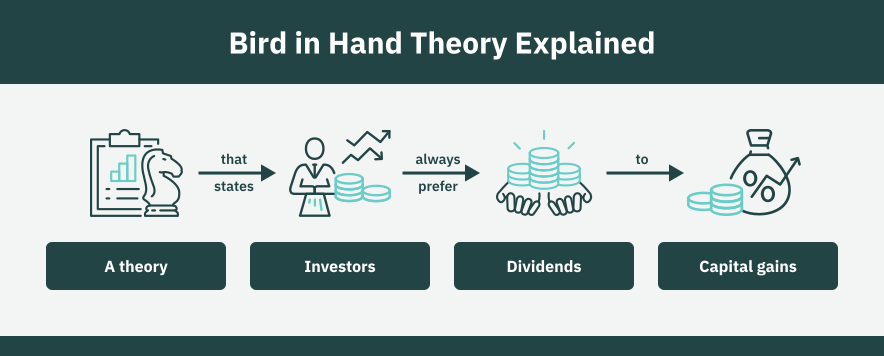
The bird-in-hand theory states that investors prefer cash flows now rather than uncertain future gains that are only dependent on the appreciation of the stock price. Dividends provide that cash return with no speculation about market conditions, while price growth relies on human and market behavior which can never be predicted. If your focus is on income, dividends and consistent payers are generally more suitable than growth companies or firms expected to deliver returns only through price appreciation.
This approach is important to understand because it shows how much of an investor’s portfolio can be built around dividends, which are actual and fairly certain and based on real returns rather than probable future profits.

- Bird in Hand Theory Defined
- The Origins and Key Thinkers
- Dividends as a Reduction of Risk
- Bird in Hand vs. Dividend Irrelevance Theory
- Benefits
- Criticism and Limitations
- Practical Implications
- Real-World Application
- Conclusion
- FAQs
Defining the Bird in Hand Theory
The bird-in-hand theory states that an investor will place a greater value on dividends than they would to the expectation that the stock would appreciate in price simply because a dividend is certain and represents a low risk form of return. The phrase is a play on the saying that “a bird in the hand is worth two in the bush” and means a sure thing is better than a possible but not certain thing. In the world of investments, the “bird” is the actual dividend (an immediate and tangible return) and the “two in the bush” is the financial appreciation of the price in the future.
Companies that consistently pay dividends create a sense of comfort for shareholders because they know they can rely on those payments. The importance of dividends grows as an investor leans toward income while waiting for possible price appreciation, a preference that has been especially visible during the recent global selloff driven by concerns over stretched AI valuations ahead of Nvidia earnings. The theory is that steady dividends reduce perceived risk, so when dividends are paid, investors see the company as financially healthy and view its future earnings with more confidence.
The theory seeks to emphasize satisfaction from steady payouts rather than reliance on speculative growth. It has shaped investor thinking and continues to influence dividend and portfolio preferences, especially for those who want dependable earnings from firms instead of taking on the uncertainty of broader stock market performance, which has been underscored lately by companies such as a major home improvement retailer projecting a sharper profit decline as customers postpone large projects.
The Origins and Key Thinkers
The bird-in-hand theory originated in the middle of the twentieth century when the question of dividend policy was a subject of conversation in the corporate finance world. Economists Myron Gordon and John Lintner created the theory as a rebuttal to the belief that dividends did not matter at all in determining a company’s value. They theorized that investors were willing to discount higher valuations for the company due to the certainty of the payouts and the immediate returns the payouts would provide. They believed that dividends are a far more dependable measure of value over capital gains (which rely solely on unpredictable third-party market participants and future management decisions).
Gordon and Lintner developed their theory directly in response to dividend irrelevance theory based on research by Franco Modigliani. They argued that dividends provide assurance in a volatile market, a point that has become more noticeable as shaken tech names have added to recent swings, and this stability is especially appealing to investors with very low risk appetites.
While the bird-in-hand theory of dividends cannot be applied everywhere it has become a foundation for discussion of dividend policy. The idea of investor psychology and the attractiveness of consistent cash flow still informs academic work and real decision making. Furthermore, Gordon and
Lintner’s notion of the preference for a known dividend over an uncertain future return plays an integral role in the notion of valuation based on dividends.
Dividends as a Reduction of Risk
Dividends lower risk since they offer a concrete and steady return to the investor outside of a volatile market. A portion of the investment is converted to real value rather than remaining in future price appreciation when a company pays cash dividends directly to the shareholders. The dividend payment provides security and confidence, especially when the market is volatile, share prices rise and fall and unrealized gains can evaporate quickly. For many investors, dividends offer not just income but proof the investment is generating a real return year over year.
Dividends also buffer the risk of equity. No matter whether the price stagnates or goes down, consistent cash payout provides a sort of a cushion from loss. Furthermore, when dividends are reinvested, they can start to compound over time, growing the total gain and decreasing the reliance on market timing. For retirees and those that rely on income, dividends can serve as a helpful source of cashflow such that they can hold off on selling shares when the market is in a downturn, thus preserving long term capital.
Psychologically, reliable dividends provide comfort when prices are erratic because investors know there is still the possibility of receiving dividends. This is a reliable benefit compared with capital gains, which are less reliable. As a result, many define dividends not as additional income, but as a key characteristic of a lower risk strategy carried out to balance income and preservation.
Bird in Hand vs. Dividend Irrelevance Theory
The bird-in-hand theory developed by Gordon and Lintner and dividend irrelevance theorem created by Modigliani and Miller are opposing ideas about the role dividends play in company value. Gordon and Lintner’s bird-in-hand theory states that investors prefer and value today’s certain dividends more than future gains in portfolio value. That consistency of dividend capital also helps reduce that risk, giving certainty in many cases the benefit of increasing valuations of dividend paying companies. Dividends are the proof of the pudding that the company has earned profits and is committed to paying them to its shareholders.

Modigliani and Miller’s dividend irrelevance theorem simply states that dividend policy does not matter in a perfectly efficient market. They argue that investors can create “homemade dividends” by selling their shares for cash, eliminating the need for a corporation to issue a payout. What matters, they believe, are the company’s investment decisions and profits; the payout is irrelevant.
And actually, markets are not perfect, and uncertainty is a huge driver of investor action. Many investors prefer the bird-in-hand theory, and dividends provide assurance and stability during market disruption. This is especially true for income oriented investors who need stable dividends, because dividends provide the assurance of payoff, and not relying on selling shares when prices lower.
While the irrelevance theory makes academic sense if one uses very narrow assumptions, the bird-in-hand perspective is more realistic, it is aligned with people’s clear preference for assurance over speculation in their everyday lives.
Benefits of the Bird in Hand Mentality
One of the great advantages of the bird-in-hand mentality is that it provides an assurance to the investor who is looking for a predictable source of income. Receiving regular income from dividends means that the shareholder is not held hostage to the value of their stock and its price fluctuations. This is even more important for income focused investors and asset holders or retirees that rely upon steady income from dividends and have to worry less about valuing their held assets and having to sell them to pay their bills when markets are down.
Dividends also create a situation that does not require the investor to speculate about the future value of the stock increasing. Dividends provide tangible, reliable returns and do not require waiting for the stock to appreciate or rely on market volatility or management’s perceived value long term outlook to reward them. Investors tend to feel financially assured as the guarantee in returns provides peace of mind.
The bird-in-hand approach makes it clear for investors to have clear expectations for returns. With a stable dividend policy, forward-looking investors gauge the future behavior of cash flows and structure their portfolios based on reliable income. Additionally, dividend paying companies are often and generally more interesting for investors than a growth company who does not pay dividends or provide instant value.
The bird-in-hand mentality – focusing on dividends as the majority of the total return – is well aligned with many investors who are more concerned with certainty, stability and transparency rather than market speculation. For many of these reasons it stands as a fundamental reality in dividend based investing and is justified in approaches to provide long term and reliable income.
Criticism and Limitations
Though the bird-in-hand theory is appealing to income-seeking investors, it does have criticism that must be addressed. The most significant objection is that it does not consider retaining profits for reinvestment purposes. Firms that do not return earnings, but retain their earnings for expansion, innovation, or acquisition, may create more long-term value than firms that pay out high dividends. In emphasizing a mediocre present value, it could lead investors to undervalue growth-oriented firms that are focused on reinvesting back into the business.
Another limitation has to do with tax efficiency. In many markets, dividends are taxed as ordinary income at rates considerably higher than capital gains, and thus provide a lower after-tax return for payout-favoring investors. In addition to taxes, the theory assumes that in all cases dividends are a better alternative than retained earnings or appreciation of capital.
The theory assumes that dividends reduce risk, but not all payouts are sustainable. A company that becomes over leveraged and then must reduce its dividend, as seen recently when a major miner reported a steep loss and trimmed its payout during restructuring, can face serious strain and introduce even more risk for investors. Proponents of the dividend irrelevance theory argue that only continued profitability and sound investment choices matter, regardless of whether profits are distributed or retained. These critiques show that while the bird-in-hand theory offers insight into investor psychology and the desire for certainty, it is only one part of the broader debate over the role of dividends in long term value creation.
Practical Implications for Event Investors
Investors using the bird-in-hand theory have a clear way to screen for dividend stocks or to build balanced portfolios based on predictable dividend income rather than uncertain future gains. This makes the theory a better fit for firms with steady, consistent dividends. Dividend investing can also reduce exposure to market swings, which have resurfaced and caused discomfort for many, especially as some investors lean on trusted stock recommendation providers to help judge the stability of payouts and cash flow. This is critical for retirees and others who rely on dividends for regular income.
These factors suggest, when investing with this framework in mind, investors are likely using a cautious approach to sustainability of dividends over expectations of growth. Corporations with good balance sheets, average earnings along with reasonable payout ratios are good candidates for this strategy. Producing firms return profits to investors through dividends which reduces the uncertainty of the compression of the payout itself, along with compounding the dividend through reinvestment, but leave corporations with retained earnings and no perceived growth potential less attractive.
In application, using this framework tends to result in increased exposure to dividend paying sectors such as utilities, consumer staples and financials where dividends are relatively constant which may limit the participation story of capital appreciation in sectors with more volatility. The benefit is safety, and exposure if the returns remain more predictable and limited risk of loss to principal. For individuals who value steady income and reduced volatility, the bird-in-hand framework should be a guiding principle and successful strategy for producing durable income-oriented portfolios.
Real-World Applicability in Modern Markets
In today’s market, the bird-in-hand theory remains relevant, even during periods of uncertainty. Economic volatility, shifting interest rates, and geopolitical tensions make future appreciation harder to predict. Recent market pressure, as stocks continue to slide amid concerns about AI and rising rates, has only strengthened the appeal of dependable payouts. Many investors turn to dividend paying equities as a defensive alternative when certainty becomes difficult to find. In the end, dividends provide steady cash returns that hold their value over time, reinforcing the idea that immediate income helps reduce the overall risk of an investment.

For income oriented investors, the theory makes the case for a sustainable strategy that produces steady streams of dividends. Retirees and other income focused investors often choose dividend payers so they do not need to sell shares to maintain a reliable flow of revenue, particularly when interest rate expectations shift again as policymakers debate the possibility of a rate cut later in the year. This frames dividends as a core element of long term financial stability and independence across all phases of the market.
To sustain credibility beyond the immediate relief that dividends provide, reinvesting dividends supports long term compounding, adding another layer of growth while helping investors move through periods of market volatility, which have been heightened lately as Treasury moves and rising uncertainty ahead of jobs numbers have stirred more anxiety. The bird-in-hand approach continues to influence how investors view dividend paying companies, regardless of new valuation models or shifting theories. Its lasting relevance comes from its blend of reassurance and tangible financial benefit, giving investors a steady way to navigate volatility and preserve wealth.
Conclusion
The bird-in-hand theory draws attention to a persistent truth, however, in dividend investing: certainty outweighs possibility. Acceptance of dividends now, rather than the possible appreciation of future investments, moves investors toward an investment that is safer and tangible and nothing is better than cash in your pocket. This idea has infiltrated both the literature of academics and discussions of practice: your enjoyment of dividends continues to be in the center of debates about dividends.
Even with its controversial nature, the approach will be a powerful belief of those investors whose qualifying criteria for an investment is based solely on income, and profitable returns based on net cash flow and low market risk. It focuses on continued belief in comfort and habits of financial security for investors who view dividends as a target investment, even in growth oriented markets.
In summary, the bird-in-hand theory is an idea or philosophy that juxtaposes risk vs reward and for those who look to preserve income or build long-term, it is a solid rule to follow as investors are reminded that dividends (the reliable ones) can certainly be part of a dependable investment method.
Bird in The Hand Theory: FAQs
-
What Does the Bird-In-Hand Theory Suggest About the Behavior of Investors?
The bird-in-hand theory suggests that investors want the certain benefit of dividends now vs. the uncertain benefit of future market appreciation. Getting an immediate tangible dividend benefit can reduce risk and reassure an investor during volatile market movements.
-
How Does This Approach Differ From Dividend Irrelevance Theory?
The dividend irrelevance theory of Modigliani and Miller states that dividend policy cannot have an effect on value because an investor could sell shares and receive cash income. The bird-in-hand theory of Gordon and Lintner suggests the dividend is important. An investor wants the right to receive cash payouts (always assured) compared to a future appreciation of market value.
-
Why Do Some Investors Prefer Dividends vs. Capital Gains?
Dividends can provide a better experience of income regardless of volatile stock prices. Dividend paying investments can help sustain a profitable return with less pressure of selling shares in a down market. This can be helpful to retirees and investors who focus on income and stable returns.
-
What Are the Criticisms of the Bird-In-Hand Theory?
Critics suggest that the bird-in-hand theory ignores reinvested earnings that build growth, long term, and financial value. It also ignores the negative features of dividend taxation, and assumes the payout will always be sustained (not always the case).
-
Is the Bird-In-Hand Theory Still Relevant in Today’s Dividend Investing?
Yes, the bird-in-hand theory is influential, particularly in unpredictable markets when investors place value on stability. While there are many research models available, its focus on steady income and lower risk continues to resonate with income investors, especially those who rely on consistent dividend investing as part of their strategy.
All reviews, research, news and assessments of any kind on The Tokenist are compiled using a strict editorial review process by our editorial team. Neither our writers nor our editors receive direct compensation of any kind to publish information on tokenist.com. Our company, Tokenist Media LLC, is community supported and may receive a small commission when you purchase products or services through links on our website. Click here for a full list of our partners and an in-depth explanation on how we get paid.

 Back to