What is the Residual Dividend Policy?


All reviews, research, news and assessments of any kind on The Tokenist are compiled using a strict editorial review process by our editorial team. Neither our writers nor our editors receive direct compensation of any kind to publish information on tokenist.com. Our company, Tokenist Media LLC, is community supported and may receive a small commission when you purchase products or services through links on our website. Click here for a full list of our partners and an in-depth explanation on how we get paid.
Why do some companies pay dividends only after taking care of everything else?
That’s the idea behind the residual dividend policy—a flexible approach where dividends come last, not first. Companies using this policy reinvest in growth opportunities before sharing any leftover profits with shareholders. As a result, payouts can vary year to year, reflecting real profitability rather than routine schedules.
For investors, understanding this policy helps set expectations. It shows how some firms prioritize reinvestment to build long-term value, even if that means less predictable income along the way.

- Residual Dividend Policy Defined
- How the Policy Works
- Rationale Behind the Approach
- Examples
- Advantages
- Limitations and Concerns
- Implications
- Analyzing Tools
- Conclusion
- FAQs
Defining the Residual Dividend Policy
Residual dividend policy means that a company makes dividends only after it has supported all companies with good profitability. Instead of creating an asset targeted to have a fixed payout, it invests first in projects that have a positive net present value. After the projects are financed, any remaining earnings are issued as dividends. As such, dividend amounts fluctuate – they increase during profitable periods in the company and will decrease or cease if there is a need to make an investment.
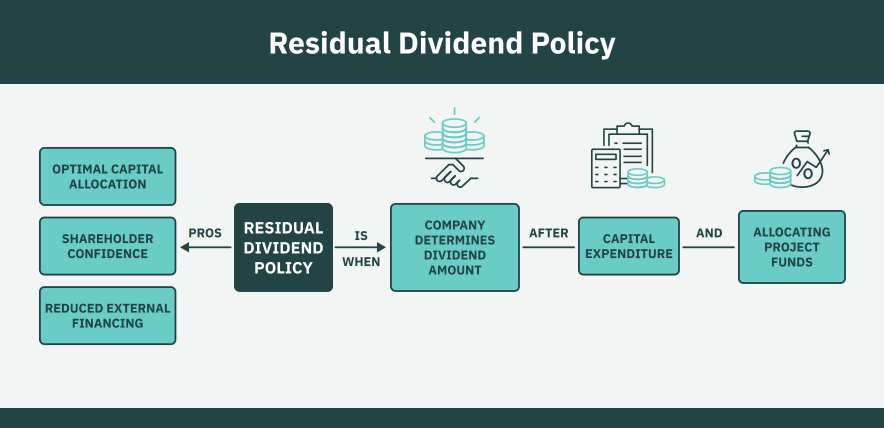
This method cannot be pre-calculated. It is the goal to align dividends with the company’s reinvestment cycle and long-term growth objectives. Investors must be satisfied with income that fluctuates and that dividends follow the growth and competitive viability of the company. The policy is based on the premise that shareholder wealth is derived more from prudent allocation of capital than from periodic payouts.
Residual dividends are not guaranteed, nor are they smoothed for the dividend investors. They fluctuate according to the income of the company and the investment focuses. While more volatile, this approach can be very rewarding for patient investors because reinvested profits can lead to the long-term improvement of the company and bigger, more sustainable dividends.
How the Policy Works in Practice
Before making any decision on dividends, there is capital budgeting involved in a residual dividend policy. Management first looks for projects that exceed the firm’s hurdle rate and have a positive net present value. They then select a financing mix in accordance with the company’s target capital structure (say 60% equity and 40% debt) and fund each project accordingly. Using retained earnings, the period’s net income, and data from the balance sheet, they determine how much equity can be generated internally. The equity required for the projects is then subtracted from total earnings, and the remaining balance becomes the residual available to be paid as dividends.
Formula: Residual Dividend = Net Income – Equity Needed for Capital Budget (at target leverage)
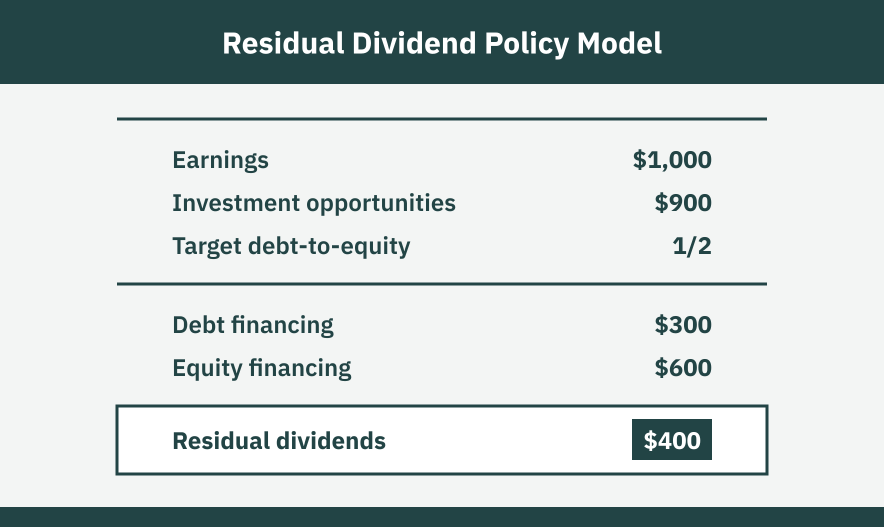
If there is a positive residual this can be paid out in the form of dividends, whether regular or, as a special dividend, from time to time. If the residual equals zero or is negative there is no dividend to be paid for that period. Thus, the payout ratio is not a goal, it is the result; it increases with high profits, fewer projects, or decreases with a greater need for reinvestment.
Since investment opportunities are irregular, residual dividends may fluctuate from quarter to quarter or year to year. Companies that would use this policy would usually justify the logic – making sure to fund growth first – to manage expectations. It is still possible to earn more dividends through reinvestment even if you cannot do it in a fixed schedule.
Rationale Behind the Approach
The reasons for residual dividend policy are based on efficient capital utilization and long-term development. Firms that operate under this model believe that shareholder value is best maximized when the profits are first allotted to projects that produce returns that exceed the cost of capital. By investing capital into positive net present-value opportunities instead of paying dividends, capital is put to productive use to grow our businesses, increase their competitive position and increase future earnings. Dividends are viewed as a secondary consideration to reinvestment demonstrating a preference for wealth creation in the longer term over short term pay-outs.
This is a policy that has a great deal of financial flexibility. Because dividend payout varies from time to time owing to changes in profitability and investment requirements, dividends are, in reality, variable. Management can save cash during periods of weakness and pay more when earnings are strong, as seen recently when Bank of America topped expectations with a 43% surge in investment banking revenue, reflecting how strong performance can translate into greater shareholder rewards. By not making hard commitments, companies are better able to sail through economic cycles, rewarding shareholders as conditions allow without risking stability.
Efficiency is also a very important factor. Prioritization of reinvestment helps to avoid underfunded projects or the subsequent requirement for capital to be raised via an expensive debt or equity issue. In other words, the residual policy links the decision to pay dividends and the actual profitability and reinvestment needs of the business. Distributions only take place when they do not make growth-friendlier, by ensuring that each dollar facilitates the company’s ability to grow, compete, and build sustainable long-term value.
Examples Compared with Dividend Aristocrats
Residual dividend payers and Dividend Aristocrats teach us two ways that companies reward their shareholders.
Companies having residual policy are focused on reinvestments. They pay dividends only when all of the profitable projects have been funded, which translates into a variable payout schedule that appeals to growth-oriented firms that are more likely to be technology or capital intensive.
For example, a technology company may use the residual model to drive earnings into research, development or acquisitions rather than pay a steady dividend. Investors who put their money in such firms usually look for long term capital appreciation rather than predictable income.
Dividend Aristocrats take a different line of attack. These S&P 500 companies – including Procter & Gamble, Johnson & Johnson, and Coca-Cola – have increased dividends every year for at least 25 years. Their consistent increases show financial muscle and disciplined management, attractive to investors who are interested in a reliable cash flow, particularly retirees or those investing in building cash flow portfolios.
Ultimately, each policy has its own type of investor who is attracted to these policies. Residual payers appeal to those who are comfortable with irregular income in exchange for longer reinvestment and growth potential while Dividend Aristocrats appeal to those who value regular and compounding returns. Understanding this distinction is important to investors when deciding which portfolio strategies to employ to meet their goals – whether it is stable income or reinvestment-driven expansion.
Advantages of Residual Dividend Policy
A key advantage of a residual dividend policy is its emphasis on efficient capital use. By channeling profits first into projects with positive net present value, companies ensure funds are invested where they can generate the highest returns. This approach maximizes shareholder value by prioritizing long-term growth before distributing any remaining earnings as dividends.
Another strength is its alignment with shareholder interests. Without a fixed payout commitment, companies maintain flexibility to reinvest earnings when opportunities arise. This can lead to stronger earnings growth—something seen recently when TSMC’s earnings beat expectations, raising questions about a possible AI bubble—and can ultimately result in higher share prices and larger future dividends. Investors focused on total return often appreciate this balance between reinvestment and eventual payouts.
The policy also supports long-term financial health. Since dividends are paid only after essential projects are funded, companies avoid overextending themselves in weaker markets. This disciplined capital allocation and careful management of capital structure preserve cash for strategic initiatives, acquisitions, or debt reduction, enhancing overall resilience. For growth-oriented firms, the residual approach ensures reinvestment is never sacrificed for short-term shareholder expectations, providing a foundation for sustainable wealth creation.
Limitations and Investor Concerns
It should be noted that a residual dividend policy is unpredictable in nature. Dividends are paid after any profitable investment opportunities have been financed so that payments can fluctuate wildly from one year to the next. When a company is reinvesting heavily, dividends may be reduced or even eliminated, which is a bad thing for investors who are accustomed to receiving a regular income from a company’s payout plan. This volatility makes it difficult for income-oriented investors to use these companies as a source of regular cash flow.
The policy is also not attractive for long-term oriented investors who are interested in the stability of dividends. Retirees and individuals who rely on dividends for their income often prefer companies that have stable or increasing payouts such as the Dividend Aristocrats. In a residual model, dividend timing and amount are a function of reinvestment needs, which discourages reliable and financially secure investors.
Variable payments can also disadvantage market perception. Investors may view a dividend cut or skipped payout as a sign of weakness, even when the company is simply prioritizing reinvestment and long-term growth. This perception of risk can raise stock-price volatility and erode confidence. As a result, the combination of uncertain income and market misinterpretation makes residual dividend payers less appealing—unless investors are specifically focused on growth and long-term capital appreciation.
Implications for Dividend Investors
Residual dividend policies provide opportunity and challenge to dividend investors. Unlike stable/ progressive payout strategies, residual dividends are not predictable and hence not ideal for people who need a reliable income. They appeal to investors who are comfortable with variability – who view dividends as a bonus, rather than an assured return. Recognizing this difference is important when it comes to setting expectations when evaluating companies.
Before investing, consider the earnings stability, capital use, and reinvestment priorities of a firm. Companies with volatile profits or aggressive growth plans may pay irregular dividends, while mature businesses tend to be more consistent. Sector trends also matter. Technology and biotech firms typically reinvest most of their earnings—a trend highlighted by the recent setback in US tech stocks that exposed the fragility of the AI-driven rally—whereas utilities and consumer staples focus on steady payouts. Understanding these differences helps investors align income goals with the right industries.
Residual dividend payers do not necessarily make for core income holdings, but they can provide it with long-term growth potential when combined with more predictable dividend stocks. The trick is combining knowledge of the payout patterns, with insight into how the management reinvests the capital. This way when dividends are fetched they are from sustainable practices. By maintaining a balance between these factors, investors can access the growth potential, while balancing the risk of irregular income.
Tools for Analyzing Residual Dividend Policies
Evaluating residual dividend policies requires the collection of financial information, company disclosures, and external research to forecast payout fluctuations. First, annual reports and earnings releases are key. These documents—along with insights from leading stock market newsletters—highlight management’s reinvestment priorities, capital allocation, and dividend history. They show whether dividends are treated as a true residual after funding growth or if management aims for greater stability.
Some important metrics are payout ratios and reinvestment rates. A low or variable payout ratio means dividends are not as important as reinvesting them. High reinvestment rates are suggestive of expansion before distributions. Tracking these numbers over a number of years helps investors determine how predictable, or volatile, dividends might be in this model.
Beyond company filings, dividend tracking platforms, reputable stock advisory services, and brokerage research tools add valuable context. They offer payout histories, analyst forecasts, and earnings projections that hint at future dividend potential in a residual framework. Combining this information with sector analysis helps investors understand how industry trends affect dividend stability.
In the end, combining financial data with future-oriented studies enables investors to better assess residual dividend stocks. Using tools such as a dividend income planning calculator can also help project payouts more accurately, allowing variability to be anticipated and income expectations managed with greater precision.
Conclusion
The residual dividend policy describes the relationship of reinvestment and shareholder payout for companies. First, they invest in high-value projects that focus on long-term growth and not short-term income. While an efficient capital allocation can be a value creator for investors, it also creates uncertainty for investors about the amount and timing of dividends.
Understanding this strategy allows investors to set their expectations in line with reality. Residual dividend payers may not be a good option for those investors who are looking for steady income, but long-term investors who can tolerate volatility may value the growth potential that comes along with each. In order to decide whether a residual-dividend policy is appropriate for a portfolio, earnings stability, reinvestment priorities and industry trends must be considered.
Ultimately, the residual dividend policy is one of a number of payout policies and is best used when combined with more certain, dividend-focused investments. Improving diversification and long-term returns can be positively impacted when used judiciously. The secret is disciplined analysis—making sure that variable dividends show financial strength, not volatility.
Residual Dividend Policy: FAQs
-
What Is a Residual Dividend Policy in Simple Terms?
A residual dividend policy implies that the company pays dividends from the profits that were left after it made all possible investments that would be profitable. The amount of the dividend is not fixed; it keeps changing based on the amount of profit left after reinvestment of the funds.
-
Why Do Some Companies Prefer the Residual Dividend Policy?
This policy is preferred by the companies as it helps them to focus on the growth projects and optimum utilization of the capital. It also allows management to have flexibility to change payouts as profits and investment requirements change.
-
How Does Residual Dividend Policy Affect Income Stability for Investors?
Also, this income is less predictable because dividends vary based on earnings and the reinvestment decisions. Since there is a constant cash flow, such stocks may not be as suitable for those investors who require a steady flow of income.
-
What Is the Difference Between Residual Dividend Payers and Dividend Aristocrats?
Residual Dividend Payers: Because they prioritize reinvestment, their payouts fluctuate, which can appeal to investors using a capture yield approach—seeking to benefit from periodic high-yield opportunities rather than steady income. Dividend Aristocrats, on the other hand, emphasize dividend stability or growth for 25 or more years, making them more suitable for income-focused investors who value consistent, compounding returns.
-
How Can Investors Evaluate Companies Using a Residual Dividend Approach?
Investors should read annual reports, payout ratios, and reinvestment plans to understand how earnings are used. Dividend tracking platforms, reputable stock advisory services, and analyst predictions can help anticipate changes and evaluate financial performance even when payouts are inconsistent.
All reviews, research, news and assessments of any kind on The Tokenist are compiled using a strict editorial review process by our editorial team. Neither our writers nor our editors receive direct compensation of any kind to publish information on tokenist.com. Our company, Tokenist Media LLC, is community supported and may receive a small commission when you purchase products or services through links on our website. Click here for a full list of our partners and an in-depth explanation on how we get paid.

 Back to