Breaking Down Dividends: Cash vs Stock Explained


All reviews, research, news and assessments of any kind on The Tokenist are compiled using a strict editorial review process by our editorial team. Neither our writers nor our editors receive direct compensation of any kind to publish information on tokenist.com. Our company, Tokenist Media LLC, is community supported and may receive a small commission when you purchase products or services through links on our website. Click here for a full list of our partners and an in-depth explanation on how we get paid.
How do cash and stock dividends impact a stock’s price?
Dividends may look like simple rewards for shareholders, but for traders they can also trigger short bursts of momentum. A cash dividend puts money directly in investors’ hands and often signals financial stability. A stock dividend, on the other hand, increases the number of shares, usually reflecting a focus on growth and reinvestment.
Each type shapes liquidity, sentiment, and short-term price action differently. Knowing how they work helps traders anticipate market reactions and spot opportunities around dividend announcements.

- Understanding Cash Dividends
- Getting to Know Stock Dividends
- Comparison
- Impact on Stock Prices
- Benefits for Traders
- Challenges and Risks
- Sector and Market Trends
- Practical Applications
- Conclusion
- FAQs
Understanding Cash Dividends Clearly
The most common form of rewarding shareholders is a cash dividend which is a direct payment of profit to the shareholders on a per share basis. These distributions are usually quarterly and give an instant income to the account in a brokerage or in the form of checks. Cash dividends are therefore broadly regarded as indicators of financial health and of a company’s dedication to value-return without forcing investors to liquidate stock.

In the case of traders, dividend announcements have the ability to rapidly change sentiment. When a company increases or announces its dividend, this is often an indicator of good earnings, which causes the stock to increase in price in the short term. On the other hand, a dividend cut or suspension could raise doubts about financial health and trigger sharp sell-offs, as seen when Anglo American posted a loss and reduced its dividend during restructuring. Such responses give traders the chance to tap into momentum, whether by buying into a dividend-driven rally or shorting after negative news.
Cash dividends are also significant in the ex-dividend dates where the share prices tend to drop by the amount of the dividend. The traders pay close attention to these dates, as they may result in predictable short-term price action.
In this manner, cash dividends exceed the rewards to the long-term investors. They provide actionable information that day traders can use as a guide to strength, volatility, and changes in sentiment: factors that may be used to advantage in short-term trading.
Getting to Know Stock Dividends
A stock dividend is the issue of more shares to the existing shareholders in place of cash dividends. Investors get new shares in proportion to their existing investment- usually in terms of percentage. An example is a 5 stock dividend which would entitle a shareholder who has 100 shares to 5 more. The number of shares increases but ownership stakes remain constant as all the investors are provided with equal shares.

The companies tend to pay stock dividends to their shareholders and save on cash, and it is an indication of a company reinvesting and growing. This is a very normal practice by companies in a growth mode where they require capital to run operations, mergers, or innovation. Recent news about Canadian Pacific siding with Buffett against further railroad consolidation show how some firms are reluctant to pursue large-scale mergers, instead preserving capital for flexibility. By issuing stock rather than cash, companies are able to maintain financial flexibility while still providing value. To long-term investors, the extra shares can be very alluring, especially when future growth compounds the holdings.
Stock dividends present a special dynamic to traders. In the case of issuance of new shares, the stock prices tend to fall to compensate for the dilution effect. This is not necessarily a bad adjustment, of course, it just shifts value to a wider base. Day traders often pay rapt attention to such events as price resets can trigger volatility, short-term momentum and sentiment changes. Monitoring such changes assists traders in predicting the stock dividend announcement opportunities.
Comparing the Two Dividend Types
Both cash and stock dividends reward the investors but in totally different ways, which influence their behavior and market forces. There is also immediate liquidity because cash dividends are immediate payment in the bank accounts of investors. They are appealing especially to those investors who are focused on income producing stocks and place a premium on consistency and stability. Stock dividends, in contrast, do not pay out cash, but instead issue new shares, which are of more interest to investors with a long-term holding period and interest in compounding value.
Both have different reactions to the market as well. Cash dividends tend to cause the short-run price decline on ex-dividend day because the payment decreases the value of the company by the dividend amount. Traders will tend to speculate this adjustment and place themselves in anticipation. Stock dividends do not decrease the value of the company as a whole because more shares are in existence as a result but they do decrease the value per share. Such redistribution can produce volatility, which attracts traders that live off momentum and large swings, often weighing changes in share income yield as they reposition.
To traders, these differences present different approaches. A cash dividend announcement can be viewed as a sign of strength and stability and can be used to ride on investor optimism prior to the ex-dividend date. A stock dividend, in turn, may provide the foundation of speculative trades as the market digests the dilution and shifts sentiment, much like when SoFi’s stock fell amid concerns that potential dilution was weighing on investor confidence. Knowing these differences, traders would be better placed to foresee the reaction and take advantage of dividend based opportunities.
Dividend Impact on Stock Prices
Dividends have a direct impact on stock price and the nature of dividend plays a role in determining short-term opportunities. A stock price will usually decline by the amount of cash dividends on the ex-dividend date. That is a normal market reaction to a shift of valuation to company to shareholders. To a day trader, these predictable price movements can generate the short-term momentum of entry or exit, forming the basis for dividend timing trades.
The stock dividends are different. They do not decrease the value of the company, but increase the shares outstanding and proportional adjustment in the share price occurs. As an example, a 10 percent stock dividend provides more shares to shareholders, however, value does not change as there is a corresponding decrease in the price per share. Becoming neutral in the long-term, the short-term responses tend to be volatile as traders reposition themselves around the dilution effect.
To active traders, the dynamics explain why it is important to monitor dividend events. Ex-dividend dates can alert to where short-term moves are possible and stock dividend announcements may create volatility and momentum trades. As traders learn to expect the influence of dividends, they can be in a position to plan their strategies with an expected movement or a surprise wave of sentiment, while also weighing how much intrinsic value from dividends is reflected in the stock price. Dividend events can thus be used as accurate indicators of short term trading activity.
Benefits of Cash vs Stock Dividends for Traders
Cash and stock dividends have their own benefits as far as trading is concerned. Cash dividends are very clear and stable. Frequent dividends are an indication of soundness and consistent profitability that are usually reassuring to the market. To those who trade by the day, this uniformity produces predictable price responses to announcements of dividends and ex-dividend dates. Short-term movement that can be capitalized on is also a reliable trigger since the immediate price adjustment after a payout creates opportunity, while longer-term investors may prefer the steady growth of long term dividend compounding.

By contrast, stock dividends are more likely to create volatility that is of interest to momentum traders. The issuance of additional shares leads to a state of dilution, and this provokes changes in prices and supply-and-demand relationships. This also tends to create increased trading activity when investors reprice valuations. Stock dividends can also be of interest to those traders who expect higher movement in yield paying shares, particularly in growth-oriented sectors where reinvestment, rather than cash, is emphasized.
The two types can be used to complement strategies of trading in various ways. Cash dividends provide market confidence and make repeatable set-ups, whereas stock dividends generate uncertainty and drive volatility and momentum. Traders who are aware of these nuances can adjust their trading style to suit either slow and steady patterns or to more rapid action. In both scenarios, dividend events offer cues that can be used to predict how the market is going to respond and take advantage of temporary price dynamics.
Challenges and Risks to Watch For
Although dividends offer trading opportunities, they also present some issues that must be identified by the traders. Cash dividends are a good feature due to their predictability, but can be an indication that a company is focusing on payouts rather than reinvestment. In the long term, this will reduce earnings growth and restrict expansion opportunities, making the stock less attractive outside of income investing or dividend-related events.
Stock dividends have other risks, the most pressing of which is dilution. The issuance of more shares devalues the existing ones that can put pressure on prices in the event that the demand fails to match the supply. To traders, the resultant volatility can be both lucrative and risky since a sharp reverse can happen when the sentiment becomes negative. This increases the risk of opening positions without an exit strategy in advance.
The most serious risk is to refer to dividends as the sole indicators of trading. Dividend events can create motion, however, overlooking other aspects of earnings power, leverage and market mood can cause a misstep. Even a sudden reduction, a change of direction which was not anticipated or an external shock can quickly wipe out progress. Guidance from leading stock market newsletters can help traders navigate these challenges while keeping strategies grounded in broader market factors.
Effective risk management is a must. Stop-loss orders, proper position sizing, and diversification will help keep the exposure limited. Dividends can provide important information; however, traders who ignore these risks, expose themselves to unneeded volatility and are less likely to take advantage of opportunities that present themselves.
Sector and Market Trends in Dividend Policies
Dividend policies are usually reflective of industry priorities and this identification can be a trader advantage. Other industries such as the utilities, telecommunications, and banking industries tend to become dependent on cash dividends to supply their shareholders with stable income. The industries create consistent cash flows but may not have high-growth potential and the payouts are a means to keep the investors interested. To traders, this creates reliability in changes of prices on ex-dividend dates.
Technology and biotech are growth-oriented industries, and they do it differently. Such companies tend to re-invest their profits in new research, growth, or innovation rather than in returning cash, much like how research universities assist Nvidia. By declaring stock dividends, they tend to try and save cash and in the process reward investors. This has the potential to introduce short-term volatility, with share dilution causing traders to reposition rapidly, a situation that is favourable to momentum strategies.
Identification of sector based trends will help traders to predict market responses. A utility company reducing its dividend yield could attract an overreaction, as such companies are supposed to be stable. On the other hand, a tech company that pays stock dividends might be an indication of strategic positioning and not an indication of danger. The clarity of such differences enables traders to adjust to the industry standards and capitalize on the certainty of established industries and the riskiness of the high growth sectors.
Practical Trading Applications
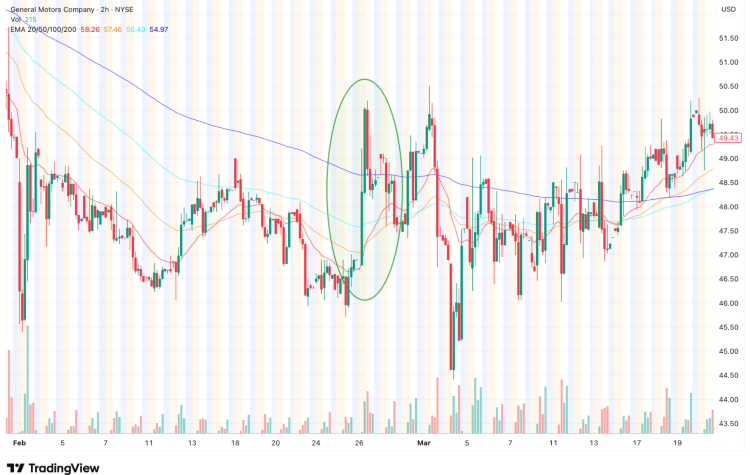
Dividend announcements can serve as short-term motivators that are used by day traders in the anticipation of price moves. As an example, in February 2025, General Motors (NYSE: GM) announced a 25% increase in its quarterly dividend, and a new buyback program of up to $6 billion in shares. That news pushed the implied yield of GM higher, and the stock soared before the opening bell by almost 5%. This provides an obvious momentum trade.
Another clear case is Magellan Financial Group (ASX: MFG), whose net profit fell 33.7%, but the company still paid a sizable final dividend plus a special dividend- thanks to a new, generous policy. This surprise dividend increase caused a trading interest as an investor could expect a sentiment-driven move even though there was an earnings miss.
It is also common to find dependable patterns around ex-dividend dates during cash dividend events when multiple companies announce the payment at the same time. An investor could look to go ahead of this, anticipating a flurry of short-term action as the market responds to when these payouts will take place.
In addition to the direct effect of a price change, the news of a dividend may influence general sentiment and liquidity. An unexpected rise could beget momentum buyers whereas a decrease could beget sellers. With the help of reliable market advisory services and by combining dividend tracking with technical settings, a trader can turn the ordinary announcements into short-term trading opportunities.
Conclusion
Dividends are relevant to both long-term investing and short-term trading but depending on the active trader, the dividend effect is of interest as far as how the announcement and ex-dividend dates can shape immediate price action. Cash dividends provide certainty and stability, whereas stocks dividends can be volatile, and cause momentum, at the expense of dilution.
The challenge that traders face is to identify these signals before they become visible to everyone and to harness them together with a technical analysis to ride the short periods of opportunity. Cash dividends allow traders to know what to expect, whereas stock dividends present high volatility to take advantage of.
Either kind of dividend is not necessarily superior to the other a matter of markets and sector trends, and a trader strategy. With dividends as a short-term catalyst, rather than as an income stream, traders can optimize watchlists, sharpen their timing, and turn routine announcements into trade opportunities.
Cash Dividend vs Stock Dividend: FAQs
-
How Do Cash Dividends Affect Stock Prices on the Ex-Dividend Date?
The ex-dividend date is the day a stock price is adjusted by the amount of the dividend since the new investors do not get the dividends. The consistent shift can allow day traders to find opportunities in the short term with regard to price and volume changes.
-
Why Would a Company Issue a Stock Dividend Instead of Cash?
A company can reward its shareholders through a stock dividend and retain its cash so that it can be reinvested or used in expanding. This is indicative of emphasis on growth and does not entail loss of cash. To traders, it frequently implies additional shares out there and a possibility of fluctuating prices.
-
Are Cash Dividends More Beneficial Than Stock Dividends for Day Traders?
Cash dividends are also transparent and predictable changes, and thus they are easier to foresee. Stock dividends are more prone to create volatility due to the dilutive effect and also due to change of sentiment. The more suitable alternative is the one that depends on whether a trader desires stability or flourishes on momentum.
-
Do Dividend Announcements Create Short-Term Trading Opportunities?
Yes. Announcements can easily trigger swift responses as traders make adjustments to payout size, frequency and/or unexpected changes. Share repurchases and stock dividend announcements can create momentum, a volume surge, or reversal, which day traders can take advantage of with timely trades. Activist pressure, as Windward has tried to put pressure on Cineplex to sell assets and use the proceeds to buy back shares, can rapidly turn into market catalysts.
-
Can Stock Dividends Dilute Share Value Significantly for Traders?
The stock dividends multiply the shares that decrease the value of the per-share value. Even the smallest ones produce insignificant effects, whereas bigger problems can lead to the apparent dilution. Traders are advised to pay attention to these happenings as they tend to trigger price movements and mood swings.
All reviews, research, news and assessments of any kind on The Tokenist are compiled using a strict editorial review process by our editorial team. Neither our writers nor our editors receive direct compensation of any kind to publish information on tokenist.com. Our company, Tokenist Media LLC, is community supported and may receive a small commission when you purchase products or services through links on our website. Click here for a full list of our partners and an in-depth explanation on how we get paid.

 Back to