What is a Special Dividend and How Does it Work?


All reviews, research, news and assessments of any kind on The Tokenist are compiled using a strict editorial review process by our editorial team. Neither our writers nor our editors receive direct compensation of any kind to publish information on tokenist.com. Our company, Tokenist Media LLC, is community supported and may receive a small commission when you purchase products or services through links on our website. Click here for a full list of our partners and an in-depth explanation on how we get paid.
What happens when a company surprises shareholders with a one-time cash payout?
That’s a special dividend—a one-time payout triggered by strong profits, asset sales, or restructuring. Unlike regular dividends, they’re irregular and often sizable, attracting both investors and traders. For investors, it’s a sign of financial strength. For traders, it creates short-term price swings and quick opportunities. But timing, taxes, and strategy still matter.
This guide breaks down how special dividends work, what to watch for, and how to use them to your advantage—whether you’re investing for income or trading the reaction.

- What Is Special Dividend?
- Why Companies Issue Special Dividends
- Special Dividend vs. Regular Dividend
- Market Reactions
- Short-Term Trading
- Tax Implications
- Examples
- Trade or Hold
- Conclusion
- FAQs
Understanding What Qualifies as a Special Dividend
A special dividend refers to a one-time cash or stock distribution made outside a company’s regular dividend schedule. In contrast to ordinary dividends, which are usually paid on a monthly basis, quarterly basis or yearly basis, special dividends are event-related or financially induced, and not intended to signal a change in long-term dividend policy. They should not be expected by the investors to repeat in the succeeding quarters.
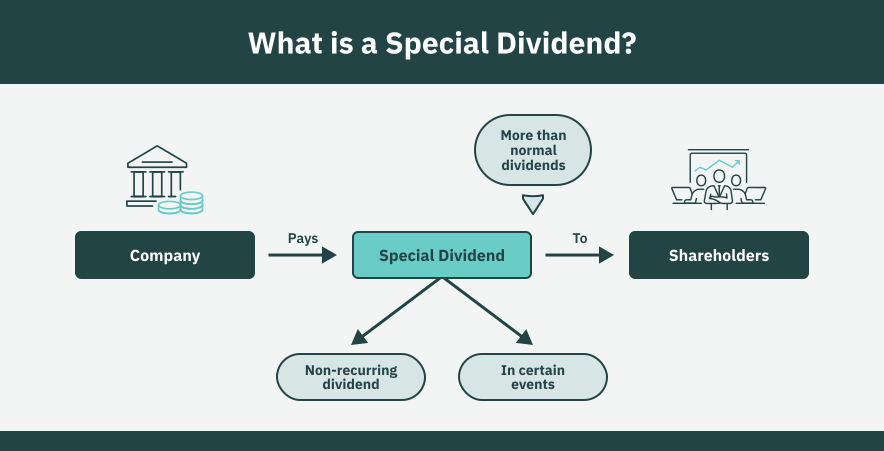
There are various motives as to why companies issue special dividends. Most commonly, it’s due to surplus funds from strong profits or the sale of a business unit or major asset. Some companies return this excess to shareholders as a reward instead of reinvesting it. Other triggers include corporate restructuring—such as a spinoff or reorganization—as seen recently when Movella Holdings Inc. completed its corporate restructuring, or a favorable tax environment where distributing cash is more efficient than holding it.
Whereas special dividends can be viewed as an indication of management confidence in the financial situation of the company, insufficient reinvestment opportunities may also be attributed to them. They offer short-term benefit to the shareholders but are not a guarantee of future dividends and performance.
Special dividends must be considered by the investors and traders in perspective. Such happenings can provide opportunity but cannot be confused with recurring revenue. They are one-off situations unique to themselves- unlike the certainty of a standard dividend flow and would be better treated as bonuses, not long-term income strategies.
Why Companies Issue Special Dividends
Special dividends are declared by companies when they have excess cash than required in its daily operations or expansion programs. One of the typical reasons is a windfall, e.g., a particularly good set of earnings or some sale of a key asset, which puts the company in possession of excessive funds. Rather than allow such cash to remain idle or to be ineffectively used by the company, the management can decide to pay back such cash to its shareholders in a single-shot dividend.
Special dividends can also be issued due to business restructuring events such as spinoff, particularly where a new inflow of cash is created or the focus is better-defined. It could be also facilitated by favorable tax conditions, and companies choose to share profits prior to the amendment of tax law. The decisions made usually tend to be strategic and aim to maximize shareholder value in the existing financial or regulatory situation.
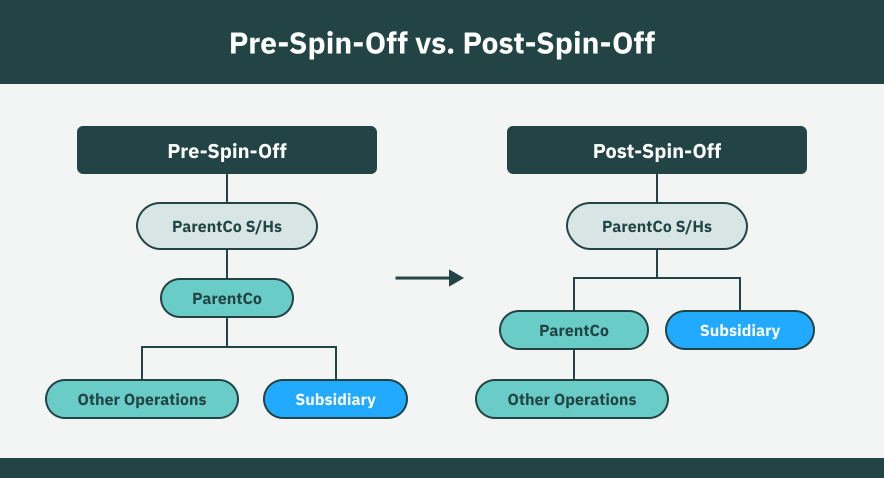
Special dividends may reflect financial discipline when such options as reinvestment are few—possibly due to economic uncertainty or a slow industry. Instead of funding low-return projects, firms can choose to repay capital, signaling strong balance sheets and a focus on shareholder interests—key factors for income-focused dividend investing.
Although they are not an indicator of recurrent income, special dividends are usually regarded as an indicator of stability and confidence. To investors and traders, they point out how the management handles the cash management and can stimulate interest as highly anticipated and opportunity-rich occasions.
Special Dividend vs. Regular Dividend—Key Differences
Although special and regular dividends imply the payment to the shareholders, they play various roles and have different patterns. Regular dividends are periodic—they are normally paid out four times a year, twice a year or once a year, and they are symbolic of a company which is committed to share profits. Long-term investors and traders looking to focus on income consider these predictable payments in their valuation models.
By comparison, special dividends are ad hoc payments that occur when unusual events such as asset sales, financial windfalls or reorganization take place. They are not on the routine and should not be repeated. Because of this, they do not represent stability in the long-term income, but rather short-term financial solvency or low reinvestment potential.
Consistent dividends serve as a stabilizer to the yield of the stock and aid in long-term investment plans. Special dividends, however, can raise short term trading because of the possibility of price movement in the lead up to the ex-dividend date. Traders can aim to realize instant profits, and long-term investors usually regard this to be a surprise gift.
Finally, frequent dividends imply stasis and stability of revenues. Special dividends point to single opportunities that are related to events. Each is valuable, just that one is used to support long term planning and the other provides tactical upside.
Market Reactions to Special Dividend Announcements
Markets tend to respond quickly when a company declares a special dividend. Such announcements are typically viewed as signs of financial strength—particularly when the payment is large—and can spark short-term price increases. Investors may interpret the move as a signal of excess cash or a recent windfall, prompting a buying spree as market participants position themselves to collect the payout, often influenced by insights from recognized investment newsletters that highlight these opportunities.
When the stock becomes ex-dividend—the date at which new purchasers are no longer entitled to the dividend—the price usually falls by an equivalent amount. This is a mechanical adjustment that can be magnified or softened by broader sentiment and other market forces. If the dividend is unusually large, there’s often increased price volatility as investors reassess the company’s outlook following the payout—especially in the case of dividend-paying stocks that don’t typically issue special dividends.
These are usually the events that short-term traders look to exploit by making an attempt at gaining profits based on price movement surrounding the ex-dividend date. Nevertheless, such an approach may be risky. Price volatility can increase in case of excessive traders attempting to respond to the identical signal. Also, any rally can be ephemeral in case the dividend is considered to be an isolated action that is not a part of a wider shareholder-friendly policy.
The background of the dividend and the reading of sentiment in the market are important aspects in dealing with these announcements.
Short-Term Trading Around Special Dividends
Special dividends usually attract short-term traders looking to profit from near-term price fluctuations. The usual strategy is to purchase shares prior to the ex-dividend date, expect a near term ramp with everyone piling in and sell prior to or at the dividend being reflected in the stock price.

Although such a tactic can be effective (particularly when the dividend is large or when the market is bullish) it is never that easy. Following the ex-dividend date the stock will fall roughly by the amount of the dividend. Nevertheless, this correction does not always occur in precision. It is either quiet or it is loud depending on the behavior of investors, liquidity and the general market conditions.
Wrong timing of entry or exit may turn a potential profit into a loss. Sharp volatility, like the kind that recently helped UBS post a net profit beat as trading activity surged, low volume, or sudden market shifts can all disrupt the setup. Beyond that, short-term capital gains taxes and the ordinary income treatment of dividends can further reduce profits from these trades.
To the traders, this strategy can only be successful when precision, discipline, and knowledge of the external market factors are adhered to. A special dividend can create a trading opportunity, but this is not guaranteed. It is quite possible that these plays may rely equally on time and sentiment as on the dividend itself.
Tax Implications of Special Dividends
Special dividends are normally treated as ordinary income and thus the recipient is expected to pay their regular income tax rate, rather than the lower qualified dividend rate. Such differences can be quite large and can diminish the net benefit, especially among those who earn high incomes or traders who do not satisfy the holding period requirements to get the preferential tax treatment. Special dividends as opposed to regular dividends are sometimes one off payments and are unlikely to qualify to be taxed at the lower rate by the time they are held long enough.
The tax effect is even more serious to short-term traders. The payout is subject to the higher rate of tax because positions are normally taken up only long enough to receive the dividend payout. Moreover, short-term capital gains tax is charged at ordinary income rate on any price gains realised during the pre-dividend period. The combination of such tax liabilities is capable of rapidly eating into profits.
There are other issues to be encountered in high-income investors. A large special dividend may move the aggregate income into a higher marginal tax bracket or cause the Net Investment Income Tax (NIIT) which will cause additional tax liability.
Finally, it is imperative to know how special dividends are treated as taxes. What looks like a generous payout might not be so generous, depending on how it is planned without proper planning there might be a high tax cost involved which will reduce the value of the payout. Being conscious and being ready is the essence of retaining more of the benefit.
Examples of Notable Special Dividend Events
On August 10, 2025, UScellular declared a special dividend of $23 per share, on the sale of its wireless operations to T-Mobile. The dividend of more than 25 percent of the share value caught the headlines. The price was pushed up as traders flooded in as the record date approached. It was at the point when the stock became ex-dividend, that the stock price fell rapidly offering a short period of tactical trading.
In the same month, NL Industries announced a special dividend of 0.21 that was paid using surplus free cash flow. It was not particularly large, but it was accompanied by the company’s typical quarterly dividend and drew income investors as well as traders. The stock re-priced as anticipated ex-dividend date, creating opportunities of disciplined set ups.
In March 2025, Pilgrim’s Pride distributed to shareholders about 1.5 billion by paying a special dividend of 6.30 dollars per share, after rebalancing its capital allocation policy. Considered by many to be a mark of financial prowess, the action produced a spike in volatility around the ex-dividend date-giving traders an opportunity to make trades and long-term holders a welcome windfall.
These new examples indicate that special dividends have the ability to stir the markets, set in motion strategic trades, and draw the attention of investors who are not necessarily interested in the income. They highlight the need to know the dynamics of how such rare serious events in corporations happen.
Evaluating Whether to Trade or Hold Through a Special Dividend
The announcement of a special dividend by a company requires traders and investors to decide whether to hold until the payment date or sell before the ex-dividend date. This decision depends on personal strategy, market conditions, and the company’s fundamentals. One key factor is how the payout affects the company’s capital structure; large cash distributions may reduce liquidity or limit future growth potential—an important consideration for long-term dividend growth investing.
One should figure out whether the dividend is a sign of surplus cash due to limited reinvestment opportunities or part of a broader capital policy shift. The company might lack a solid growth strategy and be offloading excess cash, which could imply weaker future profitability. On the other hand, special dividends backed by strong cash flow may reflect long-term stability and a shareholder-focused approach—something often flagged by top-rated stock picking services that evaluate financial health and dividend trends.
The short-term price movement should also be considered by the traders. Stocks will generally fall by the value of the dividend when they become ex-dividend and therefore it only makes sense to hold if the dividend payout exceeds the price decline, or if the stock price recovers afterward. Taxes are an issue too, special dividends are treated as ordinary income and thus cut net returns, most particularly of those with higher incomes.
Finally, one should base the decision to trade or hold on the financial health of the company, the level of dividend and how the action will position the moves as far as the overall trading or income objectives are concerned.
Conclusion
Special dividends are not just one-off payments, they tend to represent a sign of financial health and a wish to reward shareholders. Unpredictable more than regular dividends, they can generate short-term opportunities for income investors and active traders.
Nevertheless, such events are not simple. It matters in terms of tax treatment, timing, and overall company strategy. A special dividend may portray optimism- or absence of investment opportunities.
The point is to look at each payout in context whether one is trading or holding. Better long-term outcomes are the result of smart decisions and not the lure of easy cash.
Special Dividend: FAQs
-
How Do I Know if a Dividend Is Special or Regular?
A special dividend is unambiguously marked by the company and is a unique payment, which is normally provided beyond the routine. The regular dividends occur on a fixed schedule, say monthly, quarterly, etc. whereas special dividends are connected to such events as the sale of assets or surplus profits.
-
Do Special Dividends Affect Stock Prices the Same Way as Regular Ones?
Yes, the stock is usually quoted lower on the ex-dividend date by roughly the amount of the dividend, similar to regular payouts. However, because special dividends are often larger or unexpected, they can create greater price volatility before and after the event—particularly in cases where valuation models like the dividend discount model are disrupted by one-time distributions.
-
Are Special Dividends Taxed Differently?
Usually, yes. Special dividends are typically taxed as ordinary income, unless they meet the criteria to be classified as qualified dividends. This tends to lead to the increased tax rate particularly to short-term traders or the people who earn more.
-
Should I Trade Before or After a Special Dividend Payout?
It depends on your strategy. A dividend capture play involves purchasing before the ex-dividend date to secure the payout, but this exposes you to a potential price drop or higher taxes. Selling beforehand avoids those risks but forfeits the dividend. Consider timing, tax impact, and how it aligns with your overall portfolio goals.
-
Can a Company Issue Multiple Special Dividends in One Year?
Yes, but not usually. This may happen if a company experiences multiple windfalls or accumulates excess cash. Every dividend is an individual event that has an independent effect on the market.
All reviews, research, news and assessments of any kind on The Tokenist are compiled using a strict editorial review process by our editorial team. Neither our writers nor our editors receive direct compensation of any kind to publish information on tokenist.com. Our company, Tokenist Media LLC, is community supported and may receive a small commission when you purchase products or services through links on our website. Click here for a full list of our partners and an in-depth explanation on how we get paid.

 Back to