














 NEAR-1.13%
Market Analysis
NEAR-1.13%
Market Analysis
SpaceX Drops to $132.75 All-Time Low as Lockup Overhang and AI Repricing Weigh on SpaceX Stock
SpaceX stock hit an all-time low of $132.75 on July 15, breaching its $135 IPO price as lockup overhang and AI repricing pressure SPCX despite a $242 analyst target.

Editorial disclosureRead more
All reviews, research, news and assessments of any kind on The Tokenist are compiled using a strict editorial review process by our editorial team. Neither our writers nor our editors receive direct compensation of any kind to publish information on tokenist.com. Our company, Tokenist Media LLC, is community supported and may receive a small commission when you purchase products or services through links on our website. Click here for a full list of our partners and an in-depth explanation on how we get paid.
SpaceX (NASDAQ: SPCX) touched an all-time low of $132.75 on July 15, 2026, breaching its $135 IPO price just five weeks after the stock first traded on June 12, where it debuted at $150, before closing at $135.27. The stock went on to hit its prior all-time high of $225.64 on June 16 and then slid again in the weeks that followed.
The price action sets up one of the starkest analyst-vs-market disconnects in recent IPO history. According to Yahoo Finance analyst insights, 27 of the 31 Wall Street analysts covering SPCX rate it Buy or Strong Buy, with a consensus price target of $242, implying upside from the July 15 close.
Three compounding structural forces are driving the gap: AI-linked valuations repricing broadly across the IPO cohort; lockup-related supply overhang; and post-IPO euphoria unwinding as early support fades.
SpaceX Price Timeline: How $135 Became a Ceiling Instead of a Floor
The mechanics of the decline begin with a distinction the market initially ignored: the IPO price of $135 per share was the institutional clearing price set alongside the offering, not the $150 at which SPCX debuted on June 12.
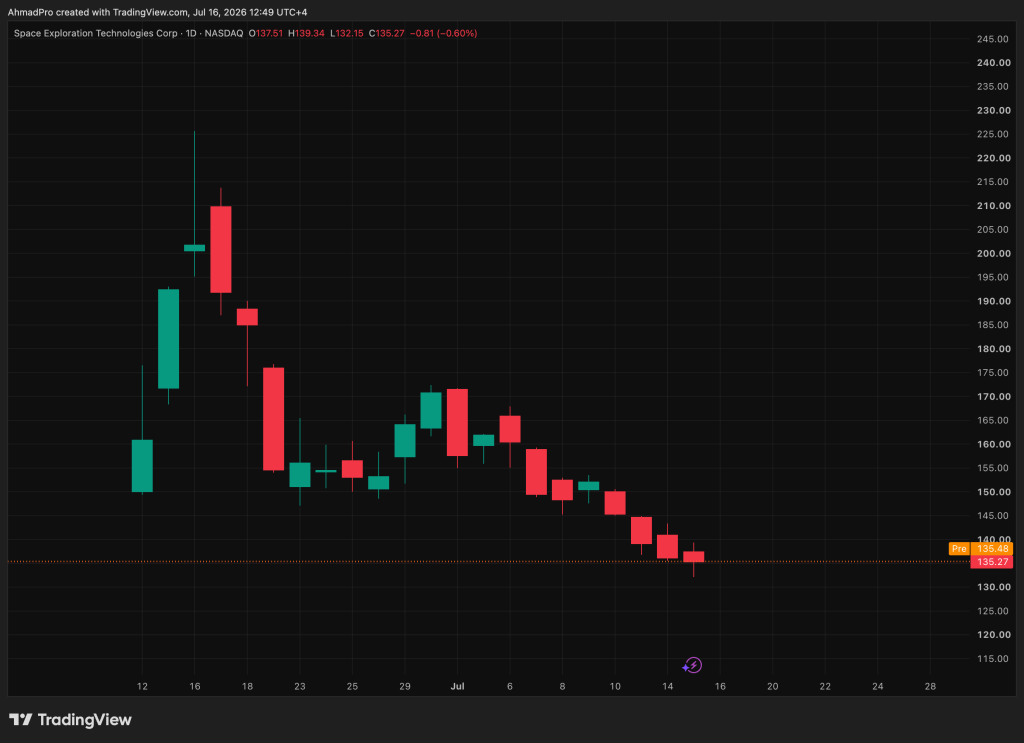
The difference between those two figures represented immediate first-day euphoria – a premium that late retail buyers paid on top of what institutions received.
The stock went on to close its first full trading day near $161 and briefly pushed to $225.64 on June 16 as momentum and AI-infrastructure positioning drove inflows, and has deteriorated in a near-uninterrupted sequence since.
The breach of $135 on July 15 matters beyond symmetry. That level marked the IPO reference price beneath which investors who bought in the offering are now sitting at a loss. With early post-IPO market support fading, the stock is increasingly trading as a true secondary-market bid.
Analyst Consensus vs. Current Price: Why 27 of 31 Buy Ratings Haven’t Moved the Stock
The 27-of-31 Buy consensus is real, but its signal value requires adjustment for IPO-specific distortions. The majority of the analyst pool covering SPCX includes banks that participated in the underwriting process, institutions whose research departments are structurally incentivized toward constructive ratings in the immediate post-IPO window.
Needham, the most recent firm to publish, maintained its Buy and raised its price target to $250 from $200 as of this week.
Evercore ISI’s Kutgun Maral, who is discussed as a bull, remains constructive but has noted that Starship has yet to prove it can scale, a material qualifier given that the rocket’s first operational payload launch is expected in the second half of 2026.
The mechanism behind the analyst-market divergence is supply-and-demand arithmetic at the float level. SPCX’s freely tradeable float at IPO represented roughly 5% of total shares outstanding, a thin market in which sentiment and momentum dominate price formation, while the overwhelming majority of shares are locked up and not available to absorb or generate a signal.
The $242 consensus target, which implies the full enterprise value of SpaceX’s launch, Starlink, satellite-to-phone, and AI infrastructure businesses discounted at long-dated growth assumptions, is analytically coherent but is being priced against a float so narrow that it functionally cannot reflect fundamental value yet.
Goldman Sachs’s long-term AI revenue forecasts for SpaceX’s infrastructure segment provide the underpinning for the highest targets in the distribution, as detailed in Goldman Sachs’s SpaceX AI revenue forecast through 2030, but those projections are years from validation.

Tim Baker
Tim Baker is a Senior Market Analyst at Tokenist with over a decade of experience educating readers about traditional finance, crypto and DeFi. A former equity researcher turned on-chain analyst, Tim specializes in regulatory framework shifts and institutional DeFi adoption. His work focuses on distilling complex liquidity cycles and the macro environment into actionable intelligence for the modern DIY investor.


