














 DAI+0.01%
Market Analysis
DAI+0.01%
Market Analysis
New York Court Upholds Kalshi Sports Contracts Gambling Claims
A federal judge ruled CEA preemption does not shield Kalshi's sports event contracts from NY gambling law, putting 65% of its trading volume at legal risk.


Editorial disclosureRead more
All reviews, research, news and assessments of any kind on The Tokenist are compiled using a strict editorial review process by our editorial team. Neither our writers nor our editors receive direct compensation of any kind to publish information on tokenist.com. Our company, Tokenist Media LLC, is community supported and may receive a small commission when you purchase products or services through links on our website. Click here for a full list of our partners and an in-depth explanation on how we get paid.
Judge Analisa Torres of the Southern District of New York denied the Kalshi motion for a preliminary injunction on July 8, 2026, ruling that the Commodity Exchange Act does not preempt New York’s application of its gambling law to the prediction market operator’s sports-event contracts.
This decision was flagged immediately by legal analyst Daniel Wallach and crypto journalist Eleanor Terrett. The case now advances to the motion-to-dismiss stage, leaving New York’s gambling claims fully intact against a product line that accounts for roughly 65% of Kalshi’s total trading volume.
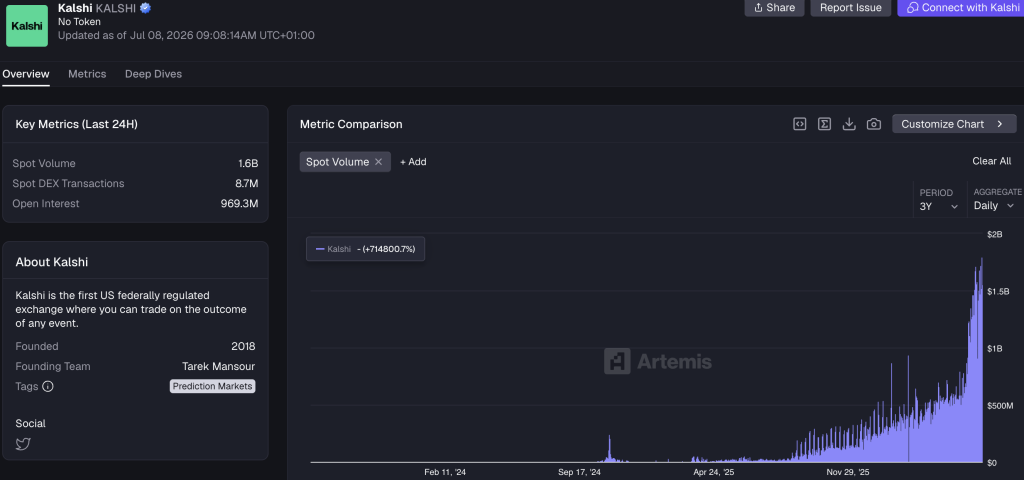
This bombshell dropped as Kalshi’s daily trading volume continues to stick above $1Bn, highlighting the continued success of one of the leading prediction markets platforms, alongside Polymarket.
Kalshi CEA Preemption Rejected at the Preliminary Stage: What Torres Actually Held and Why State Gambling Authority Survives
CEA preemption is the legal doctrine that federal law, specifically the Commodity Exchange Act (CEA), preempts conflicting state regulations.
Kalshi’s litigation relies on this theory, arguing that if the CEA preempts state gambling laws, no state commission can regulate its sports contracts.
In a recent ruling, Judge Torres rejected this argument, stating that New York gambling laws are not preempted by the CEA and that gambling oversight falls within state jurisdiction.
The court also noted that the CFTC’s jurisdiction under the CEA is limited, allowing state regulations without contradicting federal law.
Kalshi did not demonstrate a likelihood of success for a preliminary injunction, meaning the court did not freeze state enforcement during the ongoing litigation.
The case now moves to the motion-to-dismiss stage, where Kalshi can further present its preemption argument. The CFTC has also sued several states to assert federal authority over prediction market contracts, adding complexity to the situation.
65% of Volume at Risk: The Commercial Exposure Behind a Ruling That Is Not Just a Legal Footnote
Sports event contracts account for about 65% of Kalshi’s trading volume, turning a procedural setback into a significant revenue threat. A ruling allowing New York to pursue gambling-law claims could restrict or eliminate Kalshi’s most profitable product in a major financial market.
Despite ongoing legal challenges, Kalshi continues to seek investors, with its valuation tied to the contested sports-prediction market. Recent court decisions have denied protections for Kalshi’s contracts, with similar developments in Maryland.
Competitor Polymarket faces similar pressures, including a lawsuit in New York and warnings from the European Securities and Markets Authority. However, Kalshi’s reliance on sports contracts makes the New York ruling particularly critical for its revenue.
Multi-State Enforcement Pattern: New York Joins Other Jurisdictions as Federal Courts Decline to Shield Kalshi’s Sports Contracts
The Torres ruling is part of a larger context, as Kalshi faces state lawsuits in Nevada, Maryland, Massachusetts, and elsewhere, alleging that its sports-event contracts are gambling products subject to state regulations rather than federally regulated derivatives.
In October 2025, New York regulators issued a cease-and-desist order, prompting Kalshi to sue in federal court, where it initially secured a temporary hold on enforcement, now expired.
Kalshi’s attempts to obtain a federal injunction have yielded mixed results. The Third Circuit upheld a preliminary injunction against New Jersey regulators in April 2026, suggesting a strong chance of success, in contrast to the Torres ruling.
However, an Ohio district court rejected a similar block on state enforcement. This inconsistency is exactly what CFTC Chairman Michael Selig has indicated could lead to Supreme Court review.
Gaming organizations are lobbying Congress to pass the CLARITY Act, seeking to exempt sports and casino-style prediction markets from CFTC oversight, thus addressing the regulatory conflict highlighted by the Torres ruling, which reinforces state gambling law enforcement.
The author does not hold any position in the securities discussed in the article.

Tim Baker
Tim Baker is a Senior Market Analyst at Tokenist with over a decade of experience educating readers about traditional finance, crypto and DeFi. A former equity researcher turned on-chain analyst, Tim specializes in regulatory framework shifts and institutional DeFi adoption. His work focuses on distilling complex liquidity cycles and the macro environment into actionable intelligence for the modern DIY investor.


