













 BTC+0.89%
Market Analysis
BTC+0.89%
Market Analysis
Trump Accounts Launch: $1,000 Seed, 4M Sign-Ups, and How 530A Plans Work
Trump Accounts launched July 4–6, 2026, seeding $1,000 into 530A child investment accounts — here's how the tax-deferred baby savings program works.


Editorial disclosureRead more
All reviews, research, news and assessments of any kind on The Tokenist are compiled using a strict editorial review process by our editorial team. Neither our writers nor our editors receive direct compensation of any kind to publish information on tokenist.com. Our company, Tokenist Media LLC, is community supported and may receive a small commission when you purchase products or services through links on our website. Click here for a full list of our partners and an in-depth explanation on how we get paid.
The federal government officially launched Trump Accounts on July 4–6, 2026, seeding $1,000 into new tax-deferred child investment accounts for every US citizen born between January 1, 2025 and December 31, 2028, a baby savings program authorized under the One Big Beautiful Bill that the IRS confirmed has already drawn 4M sign-ups, with 1M children claiming the $1,000 pilot contribution.
President Donald Trump stated that deposits have been made into more than 500,000 accounts as of launch, establishing the program as the largest federally seeded child investment initiative in US history at opening.
The 4 million enrollment figure represents fewer than 10% of children potentially eligible across the 2025–2028 birth window, signaling that the program’s structural reach remains well ahead of its current activation rate. The accounts, formally designated as 530A accounts under the tax code, modeled structurally on 529 college plans and traditional IRAs, cap after-tax contributions from parents, grandparents, and relatives collectively at $5,000 per child per year.
The investment mandate is restricted by statute to low-cost US equity index funds carrying expense ratios at or below 0.10%. No income phaseouts apply, and unlike traditional IRAs, no earned income requirement exists for the child, making the accounts accessible to all qualifying families regardless of income bracket.
Trump Accounts: How Tax-Deferred S&P 500 Exposure Is Built Into the $1,000 Seed
Trump Accounts function similarly to a traditional IRA for minors rather than a 529 plan. Contributions are made with after-tax dollars, grow tax-deferred, and are taxed as ordinary income upon withdrawal in adulthood.
Darcy Bergen from Bergen Financial Group noted that while it’s designed for families who may struggle to save for retirement, it teaches the concept of compound interest.
A senior Treasury official confirmed that the default investment is a low-cost S&P 500 index fund, with expense ratios capped at 0.10%, excluding actively managed funds and other high-fee options.
The account has a $5,000 annual contribution limit, indexed to inflation starting in 2028. Employers can contribute up to $2,500 per child, and these contributions are generally tax-exempt for employees.
Additionally, governments and nonprofits can contribute beyond the $5,000 cap to benefit lower-income families. Accounts can be set up before the child’s 18th birthday using IRS Form 4547 or at trumpaccounts.gov, both of which require a valid Social Security number.
Enrollment Data: 4 Million Sign-Ups and What the 1 Million Pilot Claim Rate Reveals About Early Demand
The IRS reported 4 million children enrolled in the $1,000 pilot contribution, with only 1 million claims, a 25% claim-to-enrollment conversion rate, suggesting issues with application processing and awareness rather than a lack of demand.
As of early July, fewer than 10% of eligible children had active accounts, which could cover over 14 million children if enrollment reaches saturation.
Sign-up rates for Trump Accounts are particularly low in lower-income and rural counties, similar to trends in 529 plan participation.
The Social Security Administration will launch a fall outreach campaign targeting newborns in 2025 and 2026. The Treasury plans to propose automatic enrollment rules by 2026, which could improve awareness.
Projected returns assume 10–11% annual growth, with a $1,000 seed potentially growing to about $6,000 by age 18 and $15,000 by age 27.
With maximum $5,000 contributions, projections could reach around $1.1M by age 28, but this depends on consistent contributions and favorable market performance.
The 0.10% Expense Ratio Ceiling: Which Index Funds Qualify and What $4Bn in Seeded Assets Means at Scale
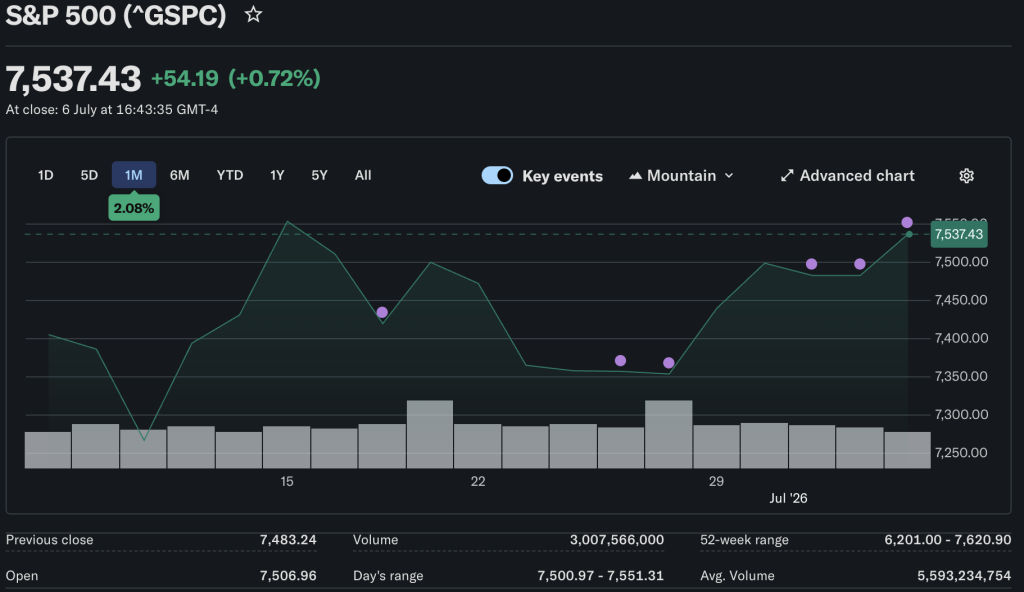
The ≤0.10% expense ratio mandate limits eligible investments to low-cost passive products such as Vanguard’s VOO (0.03%), VTI (0.03%), iShares IVV (0.03%), and Fidelity’s FXAIX (0.015%) and FZROX.
These funds primarily track the S&P 500 or a broad US equity index. Vanguard’s guidance emphasizes low-cost index mutual funds or ETFs that focus on US companies, effectively making it a passive-only rule, since no actively managed funds meet the threshold.
With 4 million accounts starting with $1,000 each, the initial $4Bn investment is expected to grow as more children enroll. The Council of Economic Advisers projects that if half of eligible families contribute at least $1,000 annually.
Total assets in the Trump Accounts could exceed $2 trillion by 2060, positioning the program among the largest retail equity capital pools in the US. This results in significant demand for passive S&P 500 index funds such as VOO, IVV, and FXAIX.
The author does not hold any position in the securities discussed in the article. All stock prices were quoted at the time of writing.

Tim Baker
Tim Baker is a Senior Market Analyst at Tokenist with over a decade of experience educating readers about traditional finance, crypto and DeFi. A former equity researcher turned on-chain analyst, Tim specializes in regulatory framework shifts and institutional DeFi adoption. His work focuses on distilling complex liquidity cycles and the macro environment into actionable intelligence for the modern DIY investor.
Related Stories
 Market Analysis
Russia Crypto News: EU’s 21st Sanctions Package Bans 14 Crypto Platforms and Introduces Country-Level Block Tool
 Market Analysis
Is Putin Set to Legalize Crypto in Russia? What Next for BTC?
 Market Analysis