














 USDC+0.01%
Market Analysis
USDC+0.01%
Market Analysis
Zuckerberg Greenlights Meta Prediction Market to Challenge Polymarket and Kalshi
Meta Arena, personally approved by Zuckerberg, targets Polymarket and Kalshi with a points-based prediction market backed by 3.56 billion daily active users.


Editorial disclosureRead more
All reviews, research, news and assessments of any kind on The Tokenist are compiled using a strict editorial review process by our editorial team. Neither our writers nor our editors receive direct compensation of any kind to publish information on tokenist.com. Our company, Tokenist Media LLC, is community supported and may receive a small commission when you purchase products or services through links on our website. Click here for a full list of our partners and an in-depth explanation on how we get paid.
Mark Zuckerberg has approved the development of a standalone prediction-market app, codenamed Meta Arena, positioning it as a competitor to Polymarket and Kalshi.
Launched without real-money wagering to avoid regulatory issues, Arena is described as “experimental but a top priority.” Meta plans to use its social platforms, Facebook, Instagram, WhatsApp, and Messenger, for user acquisition.
With a reach of 3.56 billion daily active users, Meta’s distribution scale significantly outpaces the audience of existing prediction markets like Polymarket and Kalshi.
Meta Prediction Market Explained Explained: Points System, App Structure, and How Meta Is Modeling Polymarket and Kalshi
Arena’s launch concept uses a video game-style points economy instead of cash wagering. Users earn points by correctly predicting outcomes without real money involved, a choice made to avoid CFTC jurisdiction and state gambling laws.
This structure helps Arena sidestep legal challenges faced by platforms like Polymarket and Kalshi. Sources indicate that real-money wagering may be considered in the future, making the points system a temporary measure.
The app will function independently from Meta’s core social properties, which will promote Arena content and facilitate its distribution, similar to X’s partnership with Polymarket.
Meta’s Distribution Moat: 3.56 Billion Daily Active Users Across Facebook, Instagram, WhatsApp, and Messenger
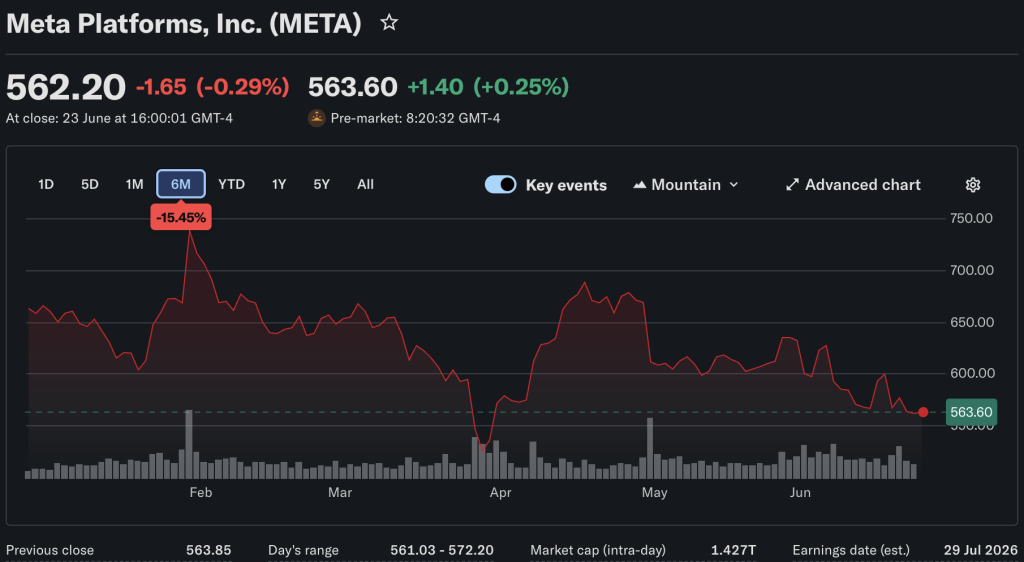
A Meta prediction market has a competitive edge over Polymarket and Kalshi through two main channels. First, its passive discovery enables Facebook and Instagram users to easily encounter and engage with Arena markets without needing to understand prediction markets, set up a crypto wallet, or transfer funds.
This seamless onboarding is unattainable for on-chain platforms. Second, Meta benefits from social graph amplification, as its algorithms can highlight user engagement with markets and notable forecasts, fostering engagement that Polymarket’s crypto-focused approach can’t match.
As of April 2026, the trading volume on Polymarket and Kalshi reached tens of billions, reflecting growth among crypto-savvy users. In contrast, Meta’s 3.56 billion daily active users represent a user base 500 times larger than that of either platform.
Even with a 0.1% conversion rate from Meta’s users to active Arena forecasters, the user count would surpass Polymarket’s monthly active users.
Polymarket’s On-Chain Edge: USDC Settlement, Permissionless Markets, and What Meta Cannot Replicate in a Points System
Polymarket differs from Arena in four key ways that a points-based app cannot match. First, it offers real-money settlement in USDC on the Polygon network, providing actual dollar value instead of platform credits.
Second, all market positions and payouts are recorded on-chain, allowing for verifiability without relying on Meta’s accounting. Third, anyone can create markets on Polymarket, including those related to Meta, where it currently hosts 35 active markets.
Fourth, its positions settle in USDC and integrate with the decentralized finance ecosystem, enabling the direct use of winnings across other protocols.
The 2024 integration of Polymarket into MetaMask enhances this composability, allowing users to trade within the wallet using any EVM-compatible token.
These features appeal to users who prioritize censorship resistance and transparent resolution, areas where Arena’s points economy falls short.
However, volume remains a concern. If Meta’s distribution leads to significantly higher participation in a points economy, Arena’s market prices could surpass Polymarket’s purely on statistical grounds.
The Cash-Wagering Scenario: What Arena Becomes If Meta Crosses Into Real-Money Prediction Markets
The existential threat to crypto prediction markets from Meta occurs only if it adds real-money wagering, which requires either CFTC DCM designation or a partnership with a regulated entity for cash settlement.
Both paths are slow and face significant political scrutiny, especially for Meta given its size and regulatory history with Congress.
The timelines for Meta’s cash-wagering launch, after formal application, are at least 24 to 36 months in a cooperative environment, influenced by Congressional discussions on jurisdiction between the CFTC and SEC.
If Meta successfully navigates regulatory scrutiny, its cash-wagering product will compete with Polymarket on ease of onboarding (no crypto wallet needed), a larger user base, and institutional trust.
At that point, the concern shifts from Polymarket’s survival, thanks to its crypto-native strengths, to whether it can effectively attract mainstream users in the face of Meta’s broad reach.
The author does not hold or have a position in any securities discussed in the article. All prices were quoted at the time of writing.

Tim Baker
Tim Baker is a Senior Market Analyst at Tokenist with over a decade of experience educating readers about traditional finance, crypto and DeFi. A former equity researcher turned on-chain analyst, Tim specializes in regulatory framework shifts and institutional DeFi adoption. His work focuses on distilling complex liquidity cycles and the macro environment into actionable intelligence for the modern DIY investor.


