














Editorial disclosureRead more
All reviews, research, news and assessments of any kind on The Tokenist are compiled using a strict editorial review process by our editorial team. Neither our writers nor our editors receive direct compensation of any kind to publish information on tokenist.com. Our company, Tokenist Media LLC, is community supported and may receive a small commission when you purchase products or services through links on our website. Click here for a full list of our partners and an in-depth explanation on how we get paid.
 By Tim Baker
Calling for a 1000x return in the 2026 bull market is what all crypto traders dream of. Most micro-cap projects fail for a variety of reasons, but if you’re looking for the high-risk, low-liquidity “moonshots” currently floating around, names like Bitcoin Hyper (HYPER), Maxi Doge (MAXI), and LiquidChain (LIQUID) are where that kind of volatility lives.
We’ve seen it happen before with Shiba Inu, Doge, and Solana. Those outliers didn’t just appear; they had specific momentum drivers that separated them from the thousands of tokens that went to zero and actually did a 1000x.
To find the current standouts, we’ve looked at over 100 tokens and filtered for the bare essentials: liquidity that won’t vanish instantly, a functional use case, and a team that isn’t hiding in the shadows. We also ruthlessly consulted and debated with AI’s Grok, ChatGPT, Claude, and Google Gemini to get their takes and work it into our own analysis.
HYPER and LiquidChain look more interesting than the rest under that lens. We’ve broken down the price targets for each below, but keep in mind that even with a data-driven setup, these are still the deepest waters in crypto.
Next 1000x Crypto July 2026: Ranked List

- New Bitcoin L2 presale offering massive staking rewards
- By using a SVM Bitcoin Hyper is revolutionizing Bitcoin's potential
- Early buyers can use $HYPER tokens for transactions, staking, and ecosystem governance

- The Ultimate Evolution of Dog-Themed Memecoins
- 25% of Supply Goes to Future Partnerships & Events
- Proof of Workout/Proof of Winning- Maximum Meme Embodiment

- Unified liquidity across Bitcoin, Ethereum, and Solana
- Faster trading, deeper liquidity, and secure cross-chain capital flow
- Potential to increase interconnectivity for developers

- First AI-Focused Content Creation Premium Platform
- 250M+ Combined Following
- Staking + Creator Benefits
Next 1000x Crypto Candidates at a Glance
 High-Growth Potential Picks — 2026 Bull Run
 High-Growth Potential Picks — 2026 Bull Run
- Bitcoin Hyper (HYPER) — Best Bitcoin L2 scaling play
- LiquidChain (LIQUID) — Leading cross-chain liquidity infrastructure
- BMIC (BMIC)– Post Quantum Cryptography Resistant Wallet
- Divine Ray (DRC)– Live Social Media Platform Built on Cosmos
- Artificial Superintelligence Alliance (FET)– Leading Crypto + AI “Super-Project”
- Maxi Doge (MAXI) — High-Beta Meme with Renounced Ownership
- SUBBD (SUBBD) — Top Creator Economy Utility Token
- Render (RENDER)– Shared Decentralized Global Network of AI Compute
- Bittensor (TAO)– Collaborative Training and Sharing of AI Compute
- Vortex FX (VFX)– Forex Trading and RWA Platform on Blockchain
What Does “1000x Crypto” Actually Mean?
A 1000x crypto is a token that could theoretically turn a small stake into 1,000 times its original value. For example, turning $100 into $100,000. In practice, this kind of return is realistic only for very low-cap projects (typically under $10M market cap) in early-stage sectors like AI agents, DePIN, or Bitcoin Layer-2 scaling, not established top-100 coins. It’s an extreme, high-risk outcome: most low-cap tokens lose most of their value, and a genuine 1000x is rare even within a full bull cycle. Treat any specific “1000x” claim as speculation, not a guarantee.
Top High-Growth Coins Compared
The table below lets you compare each project across the metrics that matter most to early-stage investors: network, sector, and standout features. Use it to shortlist the projects that align with your strategy before reading the full reviews.
| Project | Network | Sector | Presale Price | Audit Status |
Standout Feature
|
| Bitcoin Hyper (HYPER) | Bitcoin L2 / SVM | Layer-2 Scaling | $0.01 | Coinsult / SpyWolf |
65,000 TPS on Bitcoin
|
| LiquidChain (LIQUID) | Layer-3 / Cross-chain | Cross-chain | $0.01 | SpyWolf / CertiK |
Unified BTC/ETH/SOL liquidity
|
| BMIC (BMIC) | Ethereum | Quantum Security | $0.05 | SolidProof / Coinsult |
Post-Quantum Cryptography (PQC)
|
| Divine Ray (DRC) | Cosmos | AI Social Media | $0.00 | SolidProof |
Live Cosmos-based social app
|
| Artificial Superintelligence Alliance (ASI) | Multi-chain | AI Alliance | Launched ($0.21) | 80% (Various) |
Unified Agents, Data, & Compute
|
| Maxi Doge (MAXI) | Ethereum | Meme / Utility | $0.00 | Solidproof / Consult |
0% taxes, renounced ownership
|
| SUBBD (SUBBD) | Multi-chain | AI Creator Econ | $0.06 | Coinsult / SolidProof |
250M combined fan reach
|
| Render (RENDER) | Solana | DePIN / AI | Launched ($10.15) | PeckShield |
Decentralized GPU rendering network
|
| Bittensor (TAO) | Substrate | Decentralized AI | Launched ($420.50) | Community/Peer-Review |
Incentivized ML model marketplace
|
| VortexFX (VFX) | Multi-chain | Web3 Forex | $0.04 | Coinsult / SolidProof |
Web3 Bridge for Real-World Forex
|
In-Depth Reviews of the Best 1000x Candidates
Finding the next 1000x winner is mostly about cutting through the noise. Most of what hits the market is pure junk, so we didn’t just “review” these; we put them through a filter to see what would actually hold up when the hype dies down.
Here is how we narrowed the list down from hundreds of tokens to just these few:
- The Liquidity Floor: If a project has “paper gains” but you can’t sell without crashing the price, it’s a trap. We looked for tokens that have enough depth to actually move.
- The “Why” Factor: A lot of micro-caps are just copies of copies. We prioritized projects like LiquidChain that actually solve a technical bottleneck, rather than just being another meme with a new coat of paint.
- Team Transparency: No “anonymous” devs that disappear after a week. These picks have teams that actually engage and hit their milestones, which is the bare minimum for long-term survival.
Every review below breaks down exactly what the project does and where the real risks are hiding. These are the strongest setups we’ve found for 2026, but let’s be clear: in this corner of the market, you’re looking for outliers. Most things fail, but these have the best structural shot at being the exception.
1. Bitcoin Hyper (HYPER) — Best Overall Layer-2 Presale
The race to scale Bitcoin is the dominant narrative of the current cycle. For Bitcoin to move from a “digital gold” store of value to a functional global currency, it must overcome the 7-transactions-per-second bottleneck. Bitcoin Hyper (HYPER), the first-ever Layer 2 rollup for Bitcoin to integrate the Solana Virtual Machine (SVM), represents a high-performance play in this sector, which is why this is also our top pick as the best crypto presale for 2026. With over $32M raised, it is positioning itself as the “missing link” for mass adoption, and could be the next 1000x crypto.
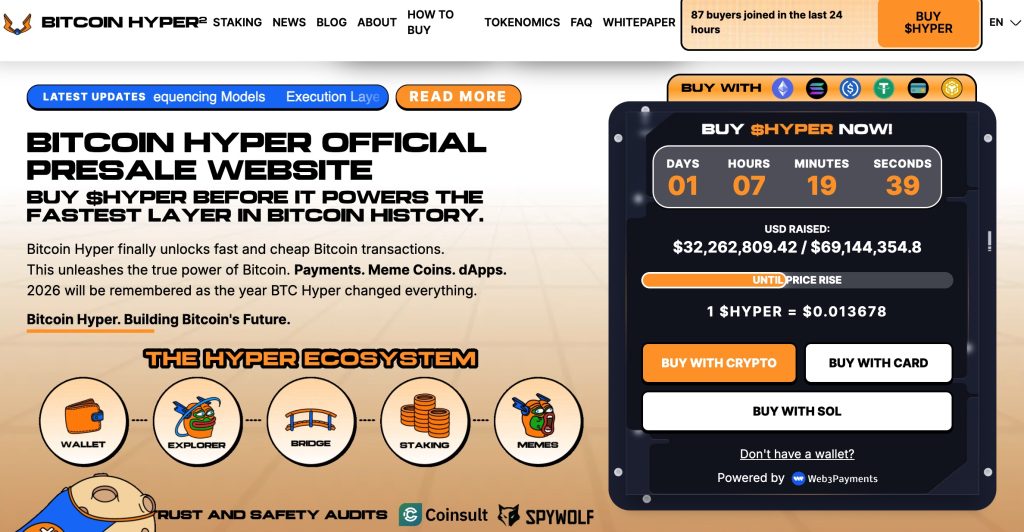
- Blockchain: Native Bitcoin L2
- Current Price: $0.01367810
- Raised So Far: $32.28M
- Audits: SolidProof, Coinsult, SpyWolf
Bitcoin Hyper earns the top spot because it tackles Bitcoin’s limited throughput by targeting an output of 100,000 transactions per second by utilizing the Solana Virtual Machine. The utility of the HYPER token is multifaceted, serving as the native gas, staking, and governance asset for the rollup. With the presale already over 90% funded, the team is moving toward a Q2 listing window.
Pros
- Dual smart contract audits (Coinsult and SpyWolf)
- 65,000 TPS target addresses scalability demand
- Over $32M raised shows strong conviction
Cons
- Presale entry window is closing fast
- Technical complexity of bridging SVM logic to Bitcoin
2. LiquidChain (LIQUID) — Best Cross-Chain Liquidity Play
The next wave of adoption will come from seamless interoperability that allows capital to flow between Bitcoin, Ethereum, and Solana. LiquidChain (LIQUID) is a Layer 3 (L3) settlement protocol attempting to fuse these segmented ecosystems.
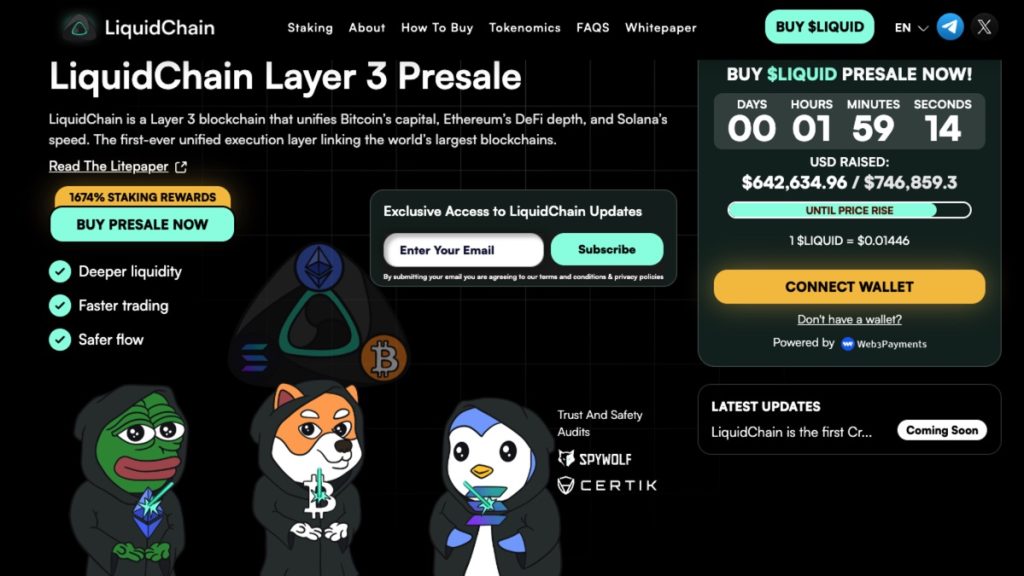
- Blockchain: Layer 3 Settlement
- Staked Tokens: 26M+ LIQUID
- Audits: CertiK, SpyWolf
LiquidChain implements a “Deploy-Once” architecture, allowing developers to access users across all three major chains simultaneously. Despite being early in its fundraising, participants have already staked over 26 million tokens.
Pros
- CertiK and SpyWolf audits provide security validation.
- 26M+ tokens staked indicates high community conviction.
Cons
- Fundraising is still in infancy relative to $20M hard cap.
- Anonymous team results in lower transparency score.
3. BMIC — Quantum-Resistant Web3 Ecosystem
BMIC is tackling post-quantum cryptography. That usually sounds like marketing fluff, but they’re actually integrating NIST-approved standards to future-proof against quantum attacks. It’s a theoretical threat for now, but it’s a decent hedge. The real draw is that they didn’t stop at the wallet. They’ve built the same security framework into their staking portal and credit card system. It’s an integrated setup, not just a collection of bolted-on features. As the threat of quantum computing gets closer, investors are going to start looking at quantum-resistant blockchains, which could drive BMIC to become a 1000x altcoin.
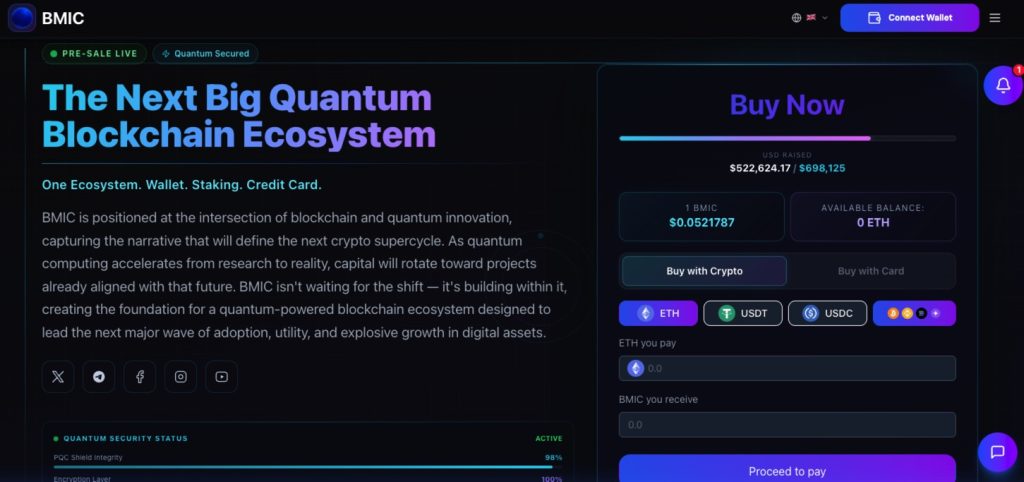
- Blockchain: Ethereum (ERC-20)
- Presale Price: $0.049474
- Amount Raised: $463K
- Audits: SolidProof, Coinsult
Raising $463k this fast is a clear signal: the “quantum threat” is moving from theoretical math to a real market concern. VCs and retail are starting to hedge against it now. The team has already put specific dates on the board for wallet and credit card testing, plus staking. If they stick to the roadmap, Phase 1 should be live in a few months.
The path to a 1000x return is almost always about front-running a massive shift in the narrative. For the 2026–2028 cycle, that shift is the realization that current encryption is vulnerable. BMIC is positioning itself as the first real ecosystem to solve this. But the part that actually works is the “burn-to-compute” tokenomics. You burn tokens to access their AI cloud. It’s a mechanical supply sink. If the compute side actually gets used, the scarcity isn’t just marketing fluff, it’s a math-driven price driver.
Pros
- Zero Public Key Exposure
- Deflationary Burn-to-Compute Model
- Institutional Grade Targeting
- Clean TGE Unlocks
Cons
- Mainnet Not Until 2028
- Quantum Threat May be Theoretical
4. Divine Ray (DRC) — Live Social Media Platform on Cosmos
Divine Ray is a social media platform that’s already live on iOS, Android, and the web. Its native coin, DRC, is built using the Cosmos SDK, which makes it compatible with the rest of the IBC network from day one. It’s rare to see a project this far along in the development cycle, it’s an actual, functional app you can download right now.

- Phase 1: $0.0000015 per DRC
- Phase 2: $0.000002 per DRC
- Phase 3: $0.0000025 per DRC
- Phase 4: $0.0000035 per DRC
- Blockchain: Cosmos SDK
- Total Supply: 5T
- ICO Tokens for Sale: 1.5T
Divine Ray targets creators and communities, spiritual groups, retreat centers, and event organizers, who want crypto tools actually baked into their social platform. DRC isn’t just a speculative ticker; it handles the heavy lifting like memberships, ad buys, and NFT minting within the app.
What’s actually refreshing here is the order of operations. Most crypto presales are just a landing page, a roadmap, and a lot of promises. Divine Ray flipped that. They already have a working social platform, the underlying blockchain infrastructure is live, and DRC has active liquidity on Osmosis. It’s a functional entry point into the Cosmos network, which is a rare find in a sector usually built on vaporware.
Pros
- Live Product
- Soverign Infrastructure with Cosmos SDK
- Immediate DEX Liquidity
Cons
- Hyper Niche Sector
- Network Effect Moat
5. Artificial Superintelligence Alliance (ASI)- Leading Crypto X AI Consortium
The Artificial Superintelligence Alliance (FET) represents the most ambitious consolidation in the history of decentralized AI. By merging Fetch.ai, SingularityNET, and Ocean Protocol, the Alliance aims to create a powerhouse capable of challenging Big Tech’s monopoly on Large Language Models and AGI. The narrative has shifted from individual niche AI protocols to a unified, multi-billion dollar ecosystem designed to provide the infrastructure for an open, decentralized AI future.

- Ecosystem: Unified Decentralized AI (Fetch, SNET, Ocean)
- Current Price: $0.22
- Market Cap: $617.27M
- Infrastructure: Cosmos-based (ASI Mainnet)
- Utility: Governance, compute access, and data monetization
The ASI Alliance earns its position as a market leader because it solves the fragmentation problem in crypto-AI. Instead of competing for the same limited resources, the merger pools together Fetch.ai’s autonomous agents, SingularityNET’s R&D, and Ocean Protocol’s data sharing frameworks. The FET token, eventually transitioning fully to the ASI ticker, serves as the universal currency for decentralized compute and AI services, making it a “pick and shovel” play for the AI era.
Pros
- Largest decentralized AI ecosystem by market cap and developer headcount.
- Combines agentic AI, AGI research, and data privacy in one token
- High liquidity and presence on all major global exchanges.
Cons
- Navigating a three-way migration creates “tokenomics fatigue” for retail users.
- Large-scale mergers can lead to governance bottlenecks compared to leaner startups.
6. Maxi Doge (MAXI) — Best Meme Coin Presale with Utility
Retail capital no longer treats meme tokens as mere experiments; they are leveraged bets on specific communities. Maxi Doge (MAXI) bridges the viral appeal of Doge culture with a “gym-bro” aesthetic, and in our opinion, is the best meme coin to buy now. With over $4.7M raised and a multi-audited foundation, it is emerging as a primary contender in the July2026 market.

- Blockchain: Ethereum (ERC-20)
- Presale Price: $0.00028120
- Hard Cap: $15.7M
- Audits: SolidProof, Coinsult
Maxi Doge distinguishes itself through structural features designed to reduce insider risk, including renounced contract ownership and a 0% transaction tax model. The ecosystem features holder-only trading competitions and a “Maxi Fund” treasury for liquidity provisioning.
Pros
- Renounced ownership eliminates team-controlled “backdoor” risk
- 0% transaction taxes favor organic trading volume
Cons
- High-beta meme branding attracts speculative capital
- Large $15.7M hard cap requires sustained momentum
7. SUBBD (SUBBD) — Best Creator Economy Token
The half-trillion-dollar creator economy is shifting away from centralized platforms that siphon creator earnings. SUBBD (SUBBD) targets the intersection of AI and creator monetization. Unlike “vaporware” projects, SUBBD is already live in beta with over 2,000 creators onboarded,

- Blockchain: Ethereum (ERC-20)
- Staking APY: 20% (Fixed)
- Audits: Coinsult, SolidProof
The token functions as the primary currency for subscriptions, tipping, and unlocking AI-powered tools like voice cloning. Fans can earn 20% APY staking rewards, creating a loyalty incentive that reduces circulating supply.
Pros
- Live beta with 2,000 creators proves immediate utility
- 250M fan reach provides an organic marketing engine
Cons
- $55M hard cap may lead to a longer raise period
- Faces stiff competition from Web2 social giants
8. Render (RENDER)- AI and Decentralized GPU DePIN Project
Render is a decentralized marketplace that lets creators rent spare GPU power from other users. Jules Urbach (founder of OTOY) launched it back in 2017, originally as an ERC-20 token on Ethereum. The actual rendering happens off-chain, but the network uses the blockchain to handle payments and verify that the work was done correctly.
- Blockchain: Ethereum (ERC-20)
- Coin Type: Utility
- Current Price: $1.99
- Market Cap: $1.06B
Render token holders are holding the currency of the network. Creators set up a job, the tokens go into escrow, and node operators get paid once the render is verified, usually through a watermark-based proof. The network handles 3D, VFX, and gaming, but it’s also picking up more AI-heavy tasks like inference. Token holders also have governance rights to vote on the direction of the project.
You can pick up RNDR on most major exchanges and move it to your own wallet. From there, you can use it to pay for rendering power or participate in those governance votes. Ultimately, the value of the network is tied directly to the actual demand for GPU time.
Pros
- Near infinite scalability and global network
- Offers rendering services at low prices compared to AWS or Google Cloud
- Burn-and-Mint Equilibrium model for deflationary mechanics
Cons
- Hardware competition has led to GPU shortages
- Complexity for non-crypto users
- Single point of failure risk with OTOY, creating centralization risk
9. Bittensor (TAO)-AI and Decentralized Machine Intelligence Training and Building Project
Bittensor is a network that pays people to produce useful AI work. It’s organized into “subnets,” which are basically specialized departments for different tasks like generating images, writing code, or scraping data. Miners do the actual work, providing the models or the raw computing power, while validators check the results. The better the output, the more TAO the miners earn.
- Blockchain: Subtensor
- Coin Type: Utility
- Current Price: $306.10
- Market Cap: $6.43B
TAO is the currency that actually makes the network function. You use it to pay fees, stake for security, and vote on how the system should change. It’s also the “buy-in” required to register or run a subnet. Unlike many projects that reward you just for showing up, Bittensor distributes tokens to miners and validators based strictly on performance. Like Bitcoin, the total supply is hard-capped at 21 million, making TAO a legit contender as the next crypto to explode.
The investment case here depends entirely on real-world usage. If we don’t see a shift where these subnets become a go-to resource for daily AI tasks, the network risks becoming a closed loop where builders just pay fees back and forth. It’s still a high-risk play. The competition is moving incredibly fast, and there’s a real danger that rewards could end up concentrated among just a few dominant subnets, leaving the rest of the network behind.
Pros
- Permissionless Innovation- Anyone can launch a subnet
- Institutional Adoption
- Supply Scarcity with over 80% of TAO Staked
Cons
- Governance Friction
- Complexity for non-crypto users
10. Vortex FX (VTX)- Web3 Bridge Focused on RWA Forex Trading
Vortex FX isn’t just another speculative crypto project; it’s built on top of an existing, high-volume trading business. They are already moving over 1,500 lots a day across forex, gold, and crypto.
What’s interesting here is how they’re pushing into the Real World Asset (RWA) space. While most RWA projects are trying to tokenize real estate or treasury bills, which can be a slow, regulatory nightmare, Vortex is focusing on the $7.5 trillion-a-day forex market. They’re essentially bridging the gap between decentralized finance and traditional currency markets. By bringing institutional-grade forex trading on-chain, they’re giving retail users a way to tap into the kind of liquidity and volume that usually stays locked behind big bank desks. It’s a smart play: forex is the ultimate “real world asset,” and Vortex is betting that the next wave of DeFi growth will come from tokenizing these massive, established cash flows.
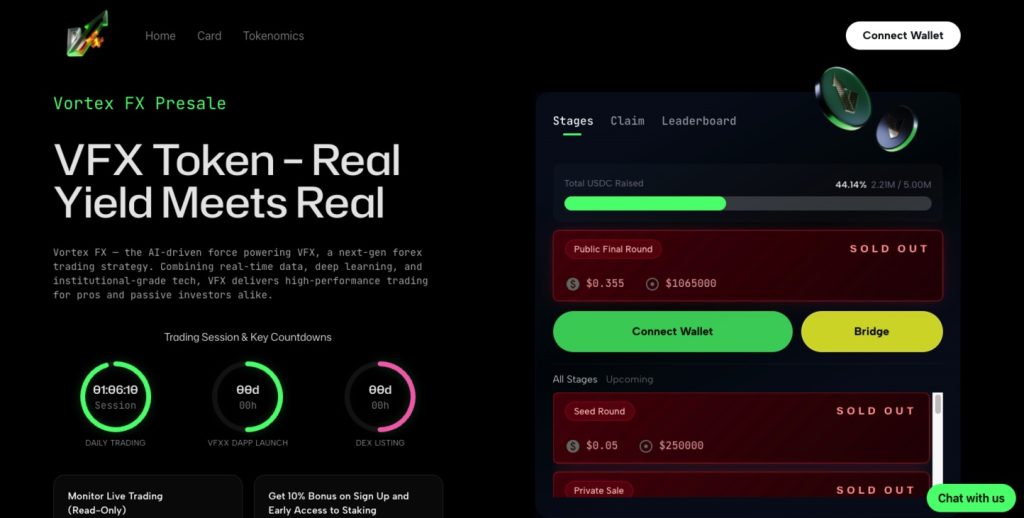
- Blockchain: Ethereum
- Coin Type: Web3
- Price: $0.355
- Amount Raised: $2.21
Traders use the VFX token as the main interface for the platform, which lets them stake for a share of the action. Holding it also unlocks zero-fee trading tiers and gets you into their daily trading debates.
The token is currently in presale at $0.355, with staking rewards sitting at an APY of up to 67.7%. It’s a high yield, but the real test is whether the team can scale their Web3 features without losing their edge in actual trading performance. If they manage to bridge that gap, there’s a clear path for the token to break out, though like anything in presale, it’s a “wait and see” on the execution.
Pros
- Regulatory Positioning with Rare Offshore Anjouan Licensing
- Dual-Market Utility
- Presale Momentum with 40% of Hard Cap Reached
Cons
- Opaque Operational Rules
- High Volatility Target
The Next 1000X Crypto Projects According to AI
We asked ChatGPT, Grok, Gemini, and Claude to each select 5 projects with 1000X potential based on our criteria above, and these were the results and the reasoning why:
ChatGPT Crypto Predictions:
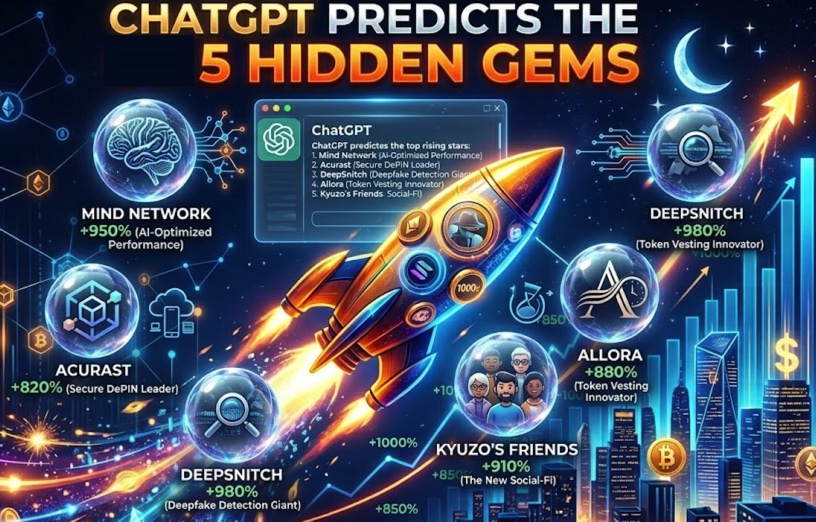
Mind Network (FHE)
- Why: It utilizes Fully Homomorphic Encryption (FHE), allowing AI models to compute on encrypted data without ever seeing the raw input. It sits at the intersection of AI and absolute privacy, a narrative that is becoming a “must-have” for institutional adoption in 2026.
Acurast (ACU)
- Why: This DePIN project turns the billions of idle smartphones globally into a decentralized cloud-compute network. By leveraging existing mobile hardware rather than requiring specialized rigs, it has a massive, low-friction path to scaling its infrastructure.
DeepSnitch (AI)
- Why: A micro-cap security layer that uses AI to detect on-chain exploits and “deepfake” wallet behavior in real-time. As DeFi total value locked (TVL) hits new highs, the demand for autonomous, AI-driven security protocols is significantly outstripping current supply.
Allora (ALLO)
- Why: It is a decentralized “intelligence” network that aggregates machine-learning models to provide self-improving predictions. Instead of just “AI on blockchain,” it creates a marketplace for specialized AI agents, making it a foundational layer for autonomous finance.
Kyuzo’s Friends (KO)
- Why: A high-risk GameFi and SocialFi play that integrates adaptive AI characters into a mass-market mobile app (LINE). It targets the “retail viral” segment; if it captures even a fraction of the traditional gaming market, the upside from its current micro-cap status is mathematically massive.
Grok Crypto Predictions
Monad (MON)
- Why: It’s Ethereum if it actually went to the gym. Parallel execution is the holy grail for degens who are tired of waiting for a transaction to clear while the market dumps. If this scales, legacy L1s are basically museum pieces.
Morpheus (MOR)
- Why: Decentralized AI compute. It’s aiming to make AI personal and permissionless rather than a corporate leash. It’s the “free speech” play for the machine-learning age.
Nillion (NIL)
- Why: “Blind computation” is a technical middle finger to the surveillance state. It lets the network process data without ever “seeing” it. In a world where Big Tech sells your data before you’ve even typed it, this is the ultimate privacy play.
Peaq (PEAQ)
- Why: The DePIN king. It’s the backbone for the “Economy of Things.” If your self-driving car ever starts earning its own crypto to pay for its own repairs, it’ll probably be running on Peaq.
GIGA (GIGA)
- Why: Pure, unadulterated culture. Sometimes the best “utility” is just a meme that scares the people who wear suits to work. It’s a bet on the Giga-Chad energy that actually runs the internet’s attention economy.
Claude Crypto Predictions
Bitcoin Hyper (HYPER)
- Why: This represents the first true Layer 2 to bring the Solana Virtual Machine (SVM) to Bitcoin. By batching transactions through an SVM rollup while settling on the main Bitcoin chain, it allows for near-instant finality and sophisticated DeFi on the world’s most secure network. Its “Canonical Bridge” is a critical piece of infrastructure for 2026 Bitcoin-native utility wave.
LiquidChain (LIQUID)
- Why: Positioning itself as a “Layer 3” liquidity layer, LiquidChain aims to solve the industry’s fragmentation problem. It allows developers to deploy an application once and natively access liquidity from Bitcoin, Ethereum, and Solana simultaneously. Its “Unified Liquidity Layer” removes the need for high-risk wrapped assets, making it a prime candidate for institutional adoption.
DeepSnitch (AI)
- Why: A high-conviction play in the AI-security sector. With a market cap often floating under $10M, DeepSnitch uses autonomous AI agents to monitor on-chain exploit patterns and “rug-pull” signals in real-time. As DeFi TVL reaches new highs in 2026, the demand for decentralized, automated risk management is becoming non-negotiable.
Monad (MON)
- Why: Though more established, its parallelized EVM execution is the holy grail for L1 scaling. By allowing transactions to process simultaneously rather than sequentially, it offers the performance of Solana with the developer ecosystem of Ethereum. If it becomes the primary home for high-frequency trading apps, the upside remains mathematically massive.
Nillion (NIL)
- Why: Utilizing “Blind Computation,” Nillion allows sensitive data to be processed by a network without the nodes ever actually seeing the data. In a 2026 environment where AI companies are desperate for private datasets and users are increasingly privacy-conscious, this provides a unique, non-blockchain-based cryptographic primitive that could redefine data sovereignty.
Google Gemini AI Crypto Predictions
Bitcoin Hyper
- Why: Actually, it’s the first time we’ve seen Solana-level speed on the most secure network in existence. If the market shifts from “Bitcoin as digital gold” to “Bitcoin as a programmable ecosystem,” this is the primary toll booth.
Mind Network
- Why: Privacy is the biggest bottleneck for institutional AI. Mind Network lets machines compute on data without ever “seeing” it. In a world where data leaks are corporate suicide, this isn’t just a feature; it’s the entire value proposition.
Acurast
- Why: Most DePIN projects fail because they require people to buy expensive, proprietary “miners.” Acurast uses the smartphone in your pocket. It’s the lowest-friction path to decentralized cloud compute I’ve seen.
Allora
- Why: Instead of just putting “AI on a blockchain,” Allora creates a marketplace where different AI models compete and collaborate. It’s the closest thing we have to a decentralized brain for the financial layer.
Nillion
- Why: It’s not a blockchain, it’s something more fundamental. It breaks data into “shards” across a network, allowing for processing without decryption. If you think the future of the internet requires absolute data sovereignty, this is the infrastructure play.
How We Chose the Next 1000x Candidates
Our methodology focuses on fundamental health rather than hype. To identify the best crypto presales 2026, we assessed the following:
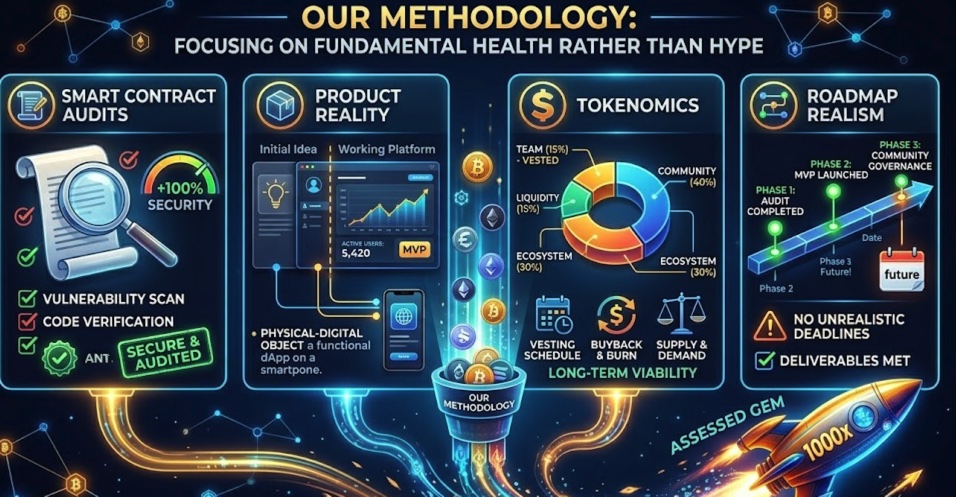
- Smart contract audits: Projects must be audited by at least two recognized firms (e.g., CertiK, Coinsult.)
- Product reality: We prioritize live betas or technically specific use cases over whitepaper-only proposals.
- Tokenomics: We review presale price, hard cap, and vesting structures to ensure long-term sustainability.
- Roadmap realism: Evaluating whether technical milestones (like HYPER’s 65,000 TPS) are achievable.
What Makes a Crypto 1000x?
Finding a project that pulls a 1000x return isn’t just about luck; it’s about spotting a specific set of conditions before the rest of the market catches on. If you’re looking for that kind of exponential growth, these are the five levers that actually move the needle.
Real Utility and a Reason to Exist
Most tokens are just noise with no utility or simply act as a way to fund those working on the project. The ones that actually scale usually solve a nagging problem or create a service people can’t get elsewhere. If the token is a “native utility” that people have to buy to use the platform, it creates a natural floor for demand. Without a use case, you’re just gambling on a game of musical chairs.
The Power of a “Cosign.”
When a startup partners with an established player, it’s more than just a press release. It’s an informal stamp of approval that solves the credibility problem overnight. Whether it’s technical consulting or just access to a larger user base, these endorsements act as a massive shortcut for growth.
Community and the FOMO Engine
An active community is the most effective marketing department in the world. When you have a group of people who are genuinely obsessed with a project, they create an atmosphere of urgency. That social proof often turns into FOMO (fear of missing out), which is the primary driver behind those vertical price charts we all look for.
CEX Listings: Opening the Floodgates
A token can have the best tech in the world, but if it’s a nightmare to buy, the price won’t move. Moving from a niche decentralized exchange (DEX) to a major centralized exchange (CEX) provides the liquidity and “one-click” accessibility needed for retail investors to pile in. Every major listing is essentially a massive expansion of the project’s potential buyer pool.
Sentiment and the “Narrative”
The biggest runs happen when a project aligns with whatever the market is currently obsessed with; whether that’s AI, Layer 2 scaling, or RWA tokenization.
Look at what happened in late 2025. Bitcoin hit $126,173 in October after a US government shutdown and a weakening dollar. That macro chaos made the “digital gold” narrative feel real again, and the rest of the market followed. If a project has solid fundamentals and happens to be in the right place at the right time, that’s when you see those legendary 1000x runs.
Sectors Likely to Experience 1000x Gains
Those looking for 1000X gains need to know which sectors to watch. We feel projects in the following sectors offer the best asymmetric bets as these projects are where the capital already exists.
- Infrastructure (L2s, L3s, & Cross-Chain): The “L1 wars” are over; the focus now is on the “Internet of Value” abstraction. Projects like Bitcoin Hyper, bringing the SVM to Bitcoin, and Layer 3s that solve the liquidity fragmentation problem are the current high-yield zones. When you fix the “speed vs. security” bottleneck for the world’s largest asset, the growth isn’t just linear.
- Decentralized Artificial Intelligence (DeAI): We’ve moved past the “AI-flavored whitepaper” phase. The 1000x potential now lies in Verifiable On-Chain Revenue (VOC); think decentralized GPU clusters (like Render’s 2026 pivot) and AI coordination layers that provide “Proof of Inference.” As compute becomes the world’s most valuable commodity, the protocols owning the supply chain are the ones to watch.
- Privacy for Corporate Financials: This is the missing link for institutional adoption. Corporations can’t use public ledgers if every vendor payment or treasury move is visible to competitors. The massive upside here is in Zero-Knowledge (ZK) infrastructure that allows for “Selective Disclosure.” This lets a CFO prove they are compliant and solvent without leaking the company’s entire financial history. It turns privacy from an ideology into a mechanical necessity for enterprise.
- Next-Gen Security & Wallets: Account abstraction has finally killed the 24-word seed phrase. The 1000x bets are in the security layers that use AI to monitor on-chain exploit patterns in real-time. As DeFi TVL hits new records, the demand for “autonomous insurance” and self-healing wallets is outstripping supply.
- Cultural Assets & Memes: Many people call this “gambling,” but in 2026, attention is a measurable resource. These projects rely on pure timing and social sentiment. While the risk of a total wipeout is high, the few that achieve “cultural permanence” represent the fastest, most aggressive path to 1000x returns, provided you have the stomach for the volatility.
FAQs: Next 1000x Crypto
Based on our evaluation of utility, audit quality, fundraising momentum, and market fit, Bitcoin Hyper (HYPER) is the top overall pick for the crypto most likely to 1000x in 2026. It has raised over $32.26M toward its hard cap, carries dual audits from Coinsult and SpyWolf, and targets 65,000 TPS using a Solana VM on Bitcoin, a credible technical approach to one of crypto’s longest-standing scaling challenges. Maxi Doge is a strong alternative depending on your sector preference.
Crypto presales often have a strong chance of doing a 1000x ROI during strong market conditions. The reason is that they have a tiny market cap, making a 1000x easier to achieve. Plus, crypto presales are highly attractive to retail investors as everyone piles in to skyrocket the investment. Crypto presales are the crypto equivalent of TradFi IPOs, only available to privileged investors, who often experience extraordinary gains
Legitimate presales share several verifiable characteristics: smart contract audits from recognized firms (CertiK, Coinsult, SolidProof, SpyWolf), a clearly stated hard cap, a working product or detailed technical roadmap, team transparency, and an official website with consistent social media presence. Red flags include no audit, anonymous teams with no product evidence, unrealistic return promises, and presale links circulated only through influencer channels. Always verify the contract address in the audit report before signing any transaction.
To pull this off, you have to ignore the Top 100 and hunt in the micro-cap abyss, specifically targeting projects with market caps under $1M that solve institutional bottlenecks, like Bitcoin Hyper’s SVM integration or FHE-based privacy for corporate financials. You’re looking for the “pre-hype” phase, buying on a DEX before a major exchange listing is even a whisper. The reality check is that you’ll need to treat that $100 as a sunk cost, likely spreading it across ten different “lottery tickets” and accepting that nine will go to zero while hoping one hits the narrative jackpot. Most people fail because they sell when their $100 hits $10,000; to hit a million, you have to have the stomach to watch life-changing gains swing through 60% drawdowns without blinking.
Vesting refers to the schedule by which presale tokens become available to claim and sell after the token generation event. A vesting schedule might release tokens linearly over six to twelve months, or it might release a percentage at TGE with the rest unlocking in tranches. Vesting protects the market from immediate sell pressure when a project launches, but it also means presale investors cannot liquidate their position instantly. Always check the vesting terms before committing capital to any presale.
For July2026, the leading entries on the top 10 presale crypto rankings include Bitcoin Hyper, Maxi Doge, LiquidChain, and SUBBD, all of which have been highlighted for their audit status and utility by independent analysts. These projects represent a range of sectors: Layer-2 scaling, meme utility, cross-chain DeFi, and creator economy, giving investors diversified early-stage exposure.
Final Thoughts
For investors seeking the next 1000x opportunity, Bitcoin Hyper stands out as the top overall pick for its infrastructure credibility and $32M in funding. SUBBD offers a direct play on the creator economy, while Maxi Doge suits those looking for meme upside with structural protections like renounced ownership. Always conduct your own due diligence and double-check contract addresses before participating.

Tim Baker
Tim Baker is a Senior Market Analyst at Tokenist with over a decade of experience educating readers about traditional finance, crypto and DeFi. A former equity researcher turned on-chain analyst, Tim specializes in regulatory framework shifts and institutional DeFi adoption. His work focuses on distilling complex liquidity cycles and the macro environment into actionable intelligence for the modern DIY investor.