













 BTC+2.69%
Market Analysis
BTC+2.69%
Market Analysis
IBIT Hits 734,762 BTC as BlackRock July Inflows Push Polymarket Odds to 60.5%
BlackRock's IBIT added $116M in Bitcoin on July 21, lifting holdings to 734,762 BTC and pushing Polymarket's $67,500 BTC odds to 60.5% by July 31.


Editorial disclosureRead more
All reviews, research, news and assessments of any kind on The Tokenist are compiled using a strict editorial review process by our editorial team. Neither our writers nor our editors receive direct compensation of any kind to publish information on tokenist.com. Our company, Tokenist Media LLC, is community supported and may receive a small commission when you purchase products or services through links on our website. Click here for a full list of our partners and an in-depth explanation on how we get paid.
The BlackRock iShares Bitcoin Trust (IBIT) added $116M in inflows on July 21, 2026, continuing a reversal of flows tied to the May–June outflow streak, which saw IBIT shed roughly $3.3 billion.
The purchase was likely facilitated through IBIT’s iShares Bitcoin Trust (IBIT) ETF and represents one of the more consequential single-session inflow prints since the fund’s recovery arc began on July 2.
This ETF data drop comes as Bitcoin surged above $66,000, currently trading for $66,300 with a +3.5% daily gain and a 24-hour trading volume of $31.5Bn.
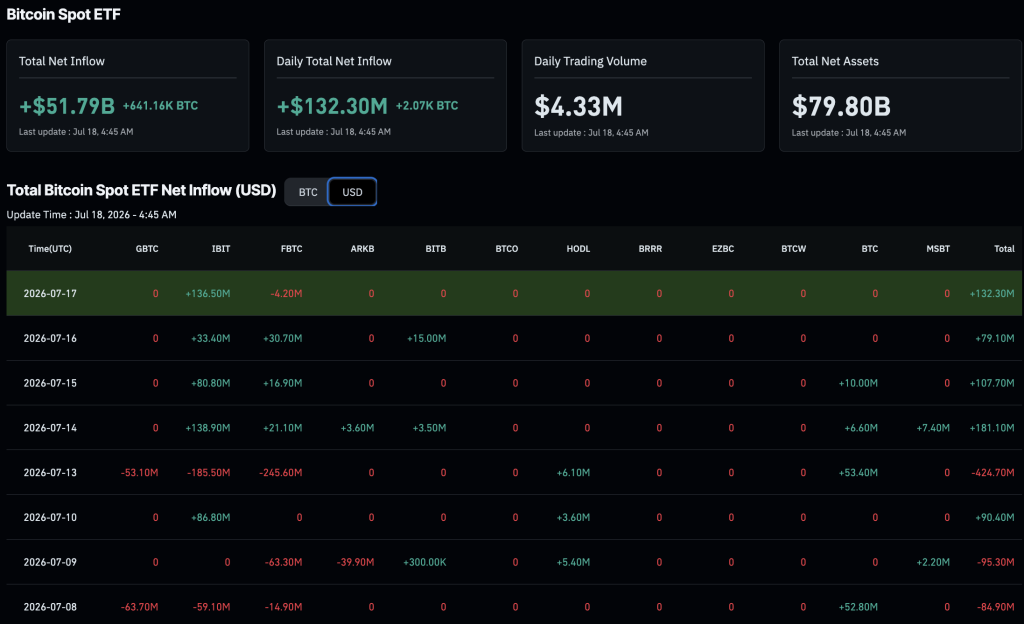
Blackrock IBIT Bitcoin Flow Reversal Mechanics: The $3.3Bn Outflow Streak and What the July Recovery Arc Reveals
The $116M July 21 inflow comes after the May–June outflow cycle that was followed by a return to net inflows. According to CoinGlass data, US spot Bitcoin ETF outflows totaled $2.73Bn over a 10-day streak that ended on July 2.
IBIT accounted for approximately $3.3Bn in redemptions during the broader May–June cycle. Weekly outflow volumes compressed from approximately $2Bn at the streak’s peak to roughly $700M as BTC recovered above $64,000.
The reversal sequence unfolded in three identifiable phases. The first positive session on July 2 produced $216M in net inflows across US spot Bitcoin ETFs; July 6 followed with $294.8M; and July 7 saw Blackrock IBIT post a single-day inflow of $187.2M, bringing its total to $209.4M, its largest print in weeks.
This drove total cross-fund inflows to $265.7M over a two-day window, per CoinGlass. The three-session window from July 2 through July 7 yielded approximately $510.7M in cumulative net inflows, establishing the structural case that the outflow streak had exhausted itself rather than merely paused.
Macro Backdrop and Institutional Context: How Softening Rate Expectations Are Channeling Capital Back Into Spot ETF Structures
The May–June outflow cycle was structurally driven by sustained upward pressure on 10-year Treasury yields, which elevated the opportunity cost of holding non-yielding assets like Bitcoin and triggered tactical de-risking among institutional allocators who had built positions through IBIT during the fund’s earlier accumulation phase.
The transmission channel now operating in the opposite direction runs through softening rate expectations, reducing the relative yield penalty for Bitcoin exposure, combined with BTC prices sitting approximately 20% below mid-May highs, a price point that institutional allocators appear to be treating as a tactical re-entry level.
IBIT’s scale means this re-engagement is not frictionless: at 734,762 BTC and an approximate AUM of $76Bn, even modest percentage-of-AUM inflows translate to nine-figure daily acquisition volumes that visibly move the structural supply-demand balance.
Butterfill characterized the early July inflows as the largest since the outflow cycle began in early May, describing the current window as a repair observation phase rather than a confirmed recovery, a distinction that remains relevant as the July 21 print extends, but does not yet definitively confirm, the inflow trend.
$67,500 as the Pivot Level: What Sustained IBIT Inflows and Polymarket Repricing Mean for Bitcoin’s Next Move
The bull case hinges on sustained IBIT inflows through July, supported by macro data such as inflation trends and Federal Reserve guidance, with the potential to reach $67,500.
Conversely, the bear case involves a resumption of outflows, in which a large redemption could prompt a reassessment of the current recovery as just a short-term bounce, especially if SEC regulatory actions introduce uncertainty for spot ETFs.
MEXC analysts have set $70,000 as the level indicating a full structural reversal, with only a 23.5% probability according to Polymarket data.
The base case anticipates consolidation between $64,000 and $67,500 as market participants evaluate whether recent inflows signal lasting institutional interest or merely tactical dip-buying, while keeping an eye on any SEC developments that could affect ETF structures.
Disclaimer: The author does not hold or have a position in any securities discussed in the article. All stock prices were quoted at the time of writing.

Tim Baker
Tim Baker is a Senior Market Analyst at Tokenist with over a decade of experience educating readers about traditional finance, crypto and DeFi. A former equity researcher turned on-chain analyst, Tim specializes in regulatory framework shifts and institutional DeFi adoption. His work focuses on distilling complex liquidity cycles and the macro environment into actionable intelligence for the modern DIY investor.
Related Stories
 Market Analysis
Consensys Confirms North Korean DPRK Contractor Accessed MetaMask Code for a Month
 Market Analysis
SpaceX Drops to $132.75 All-Time Low as Lockup Overhang and AI Repricing Weigh on SpaceX Stock
 Market Analysis