 LAB+6.55%
DeFi
LAB+6.55%
DeFi
Kraken Aave News: AAVE Founder Unveils Token Buyback Overhaul as Kraken Equity Talks Emerge
Payward Asset Management is in early talks to buy 15% of Aave Group for ~$71M in ETH and AAVE tokens, as founder Kulechov counters with Aavenomics 3.0 buyback plans.


Editorial disclosureRead more
All reviews, research, news and assessments of any kind on The Tokenist are compiled using a strict editorial review process by our editorial team. Neither our writers nor our editors receive direct compensation of any kind to publish information on tokenist.com. Our company, Tokenist Media LLC, is community supported and may receive a small commission when you purchase products or services through links on our website. Click here for a full list of our partners and an in-depth explanation on how we get paid.
In Kraken Aave news today, Kraken’s parent company, Payward Inc., is in early-stage talks to acquire a 15% common equity stake in Aave Group at a $385M valuation, citing three people with knowledge of the matter, with the proposed consideration structured as 35,000 ETH plus 250,000 AAVE tokens, worth approximately $71M combined, in exchange for the equity position and a token allocation.
The implied valuation sits at roughly 30% of AAVE’s ~$1.32Bn fully diluted valuation, a ~70% discount that Aave founder Stani Kulechov publicly rejected within 24 hours of the report landing.
Kulechov wrote on X: “First off, there is NO WAY we’d sell AAVE at a 70% discount lol,” calling CoinDesk’s framing “inaccurate” while stopping short of denying that token or partnership discussions had taken place at all.
The distinction matters: what Kraken is reportedly pursuing is equity in Aave Group, the corporate entity, not a direct secondary purchase of AAVE tokens at a discount, and that structural difference sits at the center of one of the more substantive valuation debates DeFi M&A has produced.
Kraken Aave Deal Mechanics: 35,000 ETH for Equity and Tokens, With Payward Asset Management as the Acquiring Vehicle
According to a document seen by CoinDesk, Payward plans to transfer 35,000 ETH (about $71M) to acquire 250,000 AAVE tokens and a 15% equity stake in Aave Group.
Kraken is looking to form a co-investor consortium for the deal. No agreement has been finalized; Kraken declined to comment, and Aave did not respond.
This investment would mark Payward Asset Management’s first, a newly established DeFi branch ahead of Payward’s expected IPO.
A source noted that Payward is well-capitalized and views the Aave position as the beginning of a series of DeFi investments. Payward’s financial backing includes the $550M acquisition of Bitnomial and a planned $20B valuation raise.
Despite Aave’s multi-chain total value locked (TVL) being in the tens of billions and generating approximately $134M in annual revenue, the $385M equity valuation seems low.
Kraken has also integrated Aave’s infrastructure through its layer-2 network, Tydro, providing familiarity with the codebase before any equity discussions.
Kulechov’s Public Rejection: Why Equity Value and FDV Are Not the Same Number, and Why That Distinction Does Not Fully Resolve the Dispute
Kulechov’s rebuttal highlights a key methodological distinction: equity in Aave Group differs from AAVE token market capitalization.
The Aave DAO controls economic rights and tokenomics, whereas Aave Labs, which Kraken would potentially acquire, is a service provider with no direct revenue from the protocol or the GHO stablecoin.
Evaluating $385M equity against $1.32Bn FDV conflates two separate claims on different cash flow streams.
Kulechov noted that Kraken Aave Labs has AAVE allocations that others have shown interest in purchasing through potential partnerships, countering the notion that it would sell below market value.
Grayscale’s research suggested a fair value of AAVE up to $175 per token, complicating private equity valuation when applied at a discount.
The KelpDAO exploit in April, in which the Lazarus Group minted ~$292M in unbacked rsETH and left Aave with substantial bad debt, created a context in which a discounted entry may seem feasible for Kraken.
Although deposits have stabilized around $12B since the incident, it presented an opportunity for strategic capital to engage.
Aavenomics 3.0: An Automated AAVE Buyback Signals That Token Value Accrual, Not Equity Sales, Is the Protocol’s Strategic Direction
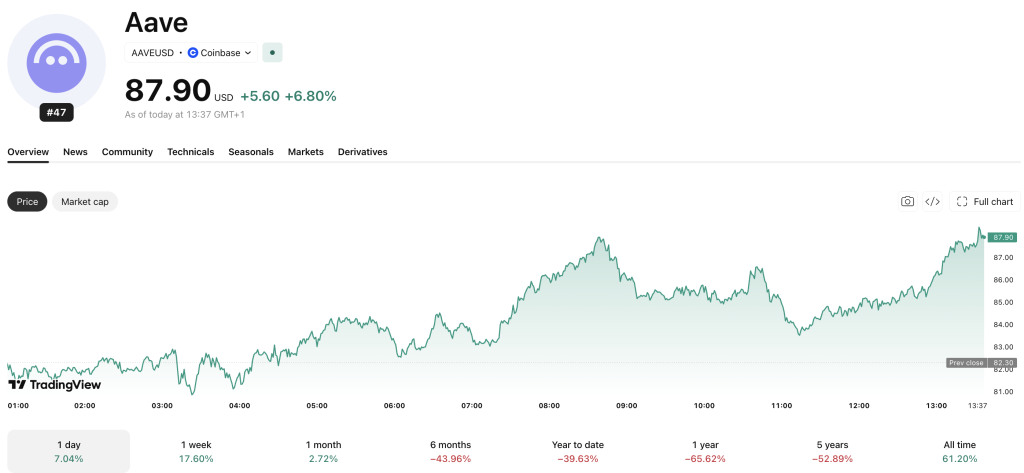
Kulechov leveraged the deal controversy to preview Aavenomics 3.0, announcing that 100% of protocol and GHO revenue will go to AAVE token holders.
This includes the existing $50M/year discretionary buyback program, supplemented by a new automated AAVE buyback mechanism.
By ensuring that token holders automatically receive all economic output, the rationale for selling equity at a discount weakens.
Though the full Aaveconomics 3.0 proposal is not yet in Aave governance forums, Kulechov’s posts provide the first glimpse. The automated buyback will eliminate committee discretion, making repurchases a protocol-level commitment.
This is significant for AAVE holders, as discretionary programs can be suspended, while automated mechanisms require governance action to halt.
This follows the Aave DAO’s approval of a $25M stablecoin funding package for Aave Labs, which passed with 75% approval.
The combination of a funded lab, recovering TVL, and the Aavenomics overhaul supports Kulechov’s argument against discounted equity transactions.
The author does not hold or have a position in any securities discussed in the article. All prices were quoted at the time of writing.

Tim Baker
Tim Baker is a Senior Market Analyst at Tokenist with over a decade of experience educating readers about traditional finance, crypto and DeFi. A former equity researcher turned on-chain analyst, Tim specializes in regulatory framework shifts and institutional DeFi adoption. His work focuses on distilling complex liquidity cycles and the macro environment into actionable intelligence for the modern DIY investor.