















Editorial disclosureRead more
All reviews, research, news and assessments of any kind on The Tokenist are compiled using a strict editorial review process by our editorial team. Neither our writers nor our editors receive direct compensation of any kind to publish information on tokenist.com. Our company, Tokenist Media LLC, is community supported and may receive a small commission when you purchase products or services through links on our website. Click here for a full list of our partners and an in-depth explanation on how we get paid.
 By Tim Baker
Identifying the next crypto to explode is no longer a game of chasing viral tweets; in 2026, it is a disciplined exercise in data analysis. The strongest breakout signals now involve rising on-chain activity, accelerating developer commits, and alignment with dominant narratives like AI agents, Bitcoin scaling, and cross-chain liquidity. While the broader market remains volatile, a selective group of projects is showing the measurable adoption required for outsized growth.
This guide provides a ranked shortlist of high-potential tokens, a technical comparison of the market’s most promising entries, and the specific methodology we use to filter signal from noise.
The Next Crypto to Explode 2026: Ranked List

- New Bitcoin L2 presale offering massive staking rewards
- By using a SVM Bitcoin Hyper is revolutionizing Bitcoin's potential
- Early buyers can use $HYPER tokens for transactions, staking, and ecosystem governance

- The Ultimate Evolution of Dog-Themed Memecoins
- 25% of Supply Goes to Future Partnerships & Events
- Proof of Workout/Proof of Winning- Maximum Meme Embodiment

- Unified liquidity across Bitcoin, Ethereum, and Solana
- Faster trading, deeper liquidity, and secure cross-chain capital flow
- Potential to increase interconnectivity for developers

- First AI-Focused Content Creation Premium Platform
- 250M+ Combined Following
- Staking + Creator Benefits
Next Crypto to Explode: Quick Picks
 Top Potential Breakouts for May 2026
 Top Potential Breakouts for May 2026
- Bitcoin Hyper (HYPER) — Leading Bitcoin Layer-2 scaling play
- Maxi Doge (MAXI) — High-engagement meme with utility incentives
- SUBBD (SUBBD) — AI-powered creator economy platform
- BMIC (BMIC)– Quantum Computing Security Play
- LiquidChain (LIQUID)– Cross-chain Liquidity Presales Project
- Solana- The High-Speed Backbone of the 2026 Retail Economy
- Chainlink- The Computing Platform for Global Finance
Top Breakout Candidates Compared
The table below compares the candidates for the next crypto to explode based on the metrics that drive 2026 valuations: network choice, sector fit, and audit security. Use this matrix to identify which projects align with your risk tolerance before reading the deep-dives.
| Project | Network | Sector | Price | Hard Cap/Market Cap | Raised | Audit Status |
Standout Feature
|
|
| Bitcoin Hyper (HYPER) | Bitcoin L2 / SVM | Scaling Solution | $0.01 | $52.8M | $32.50M | SolidProof, Coinsult |
Solana VM on Bitcoin L2
|
|
| Maxi Doge (MAXI) | Ethereum | Meme / Utility | $0.00 | $15.7M | $4.75M | Coinsult, SolidProof |
Community Trading Contests
|
|
| SUBBD (SUBBD) | Ethereum | AI Creator Economy | $0.06 | $55M | $1.53M | SolidProof, Coinsult |
20% APY + AI Voice Tools
|
|
| BMIC (BMIC) | Ethereum | Quantum Security | $0.05 | TBA | $296K | Internal/Verified |
Post-Quantum Cryptography
|
|
| LiquidChain (LIQUID) | Layer-3 | Cross-chain Liquidity | $0.01 | $20M | $62.9K | CertiK, SpyWolf |
BTC/ETH/SOL Interop
|
|
| Solana (SOL) | Solana | High Speed Layer 1 | $95.42 | $49,048,972,507 | N/A | Kudelski, Trail of Bits, Neodyme, OtterSec | Fast and Low Cost L1 | |
| Chainlink (LINK) | Multi-Chain | Oracle | $15.67 | $6,772,671,217 | N/A | Trail of Bits, Sigma PRime, PWC, CertiK | The Leader in Crypto Oracles and Cross-Chain Communication |
In-Depth Analysis: Which Crypto Will Explode in 2026?
Predicting the next crypto to explode requires looking beyond whitepapers to evaluate real-world demand. The entries below represent the projects with the strongest technical catalysts and community momentum heading into Q2 2026.
1. Bitcoin Hyper (HYPER) — The Bitcoin Scaling Catalyst
While Bitcoin remains the world’s premier store of value, its lack of native smart contracts has historically limited its utility in decentralized finance. In 2026, the race to unlock the trillions of dollars in dormant Bitcoin capital has become the most profitable narrative in crypto. Projects that can offer institutional-grade speed without compromising Bitcoin’s security are the primary candidates for a major breakout.
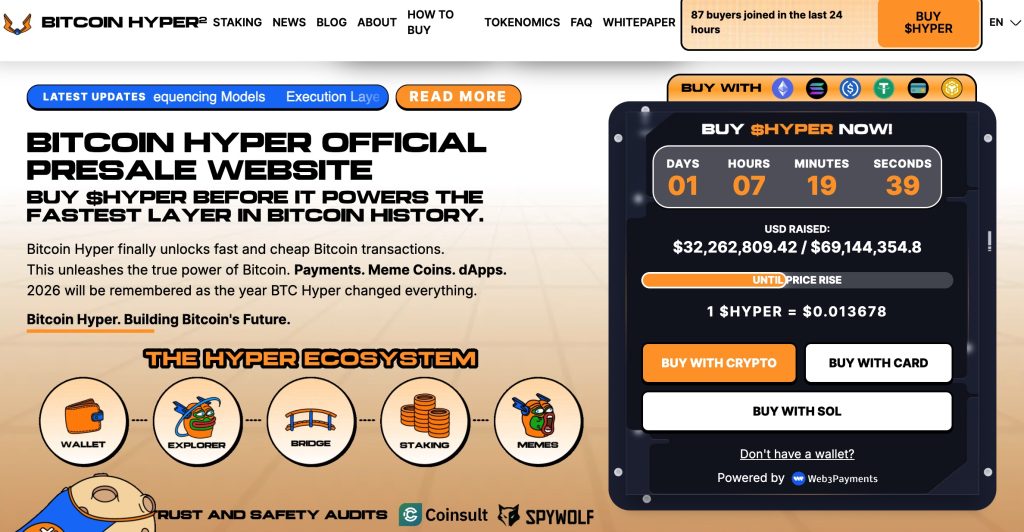
Bitcoin Hyper (HYPER) is positioning itself as the infrastructure winner by integrating the Solana Virtual Machine (SVM) as a Layer-2 rollup for Bitcoin, which makes this our best crypto presale pick of 2026. This allows for sub-second finality and high-frequency trading while settling data back to the Bitcoin mainnet. With over $32.5M raised and a participant count exceeding 112,000, HYPER is not just a concept; it is a massive community-backed bet on the “DeFi-on-Bitcoin” supercycle.
Current Price: $0.01367810
Total Raised: $32.28M
Participants: 111,489
Audits: SolidProof, Coinsult, SpyWolf
Bitcoin Hyper earns its spot as a top “next crypto to explode” candidate because it solves the most expensive problem in the industry: Bitcoin’s 7-TPS bottleneck. By using a non-custodial bridge and SVM execution, it enables DeFi use cases—staking, lending, and high-speed trading, which were previously impossible. The project has cleared multiple audits, signaling a level of technical maturity rare for projects at this stage.
The tokenomics are designed to reward early participation, with no private rounds or insider allocations disclosed. With the current presale round nearing its end, the project is moving toward its 2026 mainnet launch. If Bitcoin Hyper successfully captures even a fraction of Bitcoin’s total value locked (TVL), the native HYPER token could serve as the primary gas and governance asset for a massive new ecosystem.
Evaluating Bitcoin Hyper Fundamentals 📈
| Metric | Criteria | Performance |
|---|---|---|
| Utility | Real-world problem? | Unlocks Bitcoin DeFi via SVM Layer-2. |
| Momentum | Raising capital? | $32.5M raised with 112k+ participants. |
| Security | Verified code? | Triple-audited by SolidProof, Coinsult, and SpyWolf. |
Pros
- Solves the critical “Bitcoin Scaling” narrative for 2026
- Uses proven SVM tech for near-instant finality
- Massive community backing ($32.5M raised)
- Public-first distribution limits institutional dump risk
Cons
- Mainnet delivery scheduled for later in 2026 (Execution risk)
- Growing competition from other Bitcoin L2 protocols
2. Maxi Doge (MAXI) – High-Beta Meme with Utility
In the 2026 market, meme coins have evolved from pure jokes into social-financial experiments. The tokens that “explode” in this category are those that combine viral branding with gamified participation. Maxi Doge (MAXI) targets the “leverage-bro” and fitness subcultures, using a gym-themed aesthetic to build a highly active community, which is why MAXI is our choice for the best meme coin to buy now.

Current Price: $0.00028120
Total Raised: $4.72M
Participants: 24,677
Audits: Coinsult, SolidProof
MAXI stands out as the next crypto to explode in the meme sector due to its structural focus on engagement. With 25% of the supply dedicated to a treasury for partnerships and trading contests, the project aims to sustain interest beyond the initial listing pump. It has already raised $4.75M, showing that its narrative of “max gains and max leverage” resonates with retail investors seeking high-volatility opportunities.
Pros
- Strong community gamification via leaderboards
- Staking mechanism encourages long-term holding
- Audited contracts reduce “rug-pull” concerns
Cons
- Value is highly sentiment-driven
- Limited utility beyond the internal ecosystem
3. SUBBD (SUBBD) – AI-Driven Creator Breakthrough
The creator economy is a half-trillion-dollar industry currently hampered by high platform fees. SUBBD (SUBBD) is an Ethereum-based platform designed to disrupt legacy subscription models using AI-assisted content tools. By providing creators with AI voice generation and automated engagement features, it addresses the productivity bottleneck of modern influencers.

Current Price: $0.05753750
Total Raised: $1.52M
Staking APY: 20%
Audits: SolidProof, Coinsult
SUBBD represents a utility-first play for 2026. The token is used for all platform interactions, including subscriptions and custom requests. With a 20% staking reward and a clear roadmap for beta platform delivery, it is a primary candidate for a breakout as decentralized social media (DeSo) gains mainstream traction.
Pros
- Tangible use case in a high-growth sector
- Incentivized participation via 20% APY
- Strong AI integration narrative
Cons
- Strong competition from Web2 incumbents
- Success depends on creator migration volume
3. BMIC (BMIC) — Best Quantum-Resistant Security Play
As we progress through 2026, the looming threat of quantum computing is no longer a theoretical concern for the cybersecurity industry; a critical deadline. While traditional blockchains rely on cryptographic standards that could eventually be cracked by quantum supremacy, the next generation of “future-proof” assets is emerging. For investors looking for a high-utility play in the security sector, projects addressing this existential threat represent a massive, untapped niche in the current “Next Crypto to Explode” cycle.
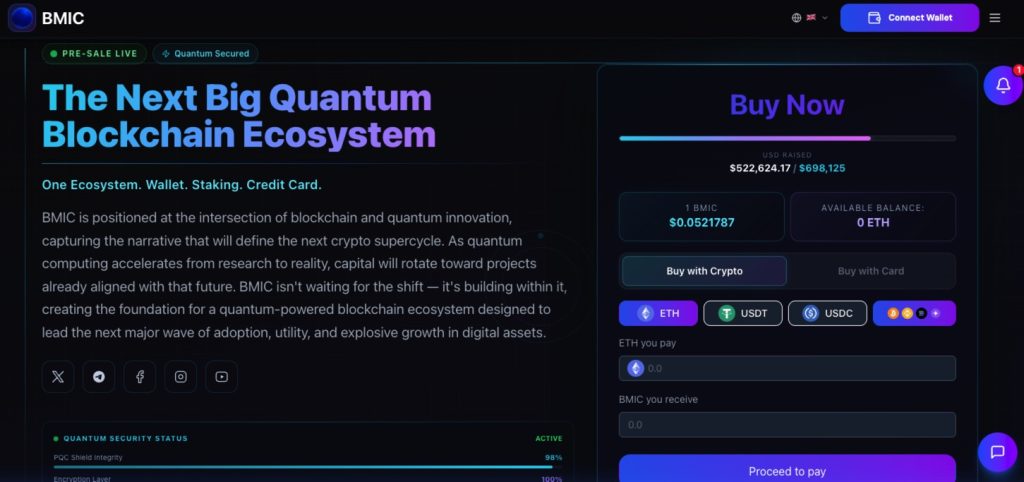
BMIC (BMIC) is a specialized security ecosystem designed to protect digital identities and assets against post-quantum threats. By launching a “wallet-first” infrastructure, BMIC isn’t just selling a token; it is building a defensive layer for the entire crypto industry. With its unique signature-hiding smart accounts and post-quantum authentication, it aims to become the gold standard for institutional and retail custody in an increasingly complex threat landscape.
Current Price: $0.048881
Raised So Far: $296,000
Payment Methods: ETH, USDT, USDC
Security Focus: Post-Quantum Cryptography (PQC)
BMIC earns its place as a top breakout candidate because it tackles a “low-probability, high-impact” event: the quantum breach of standard private keys. The project’s core product is a quantum-resistant wallet that uses signature-private routing to minimize on-chain key exposure. This “wallet-first” strategy provides an immediate consumer product while the team builds out more complex enterprise-level Quantum Security as a Service (QSaaS) APIs for regulated industries.
One of the most innovative features of the BMIC ecosystem is the “Burn-to-Compute” model. Beyond simple staking for rewards, token holders will eventually be able to convert their tokens into compute credits for the project’s planned decentralized Quantum Meta-Cloud. This creates a multi-layered utility for the BMIC token, serving as a payment unit, a governance asset, and a functional credit for future high-performance computing workloads. As institutional money moves into “safety-first” crypto assets in 2026, BMIC is positioned to capture the security-conscious segment of the market.
Evaluating the BMIC Presale Fundamentals 📈
| Evaluation Metric | What We Looked At | What BMIC Shows |
|---|---|---|
| Use Case | Does it solve a real problem? | Addresses quantum threats to wallet security and data privacy. |
| Product Viability | Is there a working solution? | Wallet-first approach with PQC signature-hiding smart accounts. |
| Tokenomics | Is it designed for growth? | Burn-to-compute model links token supply to real compute demand. |
| Market Potential | Is the sector growing? | Targets the high-growth enterprise security and QSaaS market. |
Wrapping Up: Is BMIC the Security Standard for 2026? 🏁
BMIC offers a compelling “pick-and-shovel” play for the quantum era. While it carries the inherent risks of a technically complex, early-stage project, its focus on protecting the underlying keys of the crypto economy makes it a unique hedge against future systemic risks. Whether you are interested in the long-term enterprise utility or the immediate post-quantum wallet features, new investors should monitor the rollout of their first QSaaS APIs as a primary signal of execution.
Pros
- Targets a massive, defined security gap (Quantum Resistance)
- Token utility is directly linked to wallet access and compute credits
- Enterprise angle (QSaaS) attracts regulated and institutional interest
- Staged roadmap prioritizes a live wallet product before cloud scaling
Cons
- Value depends on quantum timelines which remain uncertain
- High execution risk due to complexity of post-quantum crypto
- Early fundraising stage means lower initial liquidity compared to L2 plays
4. LiquidChain (LIQUID) — Best Cross-Chain Liquidity Play
While institutional investors spent 2025 stabilizing the core assets of the market, the 2026 “Utility Cycle” has shifted the spotlight to the plumbing of the decentralized web. The most significant bottleneck for the next crypto to explode is no longer transaction speed, but liquidity fragmentation. Capital is currently trapped in silos across Bitcoin, Ethereum, and Solana, forcing users to rely on risky wrapped assets and slow, centralized bridges.
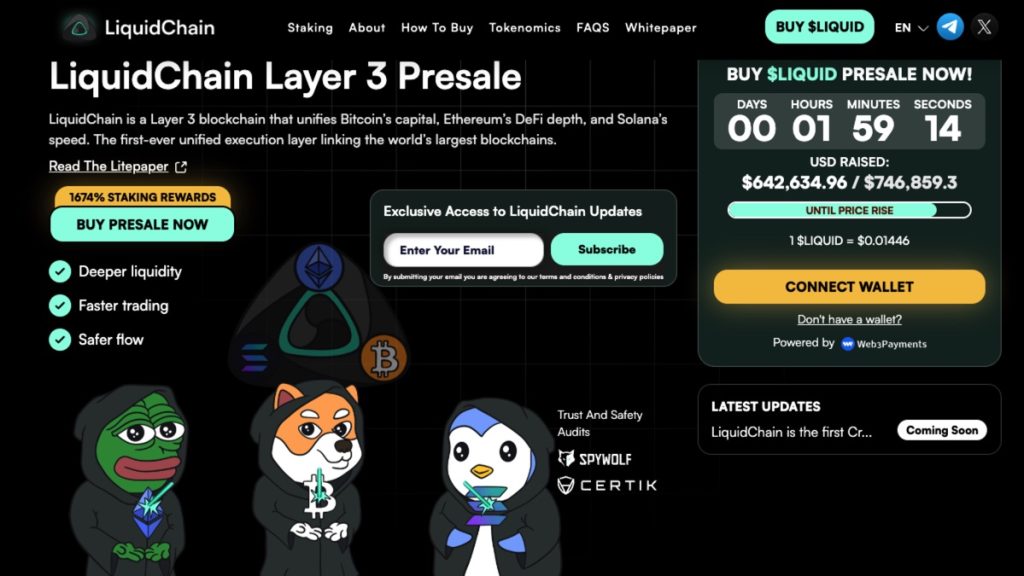
LiquidChain (LIQUID) represents a structural shift in how we move value. Operating as a Layer-3 (L3) settlement network, it is designed to fuse the “Big Three” ecosystems into a single execution environment. By offering unified access to liquidity without the need for manual bridging, LiquidChain is positioning itself as the foundational layer for the next wave of cross-chain DeFi applications.
Current Price: $0.01395
Total Raised: $579K
Accepted Payments: ETH, BNB, SOL, USDT, USDC, Card
Audits: CertiK, SpyWolf
LiquidChain earns its spot on our 2026 breakout list by attacking the “wrapped asset” problem. Most current cross-chain solutions require users to lock up real assets to receive “wrapped” versions, which have historically been the primary target for protocol exploits. LiquidChain’s Layer-3 architecture handles execution and settlement across chains natively, allowing developers to “build once and deploy everywhere.” This means a single dApp can tap into the liquidity of Solana’s retail volume and Bitcoin’s institutional capital simultaneously.
The project is heavily developer-focused, providing specialized tooling to reduce the friction of cross-chain deployment. For investors, the native LIQUID token serves as the primary currency for settlement fees and governance. With the presale currently in an early stage at $0.0125, the project offers a ground-floor entry for those betting on the “infrastructure-as-a-service” narrative that is dominating the 2026 bull run.
Evaluating LiquidChain Fundamentals 📈
| Evaluation Metric | What We Looked At | What LiquidChain Shows |
|---|---|---|
| Use Case | Does it solve a real problem? | Solves liquidity fragmentation across BTC, ETH, and SOL. |
| Technology | Is the architecture sound? | Layer-3 framework allows native cross-chain execution. |
| Audit & Security | Independently verified? | Dual-audited by CertiK and SpyWolf. Industry-leading pedigree. |
| Market Fit | Is there demand? | Focuses on developer adoption via “Deploy-Once” tooling. |
Wrapping Up: Is LiquidChain the Infrastructure Winner of 2026? 🏁
LiquidChain is a high-reward infrastructure play for investors who believe the future of finance is multi-chain. While it is earlier in its lifecycle than competitors like Bitcoin Hyper, the presence of a CertiK audit and a clear Layer-3 settlement thesis makes it one of the most credible candidates for a breakout. Investors should pay close attention to the upcoming testnet milestones as a signal that the protocol is ready for mainnet scaling.
Pros
- High-tier CertiK audit provides massive security credibility
- Targets a well-known DeFi bottleneck (fragmented liquidity)
- Layer-3 design avoids competing with L1s while leveraging their security
- Early-stage entry price offers significant potential upside
Cons
- Fundraising is in infancy compared to established presales
- Cross-chain interoperability is a highly competitive sector
- Execution risk is high given the complexity of L3 settlement
9. Solana (SOL) — The High-Speed Backbone of the 2026 Retail Economy
In 2026, the debate over “Ethereum vs. Solana” has shifted from theoretical whitepapers to cold, hard execution metrics. If Ethereum is the secure, multi-layered vault of the decentralized web, Solana has become its high-frequency trading floor. With the full commercial rollout of the Firedancer validator client and the Alpenglow consensus upgrade, Solana is no longer just a “fast” chain; it is the foundational architecture for the global network capital market, and was one of the few 1000x crypto projects that rewarded early investors.

Current Price: $95.42
Consensus Upgrade: Alpenglow (Live)
Throughput Target: 1,000,000+ theoretical TPS (Firedancer)
Finality: ~150 milliseconds
Solana’s explosive potential in 2026 is driven by its move toward massively parallel execution. Technologies like ZK Compression have slashed on-chain storage costs by 90%, making it the only viable home for massive RWA (Real-World Asset) issuance and social protocols with millions of users. The network has matured beyond “meme coin season” and into a credible backbone for institutional finance, evidenced by recent ETF filings and integration into major global payment rails.
The SOL token’s utility has never been higher. It serves as the primary gas for the million-TPS economy, the staking asset securing the Alpenglow consensus, and the native currency for the booming Solana Mobile ecosystem. As the industry moves toward sub-second settlement, Solana’s 150ms finality makes it the preferred vehicle for high-frequency DeFi, large-scale stablecoin transfers, and institutional treasury management.
Evaluating Solana Fundamentals 📈
| Metric | Evaluation Criteria | 2026 Performance |
|---|---|---|
| Scalability | Throughput and speed? | Firedancer maturity allows for million-level TPS potential. |
| Institutional Adoption | Real-world usage? | Major banks utilizing Solana for RWA tokenization. |
| Network Health | Validator diversity? | Improved client diversity with Firedancer and Agave. |
Solana Price Analysis: Technical Outlook 📊
As of June 2026, Solana is navigating a notable short-term recovery. After a period of consolidation, the price is at $86.91, successfully reclaiming the 20-day EMA ($85.99). This level now serves as dynamic support.
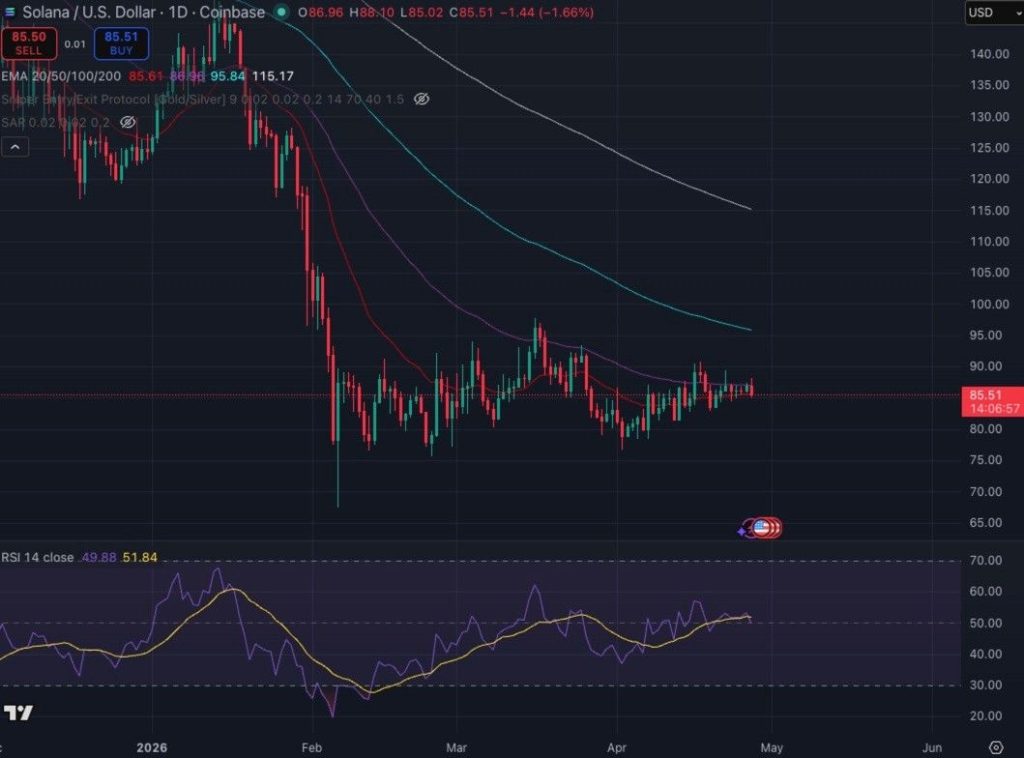
Bullish Momentum: The chart shows three consecutive lower highs, indicating a shift from “Extreme Fear” toward balanced sentiment.
Resistance Gauntlet: The 50-day EMA ($95.10) remains the primary hurdle for a full trend reversal, and price will also need to push through the 100 and 200 day EMAs before the broader retail market jumps on board.
RSI Strength: Currently at 49.09, the RSI suggests buying pressure is building with significant room to run before hitting overbought territory.
Pros
- Industry-leading transaction speeds and near-instant finality
- Firedancer provides mission-critical client diversity and stability
- Massive ecosystem of developers and consumer-facing dApps
- Dominant market share in retail trading and meme liquidity
Cons
- Past stability outages remain a lingering reputational hurdle
- High validator costs limit the potential for true decentralization
- Direct competition from increasingly efficient Layer-2 stacks
10. Chainlink (LINK) — The Computing Platform for Global Finance
For years, Chainlink was viewed simply as a price oracle. In 2026, that description is officially obsolete. Chainlink has evolved into a Decentralized Computing Platform that acts as the universal bridge between traditional finance (TradFi) and the blockchain ecosystem. With the explosion of CCIP (Cross-Chain Interoperability Protocol) and the launch of Economics 2.0, Chainlink has become the indispensable data layer for the $150 trillion global SWIFT market.
Current Price: $15.67
CCIP Volume: $18B (Q1 2026)
Total Value Secured: Over $28 Trillion
Staking Version: v0.3 (Economics 2.0)
Chainlink’s potential to “explode” in 2026 rests on its CCIP momentum. Clearing $18 billion in transaction volume in Q1 alone, CCIP is now the standard used by JPMorgan, Swift, and UBS for cross-border settlement. Furthermore, the launch of 24/5 U.S. Equities Data Streams has brought sub-second pricing for NVDA, AAPL, and ETFs directly on-chain, providing the infrastructure required for the total tokenization of the stock market.
The LINK Economics 2.0 model has fundamentally changed the token’s value proposition. Staking rewards no longer rely solely on emissions; they are increasingly funded by real user fees from CCIP and data stream usage. This “real yield” model, combined with a 75 million LINK staking target, is designed to reduce circulating supply while providing sustainable, predictable returns for long-term holders.
Evaluating Chainlink Fundamentals 📈
| Metric | Evaluation Criteria | 2026 Performance |
|---|---|---|
| Interoperability | CCIP Adoption? | The clear industry standard for institutional cross-chain messaging. |
| Data Accuracy | Security Record? | Securing $28T+ with zero major feed failures in 7+ years. |
| Tokenomics | Value Capture? | Staking v0.3 shifts rewards to real-world protocol revenue. |
Chainlink Price Analysis: Technical Outlook 📊
As of June 2026, Chainlink is showing signs of a trend reversal. Currently trading at $9.34, LINK has formed a higher low, marking a classic bullish signal.
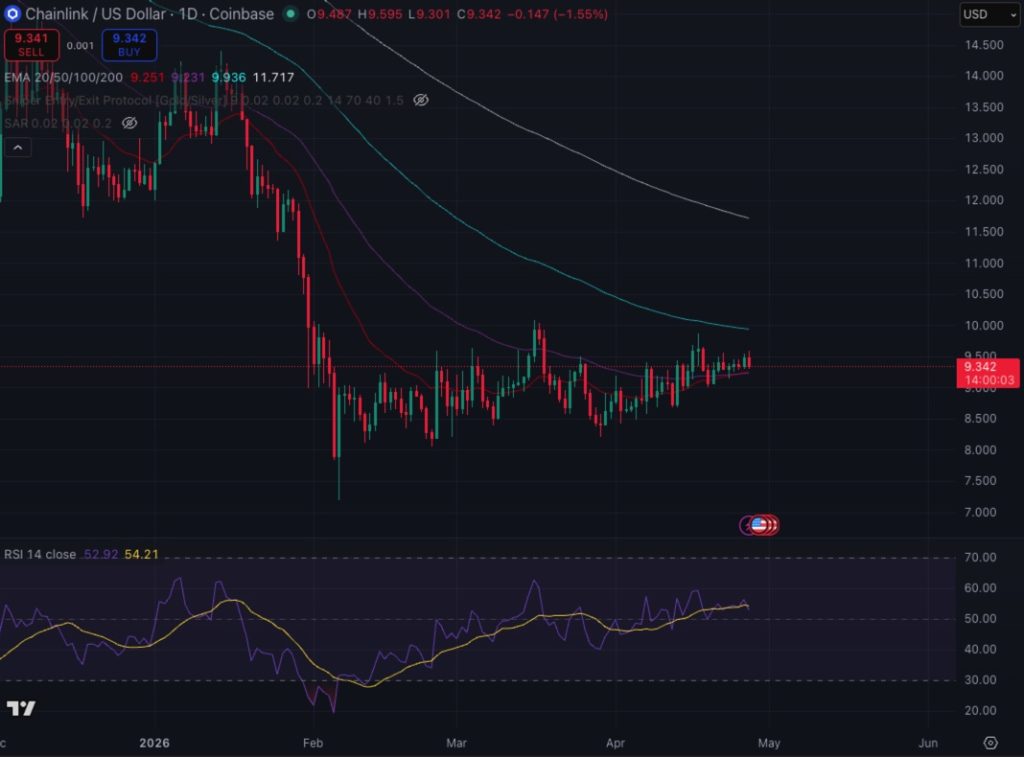
Key Reclaim: The price has closed above the 20-day and 50-day EMAs, flipping them into support.
Critical Resistance: Bulls are now eyeing the 100-day EMA and psychological price barrier at $10.00.
RSI Check: The RSI is at 50.13, crossing into bullish territory. This suggests buyer conviction is gaining the upper hand with room to move before reaching overbought levels.
Pros
- Near-monopoly status in the oracle and institutional data sector
- CCIP is the only cross-chain standard used by major central banks
- Economics 2.0 staking model provides sustainable real yield
- Critical infrastructure that DeFi literally cannot function without
Cons
- Price action often lags significantly behind technical adoption
- Increasing competition from latency-optimized oracles like Pyth
- Institutional pilots take longer to convert into retail volume
How to Spot the Next Crypto to Explode
Our methodology for identifying high-potential breakout tokens in 2026 focuses on eight core signals:
- On-chain Activity: We look for rising TVL and active wallet counts, which often precede price surges and can be an early indicator of the next 1000x crypto.
- Narrative Alignment: Projects must fit a dominant market theme (e.g., Bitcoin L2s or AI Agents).
- Tokenomics: We prioritize fair distributions with limited insider allocations and healthy vesting.
- Technical Innovation: Scalability and interoperability are mandatory for infrastructure plays.
- Audit History: We exclude projects without verified smart contracts from recognized firms like CertiK or SolidProof.
- Liquidity Depth: A planned listing on high-volume exchanges is a prerequisite for a sustainable “explosion.”
- Team Execution: Consistent GitHub commits and roadmap delivery are higher indicators than social media hype.
- Market Sentiment: We monitor sector rotation to ensure capital is flowing toward the project’s specific niche.
Crypto Market Sectors That Could Explode in 2026
The crypto market often mirrors Bitcoin’s movements, but specific high-growth sectors, most notably maturing narratives like AI and Real-World Assets (RWAs), are beginning to decouple, driving independent growth cycles. In 2026, these emerging niches have transitioned from speculative concepts to functional ecosystems, attracting significant institutional and retail capital.
Below are the primary sectors driving market momentum in 2026:
| Sector | What It Means | Examples |
| AI Cryptos | Decentralized intelligence networks and agent economies that enable autonomous, inclusive machine learning. | Artificial Superintelligence Alliance (FET), SUBBD (SUBBD), Bittensor (TAO) |
| RWA Projects | Asset tokenization protocols that bridge traditional finance (TradFi) with on-chain liquidity for bonds and commodities. | Ondo (ONDO), Chainlink (LINK), XDC Network (XDC), Tether Gold (XAUT) |
| Infrastructure Projects | Foundational L1, L2, and L3 networks designed to reduce friction for enterprise adoption and global retail use. | Bitcoin Hyper (HYPER), Ethereum (ETH), Solana (SOL), Chainlink (LINK), XRP (XRP) |
| High-Risk/High-Reward Coins | Early-stage assets and narrative-driven memes with significant volatility and potential for parabolic upside. | Maxi Doge (MAXI), Pepe Unchained (PEPU), Gassed Token (GASSED) |
| DePIN Projects | Physical infrastructure networks using crypto incentives to decentralize real-world hardware, such as storage and compute. | Render (RNDR), Filecoin (FIL), Helium (HNT), Akash Network (AKT) |
Each of these sectors offers a distinct value proposition for investors looking for the next crypto to explode. While these narratives help focus your research, they should always be evaluated alongside a project’s technical utility and long-term roadmap.
Benefits and Risks of Early Entry
Investing in the next crypto to explode before it reaches major exchanges can lead to exponential returns, but it requires a high risk tolerance.
Benefits:
- Preferential Pricing: Presale and early-stage entry prices are typically significantly lower than listing prices.
- Staking Compound: Projects like SUBBD and HYPER offer staking during the fundraising phase, allowing you to grow your position before trading begins.
- Asymmetric Upside: Small-cap projects have the potential for 10x-50x growth that established coins like Bitcoin or Ethereum no longer offer.
Risks:
- Execution Risk: There is no guarantee a project will deliver its roadmap (e.g., mainnet delays).
- Liquidity Risk: Early tokens are often locked until the TGE, meaning you cannot liquidate your position instantly.
- Volatility: Small-cap assets can experience 90%+ drawdowns even in a bull market.
FAQs: Identifying Breakout Cryptos
Bitcoin Hyper (HYPER) currently shows the strongest signals due to its $32.5M in funding and its technical solution for Bitcoin scaling. Pepe Unchained (PEPU) is also a high-potential candidate for those seeking meme-themed growth combined with Layer-2 utility.
The most effective way is to monitor on-chain analytics platforms like Solscan or Etherscan for new contract activity, participate in audited presales, and follow “developer-first” ecosystems where new utility is being built. Using non-custodial wallets like Best Wallet also gives you access to “Markets” tabs that track trending low-cap tokens.
Yes, but the market has matured. The meme coins most likely to explode in 2026, such as Maxi Doge or Gassed Token, often incorporate utility like staking, gamified engagement, or their own Layer-2 chains to sustain demand beyond a single hype cycle.
Final Thoughts
Finding the next crypto to explode requires a shift from speculation to evaluation. In the 2026 cycle, Bitcoin Hyper leads the pack for infrastructure investors, while SUBBD offers a clear entry into the AI-creator pivot. For those chasing high-beta momentum, Maxi Doge and Pepe Unchained provide the strongest community-led setups. Regardless of your choice, prioritize projects with dual audits and transparent tokenomics to protect your capital while chasing the next major surge.

Tim Baker
Tim Baker is a Senior Market Analyst at Tokenist with over a decade of experience educating readers about traditional finance, crypto and DeFi. A former equity researcher turned on-chain analyst, Tim specializes in regulatory framework shifts and institutional DeFi adoption. His work focuses on distilling complex liquidity cycles and the macro environment into actionable intelligence for the modern DIY investor.